.jpg) |
|||
| The Sandino Rebellion in Nicaragua | |||
| 1927-1934 | |||
| ó Michael J. Schroeder, 2007 | |||
| LASA '98 Paper | |||
|
"Trouble Brewing on the Border" |
|||
This unpolished conference paper is included here mainly because it contains some useful archival information, and some good arguments, and should prove useful as a source of data from which to cannibalize.
|
'Trouble Brewing on the Border': Politics, Warfare, Class Struggle, and Popular Nationalisms in Honduras and Nicaragua in the Time of the Sandino Rebellion, 1926-1934
Michael J. SchroederUniversity of Michigan-Flint
Paper delivered at theXXI International Congress of the Latin American Studies AssociationLASA98 Palmer House Hilton, Chicago September 24-26, 1998 for the panel "Borders and Nationalisms: States, Classes, and Contested Hegemonies in Ambiguous Cultural Spaces” (HIS44)
DRAFT: Please do not cite or quote without written permission; critical comment invited
"Be courageous, Nicaraguans. The hour is coming near for those calling for the intervention to give an account of their acts. To you, Nicaraguans, is your duty to begin the work while the Defending Army of National Sovereignty is getting ready. Do not weaken. My living outside of Nicaragua is a triumph for the liberty of Nicaragua. The day when you least expect it, I shall again be with you. Nicaragua will be free so long as she has sons who love her." - Augusto C. Sandino, Supreme Chief, Defending Army of Nicaraguan National Sovereignty, proclamation in La Tribuna, San José, Costa Rica, 14 November 1929, reprinted in Diario Moderno, Managua, Nicaragua, 15 December 1929
"[Guardia Nacional de Nicaragua Lieutenant] Broderick . . . captured Guillermo Garcia, a lieutenant of [Sandinista General Miguel Angel] Ortez. When captured, he was wearing a black hatband on which was fastened a button-picture of Sandino. Following words are on button: ‘Gral. Augusto C. Sandino, Defensor de la Soberania de Centro America.’ . . . He stated that they had something new that would ‘fix all the Guardia and Marines.’ . . . Garcia was killed attempting to escape." - Northern Area Commander, Guardia Nacional de Nicaragua, El Ocotal, Nicaragua, February 1930
"[People] in vicinity of Alauca, Honduras are housing and feeding many of [Sandinista General Miguel Angel] Ortez group. . . . It is reasonably certain that Ortez is in Honduras." - E. B. Moore, Captain, US Marine Corps, Managua, February and March 1930
"The common run of Honduran is a lover of the things and prowess achieved by Sandino, and whoever comes from Nicaragua is not looked well upon if they do not arrive speaking of having killed so many Americans and made fly the heads of so many Guardia. In all the parts [of Honduras] I passed through till today, I was told that if one is traveling to Nicaragua one should not fear the Sandinista forces, but those of the Guardia Nacional." - Guillermo E. Cuadra, Second Lieutenant, Guardia Nacional de Nicaragua, March 1932
"[An informer states that Sandinista General Carlos] Salgado [is] probably working his way toward Cinco-Pinos – Santo Tomas where all the inhabitants are his friends. There is little doubt but that trouble is brewing on the border." - A.C. Larsen, First Lieutenant, US Marine Corps, Managua, September 1928
In March 1932, Guillermo E. Cuadra, Second Lieutenant in the Guardia Nacional de Nicaragua, submitted a report to General C. B. Matthews, the Guardia’s Jefe Director, on his recent volunteer spy mission into Honduras.1 In twenty pages of impeccably typed single-spaced text covering fourteen days, Cuadra employs the outward form of a military report while spinning out a dramatic narrative marked by the style, imagination, and passion of a gifted storyteller. On the first page, Cuadra, the brother of the better-known Nicaraguan writers and ex-National Guardsmen Abelardo Cuadra and Manolo Cuadra, introduces what soon emerge as this remarkable report’s principal themes: the ambiguities, complexities, and ironies of political and social identities, allegiances, and motivations in a time of war and revolution on the Nicaraguan-Honduran borderlands. Posing as a traveling business agent ("Agente Viajero”), Cuadra began his secret journey on the morning of February 23, 1932, when he arrived in Chinandega, Nicaragua, on the train from Corinto.
In this world, we quickly learn, things are never quite as they seem; dangers and opportunities lurk everywhere. But the biggest dangers, like the biggest opportunities, reside most of all in the making and unmaking, and the masking and unmasking of identities. In this war-torn frontier world, political identities especially hold the key to success and failure, riches and ruin, and often, life and death. Such identities are fluid, contingent, multiple, while also, paradoxically, fixed when one can and chooses to fix them, and when others know and fix them – even if they might be mistaken. Survival, not to mention success, demands the continual re-evaluation of who, exactly, one is – and who, exactly, everyone else is. At any given moment, one needs to know, or at least have a pretty good idea of, how all the pieces of this puzzle, this ever-changing and highly patterned field of power relations, fit together. The author-spy’s primary objective was to acquire information on the major political and military actors and organizations in south-central Honduras, part of a larger military and political strategy of the Guardia intended, ultimately, to destroy Augusto C. Sandino’s rebellion, then raging across much of northern and central Nicaragua. As is well known, from 1927 to 1934, Sandino led an armed rebellion against the U.S. Marines and Nicaraguan National Guard in the cause of Nicaraguan national independence. His rebellion found its social and geographic base in Las Segovias, the mountainous frontier region bordering parts of south-central Honduras (see Map 1). Throughout his narrative, Cuadra emphasizes the widespread popular hatred for the marines and Nicaraguan Guardia in these parts of Nicaragua and Honduras, and along with it, the widespread popular support for Sandino’s rebels. Catching many glimpses of the extensive commerce in stolen Nicaraguan property, plundered by Sandinista rebels in Nicaragua and sold to Honduran merchants and traders across the border, Cuadra emphasizes as another major theme the flourishing wartime commerce, arms traffic, and the profits and power being accumulated by a broad cross-section of Hondurans as a consequence of the rebellion. A less prominent theme is the growing power of the Guardia Nacional de Nicaragua, despite the widespread popular antipathy against it in both Honduras and Nicaragua. But it is the issue of identity that saturates the text and defines its most dramatic moments – perhaps best illustrated in the often humorous and self-deprecating descriptions of the six times (in fourteen days) Cuadra’s cover was blown. General Matthews was probably more chagrined than pleased by the report, which, judging from its unconventional tone, literary style, and the progressive nationalist politics of the better-known Cuadra brothers, may have been one of its author’s intents.3 Guillermo Cuadra’s story of war and politics in the borderlands provides a fascinating glimpse into the complexities of political and social identities and relations in this little-studied but pivotal region during this period. It also raises a host of broader questions of central concern to much recent research and debate in Latin and Central American historiography: questions about popular or subaltern nationalisms and alternative visions of "the nation”; about the dynamic entwining of political, class, military, nationalist, and ethnic struggles at key historical moments, and over time; about state formation, capitalist transformation, imperialist intervention, and various forms of collective action and popular struggle; and about the role and importance of regional histories, border regions, and regional popular nationalisms in the larger history of Central American nations and states. As a growing body of scholarship attests, subaltern groups in Latin America have long and rich histories of creatively appropriating and reshaping Enlightenment languages of liberalism, republicanism, and nationalism in order to assert their own claims: for economic betterment, for political and social citizenship, for popularly defined rights and guarantees.4 This paper is a preliminary effort to examine how differently constituted groups and individuals in the Nicaraguan-Honduran borderlands appropriated Sandino’s popular nationalism during an important and volatile moment in Central American history. It explores some of the ways that borderlanders used Sandinismo in order to assert claims and rights against at least three states - Honduras, Nicaragua, and the United States – and against dominant and contending groups and individuals in Honduras and Nicaragua. This paper demonstrates that over the course of the rebellion, several thousand Hondurans – including campesinos, miners, day laborers, petty traders, mule-drivers, soldiers, army officers, landowners, merchants, politicians, and others – supported, joined, colluded with, or otherwise participated in Sandino’s struggle. The widespread popular support for Sandino in Honduras and the participation of so many Hondurans in Sandino’s Defending Army and rebellion might at first appear somewhat puzzling. As suggested in Sandino’s proclamation introducing this essay, Sandino aimed to propagate a distinctly Nicaraguan nationalist discourse and practice. Why, then, did so many Hondurans lend support to an armed rebellion whose avowed purpose was to defend Nicaragua’s national sovereignty? Why, and how, did different Honduran individuals and groups participate in Sandino’s rebellion? More broadly, what role did Hondurans and the dynamics of the borderlands play in shaping events Nicaragua and Honduras from 1926 to 1934, and the different inflections of popular nationalism that emerged from these processes? Most broadly of all, why did it matter? What difference did it make? A satisfactory response to these questions would appear to require historical investigation at four principal levels, which in turn divides this paper into four sections. The first section briefly surveys the interweaving of Nicaraguan and Honduran histories up to mid-1927, especially in the western border regions (see Map 2).5 The second section explores the dynamics of war and revolution in these regions during the period of Sandino’s rebellion (1927-1934). Drawing mainly from the Marine and Guardia archives, I seek to identify some of the principal patterns and dynamics of social struggles in the borderlands during this decade. The third section casts a wider net in an effort to map out the regional differentiation of popular nationalist discourses in Honduras and Nicaragua in the 1920s and 30s. The final section offers some brief remarks on the role and importance of regional popular nationalisms in the struggles for citizenship, rights, and social justice in modern Central American history. A broader historiographic purpose also informs the paper. In surveying the Central American historiographic landscape over the past three decades, several common features appear to distinguish the most significant contributions to the literature: inspired by substantial theoretical traditions, they address hitherto unasked questions about historical process and the historical agency of subaltern groups through rigorous interrogation of sizeable bodies of unused or under-used empirical evidence.6 This paper is offered as a contribution to this larger intellectual project – as an effort to address new questions using new evidence about a little-studied topic of no small importance to large numbers of ordinary people, and thus to begin to tell a hitherto untold story about Central American history that deserves telling.
I. Borderlands History, c. 1500-1940 In 1899, in a series of evening gatherings, a group of law students at the Universidad de Guatemala came together to eat, talk, smoke, drink, argue, and redraw the map of Central America. The result of their labors graces the cover of the tome published thirty-five years later by their intellectual guiding light – the three volume La enfermedad de Centro-América (1934) by the Central American nationalist and unionist Salvador Mendieta. In this re-imagined Central America, comprised of nineteen departments plus a federal district, the borderlands region designated in Map 2 formed part of two new departments called "Jérez” and "Nueva Segovia” (see Map 3). It was an apt imagining. From before the Spanish Conquest to 1899 and after, the histories of the regions on both sides of the present-day western border (mainly in "Jérez”7) have been shaped by a number of closely connected themes, processes, and cultural practices. These can be identified as: patriarchal caciquismo and caudillismo (male-dominated political bossism); personalism; localism; the fragmentation of authority and power; the critical role of politics and violence; and marked micro-regional variations in topography, demography, landholding, production, and commerce.
During the pre-Columbian period, the territory designated "Jérez” by Mendieta and his law school chums was densely populated by a number of similarly constituted ethno-linguistic groups (part of the Chorotega and Lenca language areas), who based their lifeways on sedentary agriculturalism, patriarchal caciquismo, and closely knit kin and community structures. The Spanish conquerors were interested mainly in discovering large cities and abundant gold. Finding neither, they and their royal bosses relegated Central America to the margins of Spain’s two main imperial centers (New Spain in the north, and the Peruvian Andes in the south). The Spanish did find in the Nueva Segovia-Choluteca region a plentiful source of labor, however, and slaving quickly emerged as the region’s leading economic activity. By the 1550s, some 500,000 natives of western Nicaragua and southwestern Honduras had been enslaved and exported to Panamá, Perú, and beyond. In the 1520s the conquerors also discovered small quantities of gold in the region’s riverbeds, and placer mining soon became the region’s second most important export-oriented economic activity. But by the 1550s the slave trade nearly disappeared because so too had most of the region’s inhabitants: native population losses through disease, slaving, and forced labor were as high as 90% during the first half-century of colonial rule. Survivors either fled, successfully eluded Spanish soldiers and tribute-gatherers, or were forcibly incorporated into encomiendas or reconcentrated into designated population centers, or reducciones. In the context of ongoing civil wars between factions of Spaniards, in the 1520s the region came under the administrative orbit of the city and province of León on the Nicaraguan Pacific coast. The rudiments of the political jurisdictions that would become the independent nation-states of Honduras and Nicaragua after 1838 were already apparent by the late 1540s, though it was not until the administrative reforms of 1785 that the two countries-to-be were designated as separate intendancies under the political jurisdiction of the Kingdom of Guatemala, in turn under the orbit of New Spain.8 From the late sixteenth to the mid-eighteenth centuries, much of the region’s remaining tributary labor was assigned to extracting and transporting pine lumber and pitch for shipbuilding in the Pacific port of Realejo (later Corinto); working the small silver mines that came to be scattered across the region; and producing a wide array of staple products. During the same period, the domestic demands of the region’s modest mining economy precipitated the growth of cattle ranching and commerce, activities that remained central to the regional political economy well after independence in 1821. A small class of Spanish landowners and merchants came to dominate the commanding heights of that regional political economy, poised at the top of a rigid, caste-like race-class social and political hierarchy that imposed deep and enduring divisions on the social fabric of the region. Despite the emergence of a small class of large landowners and political powerholders during the colonial period, Indian communities retained collective rights in land and political autonomy – collective rights in some cases retained well into the twentieth century. Political leadership in indigenous communities revolved around the figure of the cacique, or political chief. The power and privileges of caciques bore close resemblance to those of Spanish colonial-era landowning patriarchs, and to the regional caudillos of the nineteenth and early twentieth centuries – political strongmen who ruled by virtue of birth status, leadership qualities, and effective use of patronage networks.9 Colonial-era social relations in gender and sexuality synthesized the patriarchies of Spaniards and Indians in various ways, leading to the formation of a male-dominated social world, based on the patriarchal family, the near-absolute sovereignty of the patriarch, and infused with both indigenous and Hispanic discourses and practices of honor, shame, sexuality, gender violence, and male and female rights and obligations.10 Languages of rights and justice among subaltern groups were expressed through three distinct but overlapping idioms: the hierarchical but reciprocal language of patrimonialism and patronage-clientage; the discursive field of folk Catholicism; and languages of honor, shame, and masculinity. The reach of the colonial state into the region was manifested mainly in the spread of Spanish law, institutions, and property relations, and facilitated by the growth of silver mining, stockraising, and regional commerce. Twin military threats also served to extend the state’s reach: repeated raids and incursions by English and Dutch pirates, and a still-sizeable population of "wild Indians” (indios bravos) across much of northern and central Nicaragua and southern Honduras. The state responded by forming local militias in the region’s largest towns, especially Nueva Segovia (later El Ocotal), Condega, El Jícaro, Jinotega, Matagalpa, and Choluteca. Throughout the colonial period, then, various types of locally-generated collective violence came to be densely woven into the region’s political economy, and into the fabric of everyday life.11 With independence in 1821, and especially after the breakup of the Central American Federation in 1838, the border drawn half a century before between the indendancies of Honduras and Nicaragua suddenly assumed far greater importance. In the decades to follow, the co-existence of a fluid frontier zone and a fixed border shaped the history of the region in myriad ways. Indeed, as the nineteenth century progressed, the border itself became one of the region’s most salient political and economic features, lending a certain irony to the law students’ newly-imagined departments of Jérez and Nueva Segovia - for if the international border were to suddenly disappear, the principal historical cause behind the unique character of these two sub-national regions would just as suddenly vanish. In fact, in many ways the history of this region after 1838 revolved precisely around the existence of a fixed border between two independent nation-states – a border often contested, rarely defined precisely, stretching across a rugged, mountainous, isolated, yet strategically important territory. In the context of the interminable civil wars of the nineteenth century, the geographic location of the region, midway between the urban clusters of Tegucigalpa-Comayagua in Honduras and León-Managua-Granada in Nicaragua, took on special salience. The border allowed revolutionaries and politically disenfranchised elites of both countries to secure safe haven from the national regime they opposed, while marshalling troops and supplies to attack their enemies. Movements of armed groups through the region occurred thousands of times in the century from 1821 to 1926, as caudillos and regimes in both countries utilized two main corridors to do battle against rival regimes and powerholders across the border - one corridor stretching from Somotillo to Choluteca, and another, further north, extending from Somoto and Ocotal to Yuscarán, El Paraiso, and Danlí, with many minor arteries and branches.12 As the nineteenth century progressed, the region’s rugged geography and frontier character also worked to generate considerably weaker relations of patronage and clientage in comparison to the more densely populated sections of western Nicaragua and central Honduras. Indeed, one of the most striking features of the nearly continuous civil wars that wracked both Honduras and Nicaragua in the first century of independence is the infrequency with which subaltern groups exploited the opportunities opened up by squabbles among the elite to challenge existing relations of domination and subordination. The borderlands’ mountainous geography, abundant land, and small, dispersed population all served to undermine the strength and resilience of patron-client relations, opening up sufficient social and political space for at least the possibility of popular challenges to extreme class and political inequalities – a possibility that in many ways did not exist across most of the rest of this part of the Isthmus.13 The liberal and coffee revolutions came to Nicaragua in the 1880s and 1890s, and to Honduras in the 1900s and 1910s, considerably later than in the rest of Central America. In the Las Segovias-Choluteca border region, as elsewhere, the liberal assault on the land and labor of campesinos and Indians took the form of partial and uneven land privatization, coercive labor control mechanisms, and the rapid growth of coffee cultivation in select sub-regions. In the borderlands, these sub-regions included the zones around Jalapa, Dipilto, and San Juan de Telpaneca in Nicaragua, and to a lesser extent those around Choluteca, San Marcos de Colón, and Danlí in Honduras.14 Along with the growth of coffee production and intensified assaults on the land, labor and lifeways of the rural majority came a marked increase in the scale and scope of regional commerce. The commercial revolution of the late nineteenth and early twentieth centuries transformed the borderlands in important ways. As part of the same process that was also serving to sharpen class and ethnic divisions, significant lumps of capital began for the first time to be accumulated and traded across the length and breadth of the region. By the 1910s and 1920s, commerce had become an important and integral part of the political economy of the borderlands, with important consequences for the popular mobilizations that mushroomed after 1926.15 In addition, these radical transformations unfolded in the context of the Nicaraguan and Honduran states’ imposition of different laws in their respective national territories – especially those relating to the production, distribution, and/or taxation of tobacco, alcohol, and firearms, and to the organization of local militias and police forces. In the borderlands, these different legal codes, tax rates, and coercive regimes led to the florescence of smuggling, banditry, and outlawry, and added yet another layer to the multiplicity of reasons behind the region’s inhabitants’ frequent recourse to personal, political, and collective violence. Fragmentary evidence indicates that such smuggling, banditry, and violence were endemic across the region in the first century of independence and integral to the political culture and political economy of the region, particularly as the coffee and commercial revolutions accelerated in the late nineteenth and early twentieth centuries.16 In sum, a number of interconnected themes and processes shaped the colonial and post-colonial history of the borderlands region. Three hundred years of colonial rule bequeathed a host of interconnected legacies, most importantly: patrimonial caciquismo and caudillismo; personalism; localism; the fragmentation of authority and power; the centrality of politics and violence; and marked sub-regional variations – all magnified by the region’s rugged terrain, sparse population, and the general weakness of the colonial state. After 1838, these themes became enmeshed with a fixed border between two still-forming and, in theory and on paper, sovereign nation-states. The result was the formation of a distinct borderlands society, political culture, and political economy in many ways oriented around the very existence of the border – a distinctiveness that in many ways persists into the present. By the 1920s, the Nicaragua-Honduras border regions divided into three main sections (see Map 4). The first, and of primary concern in this paper, was the arc from Somotillo to Las Manos. This was in the heart of Sandino country, a border 100 miles long as the crow flies and perhaps four times as far on muleback. This is the borderlands described above: a relatively densely settled zone (relative to zones further east) of small towns, fixed villages, some surviving indigenous communities (especially Mosonte and San Lucas), large haciendas, well-developed patronage networks, long-established cattle and bull-cart paths, and increasingly well-developed commercial and military routes across and on both sides of the border. Analysis of guardia intelligence during the rebellion reveals at least eight heavily trafficked routes across the border in this hundred-mile stretch.17 Just east of Las Manos was where Mendieta’s department of "Jérez” ended and his "Nueva Segovia” began, and with good reason. This second border segment, some fifty miles as the crow flies, extended east and northeast from Las Manos, riding the ridge of the Dipilto and Malacate Mountains to Cifuentes at the northernmost tip of the Jalapa hump. In the 1920s and 30s this was a very sparsely settled area, with a physical and human geography very distinct from the 100-mile stretch preceding it. A land of jagged peaks, deep gorges and ravines, and steep mountainsides, this zone was given over almost entirely to dense pathless tropical forest and jungle in the lowlands and pine forests in the upcountry, and interlaced with a sporadic network of thinly-traveled trails and footpaths – a network of trails, it might be noted, that grew far denser and more thickly traveled as the rebellion unfolded. Following the border east and northeast from Las Manos, the next major corridor was at Cifuentes and Teotecacinte, two key crossing points at the top of the Jalapa hump. The third and longest segment of the border extended from Cifuentes and the headwaters of the Río Poteca, southeast to the confluence of the Ríos Poteca and Coco, and east along the Río Coco to Cabo Gracias a Dios on the Atlantic Coast – a border more than 350 river miles in length (and also embracing parts of Mendieta’s new department of "Colón.”) This was a major theatre in Sandino’s rebellion, and vastly different from the western Segovias. The Río Coco’s cultural orientation did not face west toward the Hispanized western Segovias but south and east toward the mostly indigenous Río Bocay and Atlantic Coast regions, giving the entire region an entirely different social, economic, political, and cultural character.18 These three sections of border played very different roles in the rebellion, the first and third being far and away the most important. Here I am concerned mainly with the Somotillo-Las Manos borderlands, in the heart of Sandino country. Throughout the decade of the 1920s, these western borderlands were highly militarized and in nearly continuous armed ferment. The 1919 civil war in Honduras, in which some 1000 people were killed, sparked armed movements across the borderlands by regional and national caudillos of both parties. The extreme instability of Honduran politics during these years, culminating in the civil war of 1924 – "the most macabre battle of this century” with upwards of 5000 dead - kept the borderlands in continual armed conflict and mobilization throughout this period. 19 The journalist Harold Denny tells a story about these years that foreshadows much about the war in the borderlands a decade later:
The political tumult and civil war in Honduras during this period were replicated, in different ways, in Nicaragua. Emiliano Chamorro’s coup d’etat in October 1925 sparked both widespread Conservative Chamorrista violence and a mighty Liberal and popular backlash. By October 1926, open civil war had broken out across the northern departments, with many reports of widespread sacking, burning, looting, raping, and killing.21 The war also sparked a lively arms trade in the Gulf of Fonseca, between La Unión in El Salvador and the Cosegüina peninsula.22 Cozy relationships between adjacent Conservative regimes in Honduras and Nicaragua also facilitated state-directed movements of arms and military resources. In July 1926, the State Department reported that "General [Emiliano] Chamorro is in very close relations with General Martinez Funes, Minister of War in Honduras, and is receiving arms and ammunition through him from the Government of Honduras.”23 By October 1926, popular mobilizations against Chamorro’s hated Conservative regime were springing up all across the western Segovias – described by the American Minister in Managua as "small groups on the west side of the country not under command of Moncada or any other important liberal chief.”24 Newspaper accounts, consular and military reports, and the testimonies produced by the Instituto de Estudio del Sandinismo (IES) in the early 1980s, all provide abundant evidence for these popular mobilizations, as I have examined in some detail elsewhere.25 In late April 1927, the American Minister continued with his assessments: "Armed marauding bands of deserters from both armies live off the country as bandits and commit acts of violence. Liberals from northern Nicaragua reenforced by Honduraneans who seem to have brought arms via Rio Negro and Rio Coco are reported well organized in widely separated parts of the country.”26 Reading these and similar consular reports "against the grain,” and combining them with a wide range of other evidence, reveals that by mid-1927 the borderlands were primed for war and popular rebellion.
II. War and Revolution in the Borderlands, 1926-1934 This section addresses four main questions: (1) What role did the border play in Sandino’s rebellion? (2) What roles did Honduran individuals and groups play in the rebellion? (3) How did the border and borderlands shape the responses of different individuals and groups in both countries to the invasion, occupation, and rebellion? (4) How did Hondurans appropriate and reshape Sandino’s popular nationalism? What did "Sandinismo” mean to Hondurans? Like the mountains and valleys it snaked through, the western Honduran border made Sandino’s rebellion possible. Without the mountains, without the valleys, and without the Honduran border, a sustained armed insurrection against the marines and Guardia would not have been possible. In many ways, the rebellion lived on the border. The Defending Army straddled the border, exploited the border, was sustained by the border, existed and survived because of the border. The border’s semi-porosity was the key to its seemingly magical powers: while the rebels could and did cross "the line” at will, the invading and occupying forces could not. This simple fact comprised an endless source of irritation and frustration for the invaders and occupiers, as might well be imagined. Public opinion and diplomatic concerns, not to mention international law, forbade the kind of response most marine and Guardia officers would have liked to pursue. On occasion the invading forces did violate international law and Honduran sovereignty (airplane bombings of targets in Honduras; "Volunteer” columns of Nicaraguans, organized and armed by the Guardia, conferring plausible deniability for any alleged official connection with the US or Nicaraguan governments27). But such violations were sporadic and of minor significance overall. The vast majority of marine and Guardia patrols did not cross the boundary line, and if some did they did so briefly, for short distances, and never admitted it. Information-gathering capacities, second only to violence-making capacities in the resources necessary for waging war, were another matter. Spies, agents, and informants for both sides saturated both sides of the border. By the end of the war both Sandinistas and Guardia had developed sophisticated information-gathering apparatuses (in which Second Lieutenant Cuadra, as he surely would have acknowledged, played a very small role). But while the Guardia’s information-gathering capacities could cross the border, their violence-making capacities could not. And therein lies a fundamental difference between the two sides, and one that shaped the struggle between them in fundamental ways. The rebels, on the other hand, could and did cross the border at will. So too could stories about marine and guardia violence against the civilian inhabitants of the Nicaraguan Segovias. That such stories were legion is evidenced, in part, by the marine and guardia’s own reports. Roving combat patrols across northern Nicaragua routinely burnt houses and stocks of food, shot at natives who ran away, seized and impressed guides, and interrogated residents for information. Rebel columns led by Salgado, Ortez, and other border chieftains spent much of their time and resources trying to elude their aggressive, relentless, heavily-armed pursuers. One might reasonably surmise that the circulation of stories about marine-guardia violence comprised one of the principal vehicles through which a deeply-felt anti-Yankee sentiment was created and nurtured on the Honduran side of the border. In addition to serving as a much-needed refuge for rebel columns, the Honduran side of the border played an essential role as a ready market for property plundered in Nicaragua. Waging war is not cheap, as Charles Tilly and others remind us. Instead it requires a steady and sustained source of capital. Throughout the war, Sandino’s ragtag rebel columns – composed overwhelmingly of barefoot, threadbare campesinos - required significant quantities of supplies to stay active in the field – most especially, guns and ammunition. One might think of this process of popular-nationalist plunder as a kind of vacuum, or drain, sucking small lumps of capital out of Nicaragua, through a thousand arteries spread out across the border, in turn bartered for the supplies necessary to wage war. All evidence indicates that the net capital drain from the Nicaraguan Segovias was sustained and substantial throughout the nearly seven years of war. And as the Nicaraguan Segovias were drained of capital, the Honduran borderlands were engorged with significant capital inflows. As one might imagine, the marines and guardia, being very concerned with both property rights and the quality and quantities of rebel arms supplies, kept very close tabs on this process of nationalist plunder and barter. For the occupation forces, this is what gave the rebellion the character of "organized banditry” – and permitted Sandino to be tarred as a "bandit” and his followers as "criminals” - as expressed in the following, eminently typical report:
The documentary evidence paints a fine-grained portrait of this process of popular-nationalist plunder. Material necessities made Sandino’s rebellion as much a class war, waged by the poor and unpropertied against the rich and propertied, as a nationalist, anti-Yankee crusade. Absent the political and jurisdictional "warping” effects of the Honduran border, such plunder, and thus the rebellion, would not have been possible. The role of the Honduran state was obviously key here. The archival record demonstrates that from 1927 to 1932, Honduran agents of the state in the border regions consistently aided and abetted Sandino’s rebels, while refusing to lend any real assistance to the marines and Guardia. The record shows that the regimes of Miguel Paz Barahona (1925-28) and Vicente Mejía Colindres (1928-1932) granted wide latitude to their subordinates in the border departments, and that these, in turn, consistently sought their own advantages - which most often meant nominal alliance with Sandinista jefes.29 On occasion, some government officials in Tegucigalpa actively assisted the Sandinistas. But the real assistance offered to the rebel cause by the Honduran government came in two forms: in paying only lip service to repeated US and Nicaraguan government requests for assistance in stamping out "banditry” in the border departments; and in granting broad autonomy to their subordinates along the border. Government and border officials comprised one of the main groups of actors in the borderlands. But many other groups of Hondurans participated directly in the rebellion, and in many different capacities. Many served as jefes (guerrilla chieftains) and officers in Sandino’s Defending Army. Hondurans often constituted the bulk of the Defending Army’s rank-and-file troops in the borderlands. They served as commercial agents, recruiters, spies, informants, couriers, and in many other capacities. The great majority of campesinos and day laborers in the Honduran borderlands evidently supported and benefited from the rebellion. The Defending Army also counted on a number of wealthy civilian patrons and employers in Honduras. Many major and minor Sandinista jefes were Honduran. Major Honduran rebel jefes included Generals Simón González, Juan Pablo Umanzor, Porfirio Sanchez, Simeón Montoya, and Colonels Carlos Quesada, Victor Lagos, Ferdinando Quintero, José de la Rosa Tejada, and Carlos Fonseca (no relation to the latter-day founder of the Frente Sandinista). In addition to Honduran-born jefes, many major and minor Nicaraguan-born Sandinista jefes were born and raised in the same borderlands milieu. Most border jefes spent most of their time straddling the border and recuperating, organizing, and recruiting in Honduras. Major borderland jefes included Generals Miguel Angel Ortez (b. Ocotal), Carlos Salgado (b. Somoto), and José León Díaz (Salvadoran). Their ranks were often augmented by temporary alliance with more than a dozen minor Nicaragua-born Sandinista borderlands jefes.30 Each of these rebel jefes, by virtue of reputation, personal charisma, patronage networks, and leadership skills, stood at the head of a band of men, generally ranging in size from five to thirty-five. Some operated more or less independently; others were more closely linked to the Defending Army’s formal chains of command. The chequered military career of Honduran-born Defending Army General Porfirio Sanchez, a key Sandinista leader early in the war, can provide a useful window on the role of Hondurans and the borderlands in the rebellion. Sanchez, a colonel in the 1926-27 Civil War under then-Liberal General Sandino, was described in early marine reports:
This last comment can be taken as emblematic of the racism and brutality of the marine invasion and occupation of the region. At the outset of the rebellion in May 1927, according to a detailed biography of Jos– León D¡az written by the politically savvy marine Captain William Stockes, "Porfirio Sanchez visited Somoto and invited [José León] Díaz to join Sandino” – making Sanchez a key early recruiter and link between Sandino and other independent Liberal bands still active in the region.32 Early on, General Porfirio Sanchez earned a reputation as a brave fighter and expert in the art of ambush, leading his troops against the marines in the famous Battle of San Fernando (25 July 1927) and in several other key engagements.33 "He is a man of much more courage than the majority of the bandit leaders,” reads one report. "He is also more daring and fights whenever he has the opportunity.”34 According to information provided by seventeen year-old Manuel Viques Molina, captured by the marines during their assault on El Chipote in late 1927, Porfirio Sanchez was at the time serving as jefe of 600 Honduran troops – an inflated estimate, to be sure, but one suggestive of both Sanchez’s importance to the rebel cause and the large numbers of Hondurans involved in the struggle, then and later.35 Yet two months later, in a February 1928 interview with the North American journalist Carleton Beals, Sandino severely castigated Porfirio Sanchez for levying "forced contributions on a number of private citizens” around Yalí, declaring: "[I]f I lay my hands on him, he will be shot.”36 Evidently this was an overstatement, intended mainly for propaganda, since Sanchez continued his affiliations with the Defending Army for at least the next three years. Still, Sandino’s castigation points to a fundamental feature of the war in the Segovias touched on earlier. Such "forced contributions” – what I am calling popular-nationalist plunder - grew increasingly common as the war progressed, and became one of the two principal ways for the rebels to acquire the resources necessary to maintain themselves in the field. (Voluntary contributions – mainly in the form of campesino labor and produce - were the second major way.) From early on, the rebels’ systematic plunder of the propertied classes of the Nicaraguan Segovias made clear that this nationalist, anti-imperialist rebellion was also, fundamentally, a class war and a civil war. Sanchez’s actions against the propertied classes of Yalí also reveals a great deal about the mindset of many Hondurans as they joined Sandino’s rebellion in droves: as much (or more) interested in loot and plunder as in Defending Nicaragua’s national honor. This is a very dicey question, of course, which I examine more fully below. In late February 1929, Porfirio Sanchez was reportedly captured and being held prisoner by the commandant of the Honduran Border Patrol at Cifuentes.37 The report was mistaken, however – a mistake that reveals much about political-military dynamics on the border at the time. In fact, at the time Porfirio Sanchez’s cousin, José A. Sanchez, was serving in the Honduran Army as Expeditionary Chief of Yuscaran.38 Considerable evidence indicates that Porfirio Sanchez’s cousin José A. Sanchez was allied with a number of key rebel columns, including those led by Generals Carlos Salgado and Miguel Angel Ortez.[39] A string of terse reports sent by Expeditionary Chief José A. Sanchez to marine-guardia intelligence across the border – ostensibly intended to assist the Nicaraguan forces in stamping out "banditry” in the border regions – show that José A. Sanchez did little to hinder the rebel cause. Consistently vague and often untimely, his reports gave the appearance of cooperation but were of little practical use. One report denounced him as a Sandinista agent: "Jose Antonio Sanchez, the Honduran border jefe and his soldiers make all Sandino’s propaganda possible and tell the people what the bandits are going to do to Santa Maria Guardia . . . Talk of [marine-guardia] patrols crossing the border caused by [Honduran] border patrols to embarrass us.”[40] The relations between the cousins Sanchez are emblematic of two broader patterns – that virtually all Honduran border officials colluded with the rebels while profiting handsomely from their activities, and that kin and family connections, often spanning the border, comprised a cornerstone of the rebels’ support networks. In any case, Porfirio Sanchez had not been detained by the Honduran Border Guard in February 1929. Instead, by May of that year he was reportedly "in Tegucigalpa . . . waiting for a job that was promised him by the Honduran Government.”41 Such government jobs for rebel jefes were relatively common. Around the same time, Sandinista Colonel Victor Lagos was said to be living in Perspire, Honduras, "where he has been made the local Comandante,”42 while Sandinista General José León Díaz was reportedly employed as a "sub-jefe on road gang near Moresli [Moroselí, Honduras].”43 During the same period, "about 40 Nicaraguan ex-bandits” were reported "working on the new road between Tegucigalpa and Danlí.”44 Honduran departmental political officials appear to have been instrumental in securing gainful employment for temporarily exiled rebel soldiers. Such road work in Honduras not only helped the rebel forces to maintain cohesion and accumulate resources while their Supreme Chief was exiled in Mexico. It also helped the rebel cause another way: the homemade bombs used with such frequency by the rebels in combat against the marines and guardia reportedly used gunpowder originally earmarked for road construction in Honduras. As it turned out, Porfirio Sanchez eventually got his government job. By October 1929, reports began circulating that he had been named Inspector of Police in Tegucigalpa.45 A few months later, by February 1930, he was reportedly "employed by the Hondurian Government as a road construction chief, [and] is trying to organize a band for operations near Las Manos and is furnishing arms and ammunition to bandits in Segovia.”46 Many other rebels were similarly employed, in government-funded road work, on private haciendas, and in the Honduran mining industry. During Sandino’s yearlong sojourn to Mexico (May 1929-May 1930), many rebels crossed the border into Honduras to seek gainful employment while their Supreme Chief sought arms in Mexico. In October 1929, Ramón Raudales, a key Sandinista agent in Danlí, was reported to have stated that "Sandino ordered all [his] men to work on fincas and gain information on troop supplies, etc. and bandits would reorganize with better equipment . . .”47 Around the same time it was reported that some "300 former bandits [are] working for the Agua Fria Mining Company” in Honduras.48 The seasonal coffee harvest also provided much-needed employment to Sandinista rebels from both sides of the border during this period. In late 1929, one intelligence analyst noted that
With Sandino’s return to Nicaragua from Mexico in May 1930, the rebel movement picked up considerable momentum. According to one report, Porfirio Sanchez "left Nicaragua and was employed as an officer in the Honduranian Army. He was in actual service when he deserted from Honduras with ten soldiers and ten policement about April 24, 1930.”50 Seven months later, in an intriguing report, Porfirio Sanchez was reportedly "now living at the house of Abraham Gutiérrez in Ocotal and leaves town frequently.”51 Abraham Gutiérrez Lobo was one of Nueva Segovia’s leading Conservative politicians, and one of the leading patrons of Conservative gang violence after the Civil War, as I have explored in some detail elsewhere.52 This report, if true, could be taken to suggest continuing links between ousted regional Conservative caudillos (defeated along with Chamorro by the Liberal José–María Moncada in the November 1928 elections) and the Sandinista rebels. More likely, it meant that Porfirio Sanchez was abandoning Sandino’s cause. January 1931 is the last time Porfirio Sanchez’s name appears in the documents, rebel or marine-guardia - a silence indicating his decisive withdrawal from the rebel cause.53 Most Honduran Sandinista jefes, unlike Sanchez, remained loyal to the end. One such Honduran rebel jefe was General Juan Pablo Umanzor, a fascinating character who makes a revealing comparison to Porfirio Sanchez. … [ story of Juan Pablo Umanzor… ] A wide array of evidence demonstrates that Hondurans comprised a large percentage of the the rank-and-file troops in Sandino’s Defending Army in the western and northwestern Segovias. From the beginning of the marine-Guardia invasion and occupation of the Segovias from June 1927, there were consistent reports that large numbers of Hondurans were joining Sandino’s movement. At least five Hondurans were among the "original twenty-nine” who agreed to continue the struggle in May 1927 at San Rafael del Norte.54 Many other early reports also noted a large number of Hondurans among Sandino’s troops. "General Sandino is the only remaining revolutionary leader of consequence,” wrote Minister Eberhardt to the Secretary of State in late May 1926. "He is headed for the Honduranean boundary with about 200 followers including sixty Honduraneans.”55 After Sandino’s sacking of the town of El Jícaro and seizure of the San Albino Mine in June 1927, large numbers of Hondurans reportedly streamed into the area to join Sandino. One North American eyewitness, Mr. L. J. Matteson, manager of the San Albino Mine, observed in late August 1927 the arrival of 200 unarmed men from Honduras who joined Sandino, and a week later, fifty more.56 Similar reports continued throughout the nearly six years of rebellion, making it clear that many hundreds of Hondurans joined or participated in the rebellion during this period.57 Early in the war, in a letter to General José León Díaz, Sandino himself emphasized the close bonds connecting rebels in Nicaragua and Honduras: "They [the marines and guardia] say that the Honduran Government assists us; but in any case, you know that the Hondurans are our brothers.”58 How did Honduran campesinos along the border view Sandino and the rebellion? While their voices remained submerged by the biases and silences in the available documentary evidence, it is apparent that the vast majority of campesinos and residents of the Honduran side of the border consistently provided a wide range of support to the rebels – food, information, shelter, and other necessities. The most important border jefes – Salgado, Ortez, Umanzor, Hernandez, González, and others – routinely sought refuge and recruits among the Honduran borderland campesinos. But why would Honduran campesinos along the border be such stalwart supporters of Sandino’s nationalist rebellion? Any compelling answer must consider a combination of factors. First, family and community relations connected campesinos and residents on both sides of the border, making marine-guardia violence against Nicaraguan campesinos also very much a Honduran problem and Honduran reality. Second, the evidence is strong that most rebel chieftains along the border worked diligently to cultivate patronage networks among Honduran borderland campesinos, distributing loot, paying for food and supplies, and so on. The evidence indicates that the most successful borderlands rebel chieftains worked hard to establish friendly and respectful relations with Honduran campesinos. Carlos Salgado in particular seems to have had hundreds of friends and allies thickly scattered throughout the region. "All Ortez and Salgado travel performed in Honduran territory,” noted one intelligence analyst in April 1929. "Salgado[‘s] men get very little to eat. All purchases made in Honduras are paid for in money.”59 Captain Stockes, aggressively chasing the elusive Salgado through the mountains, noted that "the Comandante [at Oropolí, Honduras] claims Salgado paid for all supplies in Honduras. . . . Salgado is obtaining his food, etc. from Honduras. Inhabitants of Pedregalito and Suyatal [Honduras] are well known supporters of Ortez and Salgado.”60 Third, many Honduran campesinos supported the rebellion because of the diverse opportunities it offered for material gain. The net capital flows from Nicaragua to adjacent areas in Honduras doubtless comprised, for many Honduran campesinos, an important material interest to be protected and defended. And fourth, it seems very likely that some of Sandino’s larger nationalist aspirations, and the sensibility, excitement, and novelty of belonging to a wholly new imagined political community, also motivated at least some rural folk along the border. This is, given the nature of the available evidence, the one of the weakest links in the arguments being developed in this essay. To what extent were Honduran campesinos motivated by Sandino’s nationalist aspirations? This is a key question that can only be posed here. But whatever the precise combination of reasons – (1) family and community relations, and the circulation of stories about marine-guardia violence, (2) rebel patronage networks, (3) material interests, and (4) ideological aspirations - the words of one marine analyst, penned in March 1931, apply broadly to the entire period of the rebellion: "Most of the people of Honduras are sympathizers to Sandino’s cause.”61 By 1931, as the devastating impact of the Great Depression began to be felt in both Honduras and Nicaragua, and after dissident Liberals were crushed in an abortive revolt against the regime of President Mejía Colindres, this popular sympathy in Honduras for Sandino was only magnified. As one report noted,
In the same vein, a few months later another reported noted that
At the same time, joining the rebel ranks in Nicaragua carried enormous risks. As another report noted,
This latter was, it should be noted, an accurate assessment: joining in rebel raids and combats carried enormous risks that not all Hondurans were willing to take. A wide range of evidence also makes clear that a small but significant number of wealthy Hondurans, and wealthy Nicaraguans with property in Honduras, actively patronized rebel jefes and their followers. The same bodies of evidence also make plain that Honduran Sandinista commercial agents, spies, informants, and couriers also played key roles in the rebel movement.65 The different political parties and factions in Honduras each had their own reasons for supporting Sandino. A report on the period before the November 1928 elections (in both Honduras and Nicaragua) suggests some of convoluted ways that the intricacies of Honduran politics played themselves out with respect to Sandino’s rebellion:
The collusion of Honduran Government and border officials with Sandino rebels from 1928 to 1932 is particularly ironic in light of Sandino’s own strong denunciations of the regime of President Mej¡a Colindres (1928-1932). "Nuestro Ejército reconoce como enemigo, tanto al renegado gobierno de Nicaragua, como al actual Gobierno de Honduras,” declared Sandino in August 1931, "porque los dos son agentes de los banqueros yankees, y nuestros dos pueblos (Honduras y Nicaragua), no esperan nada de semejantes piltrafas humanas.”67 … In short, the evidence reveals broad-based, cross-class support for Sandino across the Honduran borderlands throughout the period of the rebellion. At the same time, this was no cross-class alliance - far from it. Instead, different individuals and groups participated in and supported the struggle for a wide range of often divergent personal and political reasons. From the available evidence, it seems clear that many Honduran borderlanders used the rebellion as a way to advance their political and economic interests vis-à-vis others. Large numbers of Honduran borderlanders of all social strata used the rebellion in Nicaragua to enhance their own stock of material resources. Many others used the rebellion to advance their own political agenda and interests, whatever those might have been in specific instances. In sum, the content of Sandinismo for Hondurans and Nicaraguans was shaped especially by the extreme proximity and violence of foreign invaders, and by the extreme class and social divisions in the borderlands. Sandino’s popular nationalism became a vehicle for waging class war and seeking power vis-à-vis the more powerful in specific class, ethnic, political, and regional contexts, as well as a way of striking back against hated, racist, arrogant, violent invaders. While the available evidence does not permit a sufficiently fine-grained look at the content of popular nationalist ideological horizons in the Honduran borderlands, it is certainly possible that the desire to belong to a wholly new political community motivated large numbers of Hondurans to join the struggle. Considering the evidence that is available, however, this seems unlikely, at least on a broad scale. This seems especially the case when we consider that the many rebel columns – and the rebellion as a whole – reproduced the region’s fundamental and longstanding cultural patterns as outlined in the previous section - caciquismo, caudillismo, personalism, localism, and the extreme fragmentation of authority and power. Unfortunately this must remain one of the weakest links in the chain of arguments being presented in this paper. From the evidence that is available, it seems reasonable to hypothesize that Sandino’s newly imagined political community – an imaginary based on the ideals of universal fraternity, brotherhood, spirituality, "Divine Justice” – was in most cases subordinated to popular desires for vengeance against the invaders and class war against the propertied and powerful. One might hypothesize that the relative importance given to the twin nationalist components of affection toward "insiders” and antipathy toward "outsiders” hinged mainly on the physical proximity of the outsiders, in this case, the agents of US imperialism – especially to their soldiers and military. In general terms, the more proximate the violence of the invaders, the more intense and widespread the popular-nationalist impulse to expel them. This impulse to expel the invaders, however, was not necessarily linked to a desire to forge a wholly new political community. For some, the strands connecting the desire to expel the Yankees with the desire to construct an alternative society were inextricably bound together. For others, however, these connections were far shallower and more tenuous. Profiting from plundered Nicaraguan property did not necessarily entail embracing all of Sandino’s larger political and nationalist aims. As noted above, the available evidence does not permit a thoroughgoing analysis of why so many ordinary Hondurans sympathized with and supported Sandino’s cause, as the voices of ordinary Hondurans are rarely heard, and are usually mute. Oral testimonies and other evidence is needed to round out this picture of what Sandinismo meant to Hondurans in the borderlands. The extent to which Sandinismo also served, in different ways and degrees, to propagate a language of rights and social justice among groups historically excluded from elites’ vision of "the nation,” must also remain, for now, an open question. In any case, it is clear that this language of rights, justice, and self-determination would take many years of gestation and transformation before making a significant impact at the national level.
III. The Regional Differentiation of Nationalist Discourses in Nicaragua and Honduras in the 1920s and 1930s The years from Wilson’s chest-thumping moralizing to the onset of FDR’s Good Neighbor Policy (c. 1917-1934) have been called the "golden age” of Latin American nationalism and anti-imperialism – an era which saw the florescence of this ironic response to more than two decades of heavy-handed US imperial intervention in Central America, the Caribbean, and elsewhere. Sandino’s anti-Yankee popular nationalism needs to be situated within this broader pan-Latin American context. What factors inhibited and/or propelled the spread of different nationalist discourses in different parts of Honduras and Nicaragua during this period? This is obviously a very complex question, to which I can only offer general comments here. Any effort to address this question will need to consider the following issues and contexts: (1) the proximity of the agents of US imperialism, including US troops and US capital; (2) the issue of city vs. countryside; (3) the relative density of the means of social communication; (4) the relative density of patron-client relations; (5) forms and degrees of capitalist transformation; and (6) the nature of pre-existing discourses of morality, religion, masculinity, and honor, as these were interwoven with emergent nationalist discourses. If we take a step back and attempt to map out the dominant nationalist discourses in different parts of Honduras and Nicaragua, some interesting patterns emerge. In western Nicaragua, one can discern several major strands of nationalist impulse, each roughly corresponding to a general social and geographic terrain, and each divided into any number of fragments. One nationalist vision was promoted by the Liberal elite - Moncadistas, Sacacistas, and others – predominant in León, Managua, Chinandega, and generally in the region north and northwest of the Managua-Carazo highlands. On the whole, the Liberal elite decried US economic intervention but viewed US military intervention as an unfortunate but necessary evil. A second major nationalist strand, promoted by Conservative Chamorristas and others, was predominant in Granada, Rivas, Chontales, and large parts of Matagalpa. This Conservative nationalism, again divided into a number of competing factions, generally condemned US economic and military intervention, and valorized instead the major institutions of the colonial past – Church, the patriarchal family, indirect caudillo rule. A third nationalist strand, also divided into a number of threads, had emerged during the thirteen years of direct US military intervention (1912-1925). Obrerismo and related nationalist discourses, which found their social base among the artisan and working classes of the major cities of the Pacific littoral, can be characterized as vehemently anti-imperialist, anti-oligarchical, and generally sympathetic to Sandino’s aim of empowering ordinary people. A fourth major nationalist strand was Sandino’s, which as we have seen was predominant in and generally limited to the Segovias and adjacent areas of Honduras.68 Finally, one might consider the Central American nationalism of Unionists like Salvador Mendieta, whose nationalist vision was centered upon the political unification of the entire Isthmus – though the popular purchase of Mendieta’s unionist ideology was practically nil. The anti-imperialist, pro-Sandinista nationalism of the Conservative Toribio Tijerino comprises yet another nationalist strand of the period, though like Mendieta’s, Tijerino’s vision appears to have garnered little popular support.69 The configuration, contents, and social geographies of different nationalist strands during this period comprises an enormously complicated question, one that is ripe for further historical investigation. Ironically, the region of Honduras most favorably situated, in social and political terms, for widespread popular support of Sandino’s rebellion, was also the most geographically distant from the struggle. By the 1920s, the ports, cities, and banana plantations of the North Coast of Honduras had become the most highly proletarianized part of the country, with the greatest proximity to US capital, and with the most highly developed sense of class consciousness and anti-imperialism among workers. From 1927 on, the North Coast saw widespread popular sympathy for Sandino’s rebellion. But there did not emerge any institutional or organizational linkages between Sandino’s Defending Army and the labor unions, political parties, or other organizations of the Honduran North Coast. After 1930, some unemployed banana workers probably migrated south to join Sandino’s rebellion after being thrown out of work by the Depression, though they did not come in any large numbers. In cultural terms, the Segovian mountains were a universe away from the banana plantations and port cities of the Honduran North Coast. Significantly, however, Sandino remained an important popular-nationalist icon in the labor struggles of this region well into the 1940s, 50s, and 60s, providing yet another instance of the "modularity” of nationalist discourses, and how they can be reshaped and reconfigured in new and different circumstances.70
IV. Conclusion: Regional Popular Nationalisms in Central American History The basic points I’d like to conclude with include the following: First, popular nationalisms have historically served as vehicles for the propagation of languages of rights, as ways of making claims against the state and power blocs – claims for citizenship, for justice, for local self-determination, and for national self-determination. This was certainly the case in Nicaragua and Honduras during this period, though as we have seen, the precise contents of this popular nationalist vision require further investigation. Second, it is clear that regions and borderlands have at times served as crucibles for the formation of nationalist discourses – discourses which in turn, and over time, have exercised profound influence on broader and more encompassing nationalist movements and discourses. Darío Euraque, for instance, demonstrates that the Honduran North Coast played a critical role in the eventual (if partial) resolution of class conflicts in Honduras, and in shaping Honduran nationalism over the course of the twentieth century. Aviva Chomsky, in her analysis of nationalist discourses among Costa Rican banana workers in the late nineteenth and early twentieth centuries, provides another compelling illustration of the centrality and importance of regional popular nationalisms in the larger histories of Central American nation-states. Sandino’s regional popular nationalism, which gained tremendous currency in northern Nicaragua and adjacent areas of Honduras in the 1920s and 30s, was crushed by the Guardia Nacional, and then, thirty years later, resurrected in a different form by a different generation. Ultimately (though not inevitably), Sandino’s Sandinismo served as the ideological wellspring for the Sandinista Revolution and the languages of rights, social justice, and popular empowerment it engendered. In short, we need to look at the margins in order to understand the center. Finally, the content and meaning of Sandinismo for Hondurans and Nicaraguans appears to have been shaped especially by the extreme proximity and violence of foreign invaders, and by the extreme class and social divisions in the borderlands. For many borderlanders, Sandino’s popular nationalism became a vehicle for waging class war and seeking power vis-à-vis the more powerful in specific class, ethnic, political, and regional contexts, and as a way of striking back against hated, racist, arrogant, violent invaders. Even though the marines and guardia rarely ventured into Honduras, the circulation of atrocity stories among Honduran campesinos doubtless made the violence of the marine invasion and occupation a palpable part of everyday life on both sides of the border. At the same time, and on the whole, popular nationalist ideological horizons in the borderlands appear to have remained rather limited and circumscribed, as they continued to embody longstanding cultural patterns of localism, caciquismo, personalism, and the fragmentation of authority and power. While this point stands in need of much further evidence and investigation, it appears that Sandino’s newly imagined political community – an imaginary based on the ideals of universal fraternity, brotherhood, and "Divine Justice” – was in many cases significantly less important than desires for vengeance against the invaders and class war against the propertied and powerful. At the same time, it also seems clear that Sandinismo did serve, in complex and not always direct or readily apparent ways, to propagate a language of rights and social justice among groups historically excluded from elites’ vision of "the nation,” a language that would take many years of gestation before making a significant impact at the national level. History and popular struggle, in short, are neither simple nor linear, and neither is the process by which emerge languages of popular rights, social justice, and self-determination.
[1]. I would like to thank David C. Brooks, Nora Faires, and Rosario Montoya for incisive comments on drafts of this essay. Quotes on previous page are from the following sources: Sandino proclamation: R-2 Report, Managua, 17 Dec. 1929, (English translation only, with minor revisions here), Record Group 127, Entry 209, Box 1, US National Archives, Washington D.C. (hereafter cited as NA127/[entry]/[box]/[file]); report on Guillermo García in R-2 Report, Managua, 20 Feb. 1930, NA127/209/1; Capt. Moore quote from B-2 Reports, 28 Feb. and 22 March 1930; Guillermo E. Cuadra G., Sub-teniente, G.N., "Viaje a la república de Honduras, C.A.” Informe que presente el suscrito al Jefe Director de la Guardia Nacional de Nicaragua, 10 March 1932, p. 17, NA127/201/file 38, "General Misc. Data.” This (to my knowledge) hitherto unstudied text deserves publication and critical exegesis. ["Lo que es el populacho hondureño es amante de las cosas y proezas que ejecuta Sandino, y uno que llega de Nicaragua no es bien visto si no llega hablando que mató a tantos americanos y que les voló la cabeza a tantos guardias. En todas las partes recorridas por m¡ hasta hoy me dec¡an que si viajaba para Nicaragua no le llegara a temer a las fuerzas Sandinistas, sino que a la Guardia Nacional . . .”]; last quote from B-2 Report, 9 Sept. 1928. [2]. Cuadra, "Viaje,” pp. 1-2. ["Pero un ligero incidente en Chinandega me dió en qué pensar, dado el nuevo car…cter que hab¡a adaptado mi persona, sobre si hab¡a sido al fin descubierto en mi misión. Al apearme en el andén de la estación del Ferrocarril un empleado de éste empresa me llamó por mi verdadero apellido y ésto motivó la acción para que dos individuos que me preced¡an en el paso volvieran el rostro inmediatamente y se fijaran en m¡. Ordenando al conductor de un coche estaba para que me llevara a un hotel de la ciudad, cuando los mismos dos individuos que se volvieran antes para mirarme, se acercaron a m¡ y me preguntaron si para Honduras iba. Por supuesto que yo no ten¡a motivos para negar que iba a Honduras y as¡ fué que contesté que efectivamente ir¡a. Entiendo que cuando uno viaja en la forma que yo lo hac¡a hay que desconfiar hasta del m…s m¡nimo detalle.”] [3]. See Abelardo Cuadra, Hombre del Caribe, ed. Sergio Ram¡rez (San José, Costa Rica: EDUCA, 1977), and Manolo Cuadra, Solo en la compañía, 2nd ed. (Managua: Nueva Nicaragua, 1992; orig. 1942), and his El gruñido de un bárbaro: visiones y confesiones (Managua: Nueva Nicaragua, 1994). [4]. Among the most compelling recent contributions to a sizeable literature are Aviva Chomsky, West Indian Workers and the United Fruit Company in Costa Rica, 1870-1940 (Baton Rouge: Louisiana State University Press, 1996); Peter Guardino, Peasants, Politics, and the Formation of Mexico’s National State: Guerrero, 1800-1857 (Stanford: Stanford University Press, 1996); Aline Helg, Our Rightful Share: The Afro-Cuban Struggle for Equality, 1886-1912 (Chapel Hill: University of North Carolina Press, 1995); Florencia Mallon, Peasant and Nation: The Making of Postcolonial Mexico and Peru (Berkeley: University of California Press, 1993); Jeffrey Gould, To Lead as Equals: Rural Protest and Political Consciousness in Chinandega, Nicaragua, 1912-1979 (Chapel Hill: University of North Carolina Press, 1990); and the prolific scholarship of Alan Knight, especially his The Mexican Revolution, 2 vols. (Lincoln, Nebraska: University of Nebraska Press, 1986). [5]. In this paper the terms "borderlands,” "western borderlands,” and "border regions” are used interchangably to signify the region designated in Map 2. Since one objective of this section is to generate a comprehensive bibliography on the history of these borderlands, bibliographic suggestions are especially welcome here. [6]. Important recent contributions to Nicaraguan and Honduran historiography include the pioneering works of Jeffrey Gould, including his To Lead as Equals; "’La raza rebelde’: las luchas de la comunidad indígena de Subtiava, Nicaragua (1900-1960),” Revista de Historia (Costa Rica), nos. 21-22 (1990): 69-117; "El trabajo forzoso y las comunidades indígenas nicaragüenses,” in Héctor Pérez-Brignoli and Mario Samper, eds., El café en la historia centroamericana (San José, Costa Rica: FLACSO, 1992); "’Vana ilusión!’: The Highlands Indians and the Myth of Nicaragua Mestiza, 1880-1925, Hispanic American Historical Review, 1993; and most recently, his To Die in This Way: Nicaraguan Indians and the Myth of Nicaragua Mestiza (Durham, N.C.: Duke University Press, 1998); Knut Walter, The Regime of Anastasio Somoza, 1936-1956 (Chapel Hill: University of North Carolina Press, 1993); Darío Euraque, Estado, poder, nacionalidad y raza en la historia de Honduras: ensayos (Tegucigalpa: Centro de Publicaciones, Obispado de Choluteca, 1996); his "Formación nacional, mestizaje y la inmigración …rabe palestina a Honduras, 1880-1930,” Estudios Migratorios Latinoamericanos, 9, no. 26 (April 1994); and his Reinterpreting the Banana Republic: Region and State in Honduras, 1870-1972 (Chapel Hill: University of North Carolina Press, 1996); Marvin Barahona, El silencio quedó atrás: testimonios de la huelga bananera de 1954 (Tegucigalpa: Editorial Guaymuras, 1994); and his La hegemonía de los Estados Unidos en Honduras, 1907-1932 (Tegucigalpa: Centro de Documentación de Honduras, 1989); Charles R. Hale, Resistance and Contradiction: Miskitu Indians and the Nicaraguan State, 1894-1987 (Stanford: Stanford University Press, 1994); Julie Charlip, "Cultivating Coffee: Farmers, Land, and Money in Nicaragua, 1877-1930,” Ph.D. thesis, University of California, Los Angeles, 1995; Elizabeth Dore, "Land Privatization and the Differentiation of the Peasantry in Nicaragua’s Coffee Revolution, 1850-1920, Journal of Historical Sociology 8, no. 3 (Sept. 1995); her "Patriarchy and Private Property in Nicaragua, 1860-1920,” in Valentine M. Moghadam, ed., Patriarchy and Economic Development: Women’s Position at the end of the Twentieth Century (Oxford: Clarendon, 1996); and her "Property, Households, and Public Regulation of Domestic Life: Diriomo, Nicaragua, 1840-1900,” Journal of Latin American Studies 29 (3), Oct. 1997; Michel Gobat, "Granada’s Conservative Revolutionaries: Anti-elite Violence and the Nicaraguan Civil War of 1912,” paper presented at the Third Central American Congress of History, San José–, Costa Rica, July 15-18, 1996; Robert H. Holden, "El carácter del ejército de Honduras a finales del siglo XIX: Bandas armadas o institución nacional?” Revista de Historia (Managua), no. 9, I semestre, 1997; Robert G. Williams, States and Social Evolution: Coffee and the Rise of National Governments in Central America (Chapel Hill: University of North Carolina Press, 1994). See also Aviva Chomsky and Aldo Lauria-Santiago, "Introduction: Identity and Struggle in the History of the Hispanic Caribbean and Central America, 1850-1950,” and Lowell Gudmundson and Francisco A. Scarano, "Conclusion: Imagining the Future of the Subaltern Past—Fragments of Race, Class, and Gender in Central America and the Hispanic Caribbean, 1850-1950,” in Aviva Chomsky and Aldo Lauria-Santiago, eds., Identity and Struggle at the Margins of the Nation-State: The Laboring Peoples of Central America and the Hispanic Caribbean (Durham, N.C.: Duke University Press, 1998). The recent six-volume general survey of Central American history, Historia General de Centroamerica (San José: FLACSO, 1993) represents an important historiographic landmark and a valuable contribution to the literature, though as a synthesis of existing scholarship, it does not contribute significantly to the stock of existing empirical knowledge of the region. [7]. This gets rather complicated, and requires some sub-regional knowledge. From before the Spanish conquest to the present, the zones surrounding the actual border in the territory designated "Nueva Segovia” by these law students were characterized by a very different political-cultural landscape than that obtaining further west in the border zones in the department of "Jérez” (named in honor of Máximo Jérez, a nineteenth century Liberal hero, and meant to acknowledge León’s historic domination of the region). For at least 500 years, the parts of "Jérez” corresponding to the actual borderlands have been characterized by relatively dense populations, large towns, settled villages, well-established patronage networks, viable indigenous communities in some districts, and sharp class and ethnic divisions. The border zones further east, in the department designated "Nueva Segovia,” on the other hand, were, from the pre-Columbian period to the present, much more of an agricultural frontier – far more sparsely populated, with towns and villages in the zones past the confluence of the Rios Coco and Poteca based not on sedentary agriculture but on riverine trade and semi-sedentary hunting, fishing, and gathering. For further discussion, see below. [8]. David R. Radell, "Historical Geography of Western Nicaragua: The Spheres of Influence of León, Granada, and Managua, 1519-1965,” Ph.D. thesis, University of California, Berkeley, 1969; Linda Newson, Indian Survival in Colonial Nicaragua (Norman: Oklahoma University Press, 1987); William L. Sherman, Forced Native Labor in Sixteenth Century Central America (Lincoln: University of Nebraska Press, 1979); Francisco Moscoso, Los cacicazgos de Nicaragua antigua (San Juan, Puerto Rico: Instituto de Estudios del Caribe, 1991); Hector Pérez-Brignoli, A Brief History of Central America (Berkeley: University of California Press, 1989), 62. [9]. For an often humorous, strongly condemnatory, and all but forgotten look at the phenomenon of caciquismo in Central American history and society, see Salvador Mendieta, Cuentos caciquistas centroamericanos (Managua: Tipografía Moderna, 1911). [10]. Murdo J. MacLeod, Spanish Central America: A Socioeconomic History, 1520-1720 (Berkeley: University of California Press, 1973), esp. chap. 13; Sherman, Forced Native Labor; Germán Romero Vargas, Las estructuras sociales de Nicaragua en el siglo XVIII (Managua: Vanguardia, 1987); José Dolores Gámez, Historia de Nicaragua desde los tiempos prehistóricos hasta 1860 (Managua: El Pa¡s, 1889), pp. 136, 245, 272 ff.; Lowell Gudmundson and Héctor Lindo-Fuentes, Central America, 1821-1871: Liberalism before Liberal Reform (Tuscaloosa, Alabama: University of Alabama Press, 1995), pp. 53-65; Moscoso, Los cacicazgos de Nicaragua antigua. There is a dearth of scholarship on gender and sexuality in colonial Central America; for useful comparative treatments see Steve Stern, The Secret History of Gender: Women, Men, and Power in Late Colonial Mexico (Chapel Hill: University of North Carolina Press, 1995); Lyman L. Johnson and Sonya Lipsett-Rivera, eds., The Faces of Honor: Sex, Shame, and Violence in Colonial Latin America (Albuquerque: University of New Mexico Press, 1998); and the pioneering study of Rocío Tábora, Masculinidad y violencia en la cultura política hondureña (Tegucigalpa: Centro de Documentación de Honduras, 1995). [11]. MacLeod, Spanish Central America, chap. 20; Romero Vargas, Las estructuras sociales, pp. 209-211, 324-338; Mendieta, La enfermedad, vol. 2, pp. 27-217; Pedro Agustín Morel de Santa Cruz, "Visita apostólica, topográfica, histórica y estad¡stica de todos los pueblos de Nicaragua y Costa Rica,” 1752 (reprinted in Revista Conservadora del Pensamiento Centroamericano, vol. 17, no. 82), pp. 22-30; e.g., here is the cleric Morel de Santa Cruz’s description of the town of Segovia’s defenses in 1751: "La pieza del lado de arriba sirve de sala de armas en que hay ciento sesenta y tres fusiles, cincuenta cañones organizados de mosquetes y arcabusques, cien garnieles y cartucheras, cincuenta portafusiles, cincuenta bayonetas, doscientos lanzas y lunetas, quinientas libras de pólvora y dos mil balas, tambores y otros pertechos. Todos estas provisiones están a cargo del Sargento Mayor de la misma ciudad, que no solo manda en lo militar de ella sino también en la villa de Estelí y pueblo de Condega, Jícaro y Jalapa. Hay así mismo tres compañ¡as, dos con doscientos dos hombres . . .” (pp. 25-26). This was a frontier town and society clearly well prepared for war. [12]. On the civil wars of the nineteenth century and the movement of armed groups through this region see Gámez, La historia de Nicaragua; Francisco Ortega Arancibia, Cuarenta años de historia de Nicaragua, 1838-1878, third ed., reprint (Managua: Banco de Am–rica, 1975); Jerónimo P–rez, Obras históricas completas, second ed., reprint (Managua: Banco de Am–rica, 1993); Pedro Joaquin Chamorro Zelaya, Fruto Chamorro (orig. 1960), reprinted in Revista Conservadora del Pensamiento Centroamericano, no. 91, April 1968; Pedro Francisco de la Rocha, "Revista pol¡tica sobre la historia de la revolución de Nicaragua” (orig. Granada: Imprenta de la Concepción, 1847), reprinted in Revista Conservadora del Pensamiento Centroamericano, no. 180 (July-Sept. 1983); José– N. Rodr¡guez, Estudios de historia militar de Centro-América (Guatemala: Tipografía Nacional, 1930); Dana G. Munro, The Five Republics of Central America (Oxford: Oxford University Press, 1918). [13]. Despite the general dearth of empirically-grounded case studies of patron-client relations in postcolonial Nicaraguan history, useful insights on the topic can be gleaned from a range of published sources, including Salvador Mendieta, La enfermedad de Centro-América, vol. I and II, and his Alrededor del problema unionista de Centro-América, 2 vols. (Barcelona, 1934); Enrique Guzman, Diario Intimo; José Coronel Urtecho, Reflexiones sobre la historia de Nicaragua (de Gainza a Somoza), vol. II, La guerra civil de 1824 (e.g., p. 221: "Los propietarios rurales eran así la clase social predominante en León, sin que su influencia sobre las clases populares fuera hasta entonces disputata por nadie. En ninguno de los movimientos pol¡ticos ocurridos desde la ca¡da del Imperio, se trató de levantar a las llamadas masas contra los propietarios leoneses.”). See also E. Bradford Burns, Patriarch and Folk: The Emergence of Nicaragua, 1798-1858 (London: Harvard University Press, 1991). [14]. Williams, States and Social Evolution, pp. 83-91, 95-97. US Marine and Guardia Nacional patrol, combat, and intelligence reports (which extend from May 1927 to December 1932) permit one to identify with some precision the major sub-regional zones of coffee cultivation in Las Segovias; see Michael J. Schroeder, "’To Defend Our Nation’s Honor’: Toward a Social and Cultural History of the Sandino Rebellion in Nicaragua, 1927-1934,” Ph.D. thesis, University of Michigan, 1993, pp. 105-111. [15]. The literature on the liberal, coffee, and commercial revolutions in Las Segovias and adjacent areas of Honduras in the late 19th and early 20th centuries is slim; in addition to Gould, "¡Vana ilusion!” and "El trabajo forzoso,” and Williams, States and Social Evolution, see Centro de Investigaciones y Estudios de la Reforma Agraria (CIERA), Nicaragua: …y por eso defendemos la frontera (Managua: CIERA-MIDINRA, 1984), chaps. 3-4. [16]. While glimpses into these longstanding patterns surface with some frequency in the marine and Guardia archives, more substantive evidence for these patterns for the nineteenth and early twentieth centuries is needed; in addition to travel accounts, useful sources might include La Gaceta, the official dailies of the Nicaraguan and Honduran National Assemblies. [17]. These are: Somotillo-El Triunfo; Cinco Pinos; El Espino; Oyote; Santa Emilia; Santa María; Pedregalito; and Las Manos. [18]. For a valiant effort to map out the major culture zones of the region, see David C. Brooks, "Rebellion from Without: Culture and Politics along Nicaragua’s Atlantic Coast in the Time of the Sandino Revolt, 1926-1934,” Ph.D. thesis, University of Connecticut at Storrs, 1997, 215-219 ff. [19]. Darío Euraque, Reinterpreting the Banana Republic: Region and State in Honduras, 1870-1972 (Chapel Hill: University of North Carolina Press), 45 ff. In testimony before the Senate Foreign Relations Committee in March 1927, Stokely W. Moran, chief of the Latin American Division in the Department of State, testified as follows: "In fact, in the Honduras revolution in 1924 the leaders on the revolutionary side were so shrewd that they would not permit their soldiers to attack a town, because they knew that if they got in there and got a satisfactory package of loot they would go right home. . . . I was there at the time.” United States Daily, 16 March 1927, in USDS 817.00/4899. [20]. Harold Denny, Dollars for Bullets (New York: 1928),183. [21]. F. Flores, Constitutionalist Encampment, Amescaltepa, Nicaragua, 24 Feb. 1927, to the Chief of the Invading Forces of the United States, Leon, USDS 817.00/4652, e.g.: "The hordes of the unruly Diaz, supported by the troops under your command, continue committing all classes of crimes in the above-mentioned towns, in your sight and with your tolerance and with your tacit approbation. They continue sacking, assassinating, horsewhipping, imprisoning, and abusing the peaceful and defenseless people sheltered in the towns and cities. . . . [They] steal property and animals, kill the peasants, violate the women, sack the farms and plantations and later burn them . . . [They are] bands of sackers, robbers, killers, rapists, and incendiaries . . .” For graphic depictions and passionate denunciations of Conservative violence during these years by Nicaraguans, see the extraordinary collection of letters to US Special Envoy Henry Stimson, in USDS 817.00/4954. [22]. US Minister Caffery, San Salvador, to Sec. State, 2 Sept. 1926, USDS 817.00/3747. On Sept. 6, 1926, the Nicaraguan Government informed the American Minister that "an important battle took place at Somotillo, Department of Chinandega, yesterday [5 Sept. 1926], large number of casualties, 32 killed and complete route of Liberals with total loss of arms.” Dennis, Managua, to Sec. State, 6 Sept. 1926, USDS 817.00/3759. [23]. "General Conditions Prevailing in Nicaragua,” 1 July 1926, p. 7, USDS 817.00/3690. [24]. Eberhardt, Managua, to Sec. State, 9 Oct. 1926, USDS 817.00/3905. [25]. Schroeder, "To Defend Our Nation’s Honor,” chap. 4. [26]. Eberhardt, Managua, to Sec. State, 23 April 1927, USDS 817.00/4719. [27]. Reports of marine-piloted planes violating Honduran airspace and bombing Honduran targets appear in intelligence reports, 1928-1930; e.g., B-2 Report, Managua, 31 March 1929, R-2 Report, Ocotal, 8 April 1929. Several such volunteer columns operated in the borderlands from late 1928 to mid-1929, when they were disbanded, including bands led by Colonel Simon Jiron Caldera, Colonel Castillo, Colonel Felipe Flores; R-2 and B-2 Report; on disbandment of voluntarios, B-2 Report, Managua, 18 July 1929. [28]. R-2 Report, Ocotal, 8 April 1929. [29]. According to Euraque, Reinterpreting the Banana Republic, the attitude of President Mej¡a Colindres toward Sandino changed dramatically after 1930, after which "the Honduran president often asserted his wish to see Sandino’s downfall.” (p. 58). A wide array of evidence in the marine-Guardia archives, however, indicates that whatever President Colindres’s public assertions, in practice the regime continued to pay only lip service to repeated US and Nicaraguan government requests for a tightened border and a beefed-up border patrol, and continued to grant wide latitude to government officials in the border departments. This policy of benign neglect changed dramatically with the election of General Tiburcio Carías Andino to the Honduran presidency in 1932 – for the rebels a case of terrifically unfortuitous timing; see below. [30]. These included Segundo Alfaro, Juan Altamirano, Fidencio Carazo, Modesto Escalante, Fulgencio Hernández, Inez Hernández, Julian Gutiérrez, Antonio Maldonado, Juan Martínez, Teodulo Molina, Valentín Muñoz, Daniel Rios, and Verbonico Vaquedano. NA127/209/1 and /2. [31]. Untitled list describing leading "bandits,” c. 27 Nov. 1927, NA127/43A/3; Patrol Report, W. Brown, 11 Nov. 1927, NA127/212/1, and B-2 Report, Managua, 18 July 1929. Another intelligence report updated and added to these portraits: "Normal height, well built, very dark, heavy beard, very long scar along right side of face, heavy black hair, 33 years old, small mustache, black eyes, small sharp pointed nose, round face, thick lipped, small mouth, round chin, normal forehead.” Data sheet on Porfirio Sanchez, 9 April 1930, NA127/209/10. [32]. On this process of recruitment early in the rebellion see Schroeder, "To Defend Our Nation’s Honor,” chap. 7. [33]. Anastasio Somoza García, Sandino o el Calvario de las Segovias (Managua: Tipografía Robelo, 1936), p. 57; Robert E. Conrad, Sandino: Testimony of a Nicaraguan Patriot (Princeton: Princeton University Press), pp. 58, 88-89. [34]. Data sheet on Porfirio Sanchez, 9 April 1930, NA127/209/10. [35]. Statement of Manuel Viques Molina, in Report re Chipote, R. W. Peard, Ocotal, 18 Nov. 1927, NA127/220/2. [36]. Conrad, Sandino, p. 178; cf. Somoza, Sandino, pp. 80-81. [37]. B-2 Report, Managua, 11 March 1929; another report from the same period noted "unconfirmed reports . . . that about sixty bandits crossed the border near Cifuentes last week with the announced intention of quitting,” a group that included General Porfirio Sanchez; R-2 Report, Managua, 12 March 1929. A few weeks later another intelligence analyst observed that "The whereabouts of [Porfirio] Sanchez is not known . . . lack of any report on him for nearly six weeks” [B-2 Report, Managua, 31 March 1929]; a week later reports placed Sanchez in Tegucigalpa, Honduras [R-2 Report, Ocotal, 8 April 1929]. In mid-May 1929 one Juan García, "a Nicaraguan who has been living in Cifuentes for the past two years,” claimed that some 40 men under Porfirio Sanchez and other Sandinistas crossed the border at Cifuentes on Feb. 25. In early June it was reported that "Porfirio Sanchez is in Honduras waiting around for a job” [B-2 Report, Managua, 4 June 1929]. [38]. In addition, one of José A. Sanchez’s soldiers, one Alejandro Vallardez, was identified as a key supporter of Sandinista General Miguel Angel Ortez; R-2 Report, Ocotal, 8 April 1929. [39]. Ibid. [40]. Bn-2 Report, Managua, 22 June 1930. [41]. R-2 Report, Ocotal, 31 May 1929; see also the very revealing report, "Unsatisfactory conditions on Nicaraguan-Honduran border,” J. A. Rossell, 12 April 1929, NA127/43A/3. [42]. B-2 Report, Managua, 4 June 1929. [43]. B-2 Report, Managua, 13 Oct. 1929. [44]. R-2 Reort, Ocotal, 30 June 1929. [45]. B-2 Report, Managua, 13 Oct. 1929. [46]. R-2 Report, Managua, 20 Feb. 1930. According to an earlier report (R-2 Report, Managua, 18 Jan. 1930), in January 1930 Sanchez had returned to Nicaragua and integrated into the forces of Pedro Altamirano in Jinotega; however, in light of subsequent reports on Sanchez, and the unlikelihood of his joining a band organically disconnected from the border region, the report is very likely mistaken. [47]. B-2 Report, Managua, 13 Oct. 1929. [48]. B-2 Report, Managua, 13 Oct. 1929. [49]. R-2 Report, Managua, 17 Dec. 1929. [50]. Other reports on Sanchez’s whereabouts include the following: .”[50] In mid-May 1930, Sanchez, along with rebel Generals Ortez and Umanzor, was reported in Las Dificultades, Honduras, with some 70 men; around the same time he was reported "in the Teotecacinte area awaiting Sandino, along with Ortez and Salgado.” In June, Sanchez was reportedly in Nicaragua with Sandino and his Chief of Staff Francisco Estrada; Bn-2 Report, Managua, 22 June 1929; Area Intelligence Report, Ocotal, 18 May 1930; Bn-2 Report, Managua, 21 May 1930. [51]. Northern Area Intelligence Report, 18 Jan. 1931. [52]. See Michael J. Schroeder, "Horse Thieves to Rebels to Dogs: Political Gang Violence and the State in the Western Segovias, Nicaragua, in the Time of Sandino, 1926-1934,” Journal of Latin American Studies 28, May 1996, 383-434. [53]. It is significant that Sanchez seems to have been written out of the Sandinista pantheon of heroes; e.g., his name does not appear in Sandino’s extensive remembrances of the most important Sandinistas in José Román, Maldito País (Managua, 1983), 119-142, though he is mentioned briefly, p. 71. [54]. Santos López, Memorias de un soldado (León, 1976); Sandino, El pensamiento vivo, vol. 2, p. 412. [55]. Eberhardt to Sec. State, 26 May 1927, USDS 817.00/4867. His report a week later was more encouraging: "[No] serious movement of Sandino against Honduras need be feared. Of the 200 men . . . as accompanying him towards Honduranean boundary, more than half are reported to have left him and to have lain down their arms. Last authentic reports located Sandino at Yali with less than 50 armed men about a week ago.” 3 June 1927, 817.00/4884. [56]. Mr. L. J. Matteson, interview with, E. S. Tuttle to Brigade Commander, León, 6 Dec. 1927, Personal Papers Collection, Marine Corps Historical Center, Washington D.C., box "Sandino.” [57]. Examples of reports showing a large percentage of Hondurans among Sandinista troops in the borderlands include the following: From R-2 Report, Managua, 18 Jan. 1930: "In this locality Salgado probably had a great deal of influence in obtaining a few recruits which brought their total strength up to around 70, a greater percentage of whom are Honduranians.” From R-2 Report, Managua, 20 Feb. 1930: "All men with Salgado are believed to be Hondurans.” From GN-2 Report, 1 Feb. 1931: "The Ortez-Diaz groups . . . include many Hondurans.” From GN-2 Report, 1 March 1931: "Salgado was again reported between Somoto and the Honduranean border waiting for more recruits and supplies from Honduras.” Dozens of similar reports could be cited. [58]. Sandino, El pensamiento vivo, vol. 1, p. 195. [59]. R-2 Report, Ocotal, 8 April 1929. [60]. R-2 Report, Ocotal, 8 April 1929. [61]. Northern Area Intelligence Report, Ocotal, 15 March 1931. [62]. GN-2 Report, 1 Aug. 1931. [63]. GN-2 Report, 1 Jan. 1932. [64]. GN-2 Report, 1 Aug. 1931. [65]. While constraints of time preclude a detailed demonstration of these points, they can be supported with abundant evidence. [66]. R-2 Report, Managua, 12 Feb. 1929. [67]. A.C. Sandino, Pensamiento Vivo, Sergio Ramírez, ed., vol. 2 (Managua: Nueva Nicaragua), 192. [68]. It might be noted that this scheme excludes eastern Nicaragua, where at least two other ethnic-nationalist impulses predominated: (1) among urban Afro-Caribbean creoles residing mainly in Bluefields and Puerto Cabezas, and (2) among the Miskito and other Indians of the interior. For the sake of simplicity, here I confine my attention to western Nicaragua and northern and western Honduras. [69]. Some of the writings of Toribio Tijerino can be found in Revista Conservadora del Pensamiento Centroamericano; see "Mi pelea,” vol. 4, no. 22, July 1962, and "Reminiscencias Históricas,” in vol… [70]. Benedict Anderson, Imagined Communities. The Honduran National Archives contain many publications and broadsides from the 1940s, 1950s, and after, by labor unions, nationalist and anti-imperialist groups, and others which reveal the continuing resonance of Sandino’s image for ongoing struggles.
|
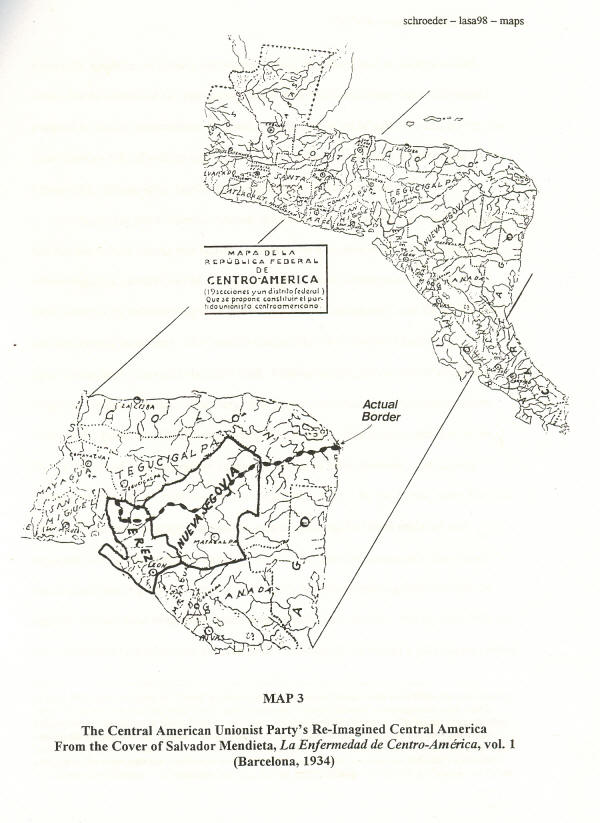
Sandino Rebellion Homepage Top 100 Home Back to MJS Vita