.jpg) |
|||
| The Sandino Rebellion in Nicaragua | |||
| 1927-1934 | |||
| © Michael J. Schroeder, 2007 | |||
| Intelligence Matters | |||
|
"Intelligence Capacities of the U.S. Military |
|||
| in the Sandino Rebellion, | |||
| Las Segovias, Nicaragua, 1927-1932: | |||
| Successes, Failures, Lessons " | |||
|
Intelligence Capacities of the U.S. Military in the Sandino Rebellion, Las Segovias, Nicaragua, 1927-1932: Successes, Failures, Lessons © Michael J. SchroederOutline
In one of the twentieth century's most poorly understood unconventional wars, from May 1927 to December 1932 the US Marines fought to a stalemate the ragtag rebel bands of the Nicaraguan nationalist rebel leader Augusto C. Sandino. This essay analyzes the intelligence successes and failures of the US military in this conflict in order to identify the principal lessons that can be drawn for this current age of global terror networks and other unconventional anti-US forces.1
1. The Theatre of Operations: Geography, Politics, Culture The war against Sandino's nationalist rebels was fought in the sparsely inhabited mountains of north-central Nicaragua, a region known as Las Segovias. Inhabited by roughly 120,000 people spread over some 6,000 thickly forested square miles, this rugged and isolated region, a kind of Nicaraguan "wild West," was uniquely constituted to serve as the base for a prolonged campesino (rural folk) rebellion against the US invasion and occupation.2
The accompanying map illustrates
aspects of the social geography of this region and its
two main sub-
Inhabited mainly by rural,
impoverished, non-literate campesinos, Indian and
mestizo (of mixed Extreme political inequalities and frequent recourse to political violence buttressed these extreme inequalities in social class and race. With political power in the hands of a few, the region's grinding poverty, shallow markets, and limited business opportunities led to exceptionally keen competition for state offices among the elite. In the century after Nicaragua's independence from Spain in the 1820s, Las Segovias was continually embroiled in a kind of low-intensity political war, with family-based factions of Liberals and Conservatives violently vying for control of state offices. Caudillismo, or political-military strongman-ism, dominated the political and military landscape. Especially around election times, local and regional caudillos (political-military strongmen) routinely mobilized armed gangs in order to promote their political interests and attack the interests of their foes. Such gangs, bound together by hierarchical but reciprocal relations of patronage and clientage, personal loyalties, and family networks, were the region's principal source of violence. Smuggling, banditry, and other forms of outlawry were also widespread. By the 1920s this culture of political gang violence and organized criminality had become deeply entrenched and highly developed, a political culture in which violence and threats of violence ranked high among the principal means through which politics was practiced.4 Caudillismo, personalism, the patriarchal family, and patron-client relations were rooted in highly elaborated cultural notions of honor, shame, and masculinity. Men's honor derived from both social status and virtuous behavior. Higher social status necessarily conferred more honor, while virtuous behavior was based on a man's capacity to act "with manliness" (con hombría). A man's manliness, in turn, was based especially on his capacity to control and monopolize his women's sexuality. For a man's wife or daughter to be sexually active outside of his control, or sexually assaulted or raped, brought dishonor and shame to both the victim and to the man claiming sexual dominion over her. Patriarchy, masculinity, and honor ideology, along with folk Catholicism and campesinos' valorization of their independence and autonomy, became essential components of the popular-nationalist ideology motivating the Sandinista rebels.5
The Sandino rebellion grew out of a civil war between two political parties, Liberals and Conservatives. When the civil war erupted in late 1926, the thirty-one year-old Nicaraguan exile Augusto Sandino was working as a mechanic in the Mexican oilfields. An ardent nationalist and anti-imperialist with a clear vision of his homeland's future, he returned to Nicaragua, journeyed to Las Segovias, and got a job as a payclerk in the US-owned San Albino gold mine. Soon he mobilized the mine workers, organized an army, became a Liberal general, and by the end of the war in May 1927 commanded nearly a thousand loyal troops. The US-brokered peace ending the war called for the defeated Conservatives to retain power until US-supervised elections in late 1928, continued US military occupation until the establishment of "stability" and "order," and the creation of a "non-partisan constabulary," the Guardia Nacional de Nicaragua (GN).6 Sandino was infuriated. Believing passionately that the peace treaty violated Nicaragua's national honor, he determined to fight to the death for a free and independent homeland. From the remnants of his Liberal army he fashioned his Defending Army of Nicaraguan National Sovereignty (EDSN), whose watchwords were "to defend our nation's honor," "Free Homeland or Death" (Patria libre o morir), and "Homeland and Liberty" (Patria y Libertad).7 Sandino was driven by a complex and eclectic apocalyptic millenarian religio-political ideology that went far beyond his aim of expelling the Marines and creating a workers' and campesinos' state in Nicaragua. Influenced by Gnosticism, Bolshevism, Rational Spiritism, and many other religious and political doctrines of the post-Mexican Revolution era, his ultimate goal was to spark a "Proletarian Explosion" among Latin America's "Indo-Hispanic Race," thereby ushering in a new age to be ruled by "Divine Justice." Fully expecting death and martyrdom, he saw himself as "an instrument of Divine Justice" in the epic and continent-wide struggle against US imperialism and for the redemption of the "Indo-Hispanic Race."8 As was the case later in Vietnam, Algeria, and many other anti-colonial national liberation movements, the war he initiated combined features of both a quasi-religious anti-imperialist guerrilla crusade and a civil war. In late May 1927, in response to Sandino's sacking of the San Albino Mine and armed resistance to the peace accord, the Marines launched an invasion of Las Segovias. Soon they established garrisons in most of the region's major towns. After his disastrous frontal assault on the Marine garrison in Ocotal in July 1927, Sandino retreated east to his "mountain fortress" of El Chipote. Marine-piloted planes bombed the mountain daily in November and December, but by the time US ground forces took the mountain in January 1928, Sandino's main body of troops had fled into the highlands of Matagalpa-Jinotega and far to the east, sacking other US-owned gold mines. Meanwhile the rebels had organized much of the Segovian countryside, establishing base camps, supply lines, and communications networks, and incorporating many Segovian campesinos in the fight against the US invaders.9 Over the next five years the conflict became stalemated in a classic "cat and mouse" guerrilla war. The Marines-GN controlled the towns and the major roads. The rebels, enjoying widespread popular sympathy, controlled most of the countryside. Prefiguring the "search-and-destroy" missions of Vietnam, each day a dozen or more Marine-GN patrols set out from their garrisons in search of the elusive rebels. Ground patrols were assisted by air patrols, which provided reconnaissance, dropped food and supplies, bombed and strafed "suspicious" locales, and generally served as adjuncts to their counterparts on the ground. Marine-GN ground forces were equipped with the most sophisticated weapons then available: sub-Thompson machine guns; Lewis machine guns; Browning automatic rifles; rifle grenades; Krag rifles; Colt automatic pistols. The rebels, in contrast, were chronically hamstrung by inadequate arms and shortages of ammunition, typified by rusty 1898 Springfield rifles; homemade dynamite bombs that were always noisy but rarely lethal; and more commonly, simple cutting weapons like machetes and cutachas. Of nearly seven hundred military "contacts" between Marine-GN ground forces and the rebels from May 1927 to December 1932, the great majority were between small bands of men (75% with 50 or fewer on each side); brief in duration (80% less than 30 minutes); initiated by the Marines-GN (75%); and won by the Marines-GN (at least 60%). At the same time, fewer than one ground patrol in twenty achieved its goal of establishing "contact" with the rebels.10 Despite the superior weaponry of the Marines-GN, the EDSN grew rapidly in power and numbers, until by late 1932 the rebels represented a genuine threat to the national state. Their principal advantage, and the reason they were able to fight the Marines-GN to a stalemate, was in the realm of intelligence. Employing a sophisticated espionage and intelligence system spanning the entire region, the rebels were continually and reliably informed about the number, locale, and direction of roving Marine-GN ground patrols, as virtually all contemporary observers agreed. In contrast, reliable intelligence was the most important military resource the Marines-GN consistently lacked. The comments of one Marine patrol commander captured this disparity: "The grapevine system of communication is as well developed in this country as in any other. Guardia and Marine patrol movements are known at once. Correct information is the great need, if contacts are to be made and very seldom can it be obtained in time from the natives."11 As in most unconventional and guerrilla wars, there was no clear distinction between civilians and rebels. Women who cooked for the rebels; boys who ran messages for them; girls who stood lookout for them; men who planted more land to feed them; old people who lied for them; families who tended their wounded: such people were neither peaceful civilians nor rebel combatants but something in between. Such blurring of lines between soldiers and civilians led to an insoluble paradox characteristic of guerrilla wars—the inability of the occupying forces to distinguish between the unarmed civilians they meant to protect and the "bandits" they aimed to "exterminate." The Marines-GN devised many ways to address this paradox, including issuing "good conduct papers," implementing reconcentration programs, compiling lists of rebels and their supporters, and the like, none of which succeeded in stemming the rebel tide.12 Related ground-based efforts, predicated on intimidation and violence, included searching and destroying civilian homes; threatening and assaulting people in their homes and on the trail; sexually assaulting women and girls; shooting people who ran away; and rounding up, jailing, interrogating, and sometimes torturing and killing suspected rebels and rebel supporters. Their counterparts in the air routinely bombed and strafed "suspicious" homes and nearby livestock. An enormous amount of credible evidence from a variety of sources demonstrates that the Marines-GN employed a great deal of indiscriminate violence in order to root out the rebels and destroy their base of social support. On the whole these efforts backfired. By violating campesino values of honor, masculinity, and autonomy, Marine-GN violence, on the ground and from the air, and the enormous popular hatred it generated across Las Segovias, became far and away the single most important factor fostering popular sympathy for the rebels, unifying the diverse bands of the EDSN, and contributing to the rebel army's expansion and growth.13 Running parallel to the guerrilla war between Marines-GN and the EDSN was a civil war and class war between Sandinistas and their civilian opponents, most of whom were elite or members of the "middling" social class. Rebels were constantly worried about "traitors" and "treason" among civilians, with good reason, since significant numbers did ally with the Marines and Guardia. At the same time the war effectively "democratized" the use of violence, creating opportunities for lower-class Segovianos to wage class war against the rich and powerful and to continue ongoing fights against their personal or family enemies under a nationalist rubric.14 The Marines began their withdrawal from Las Segovias soon after the national elections of November 1928. The next few years saw the gradual "Nicaraguanization" of the war, as the Guardia Nacional assumed control over most offensive military operations and intelligence efforts. In April 1931 the Nicaraguan Military Academy was founded, which graduated from 20 to 30 Guardia officers per month. By late 1931 only several hundred Marines remained in Las Segovias, and by January 1933 there were no more Marines in Nicaragua. In February 1933 Sandino signed a peace treaty and disarmed. A year later the Guardia, under its Director Anastasio Somoza García, assassinated Sandino and annihilated what remained of the EDSN.15
3. U.S. Marine Corps Culture in Las Segovias The US Marines who invaded and occupied Las Segovias formed a tight-knit community of white males who prized above all else duty to their country and loyalty to their fellow Marines; had long experience successfully suppressing "banditry" in tropical countries; through extensive training and experience knew that violence-making was at the core of their mission as soldiers; and saw themselves and their white US heritage as racially and culturally superior to the racial and cultural heritage of the people of Las Segovias. Many types of documents from the period exude this sensibility of cultural arrogance and anti-Hispanic and anti-Indian racism.16 In the 1920s Marine Corps culture was also infused with a powerful sense of its own missionary zeal and moralism, partly a product of Wilsonianism combined with the mythologization of the US role in the Great War. In the Marines' collective moral imagination, they were benevolent paternalists whose mission – to bring order and stability to a profoundly barbaric and disorderly land – was genuinely altruistic and civilizing. Imagining themselves as stern but fair father-figures determined to uplift and discipline the ignorant, primitive, childlike people of the region, and in the light of their training as soldiers, they legitimated their own extreme violence in their prosecution of the war. Even in the most self-critical and subversive moments – for instance, in the personal diary of one junior officer who decried the ignorance and foolishness of his commanders in the wake of a particularly disastrous incursion – these bedrock assumptions about the essential goodness of the US Marine Corps and the childlike barbarism and/or moral bankruptcy of the Nicaraguans remained fundamentally intact.17 In the beginning of the invasion and occupation, and despite the Marines' recent interventions in the Philippines (1899-1903), Cuba (1906-1909, 1912, 1917-1922), Mexico (1914), and the Dominican Republic (1912-1924), very few spoke Spanish or knew much about Latin society or culture. The great majority depended on interpreters in their day-to-day interactions with locals. Over time this changed to a degree, as a number of prominent officers became nearly fluent in Spanish and learned much about Segovian society and culture. But on the whole and with some important individual exceptions, the Marine Corps as an organization remained profoundly ignorant of and arrogant about the society and culture in which it operated.
These contexts established, we turn to Marine-GN efforts to acquire and analyze intelligence. Intelligence acquisition took place in two principal arenas: from the air, and on the ground. Intelligence gathered from airplanes was of very limited utility. In most cases airplanes could be heard for miles, and the rebels quickly learned to hide and shield their activities from them. The quality of intelligence acquired on the ground varied greatly according to type. (1) Far and away the most common source for intelligence derived from spontaneous reports by locals to Marine-GN officers in garrisoned towns and from interrogations of locals encountered on patrol. Each day dozens of such reports were received. Information from such sources was of mixed quality, occasionally useful, but on the whole highly unreliable. Such reports were routinely filled with lies, fabrications, and half-truths. The quality of information depended mainly on people's motives for supplying it, which varied greatly. Very commonly, locals appeared at a Marine-GN barracks to denounce specific individuals as Sandinistas. Occasionally they did so in good faith, but far more often they did so for motives that could only be guessed at in lieu of subsequent investigation. Usually it was to denounce personal or political enemies, or to spread disinformation. Liberals denounced Conservatives and vice-versa. Members of one political faction denounced members of another. Landowners denounced neighbors with competing land claims. Illicit liquor producers and smugglers denounced competitors-in-crime. Jilted lovers denounced unfaithful partners. People lied for myriad reasons, and their lies were often very inventive and elaborate. Predictably, the Marines-GN expended substantial resources investigating such false claims.18 An important exception to the generally poor quality of most spontaneous reports came from civilians who had been robbed or otherwise victimized by the rebels. Such people often gave useful information about the jefe (chieftain) and band that had victimized them. Most Marines' ignorance of the language, however, made it difficult for them to question these informants directly. For this reason distinguishing between true and false reports was a major problem, especially early in the war. In addition, such informants usually provided useful information only in response to specific episodes, and rarely could be relied upon regularly.19 In general, the higher the social status of the informant, the more materially harmed by the rebels, the more rooted in a specific locale, and the longer the period of time over which the informant supplied information, the more likely it was for such information to be accurate. This was especially true later in the war, as Segovian society became increasingly polarized along class and ideological lines, and as the national state grew more stable. But there were many exceptions. Elites lied almost as much as poor people did. Most people moved around a great deal. And some prominent individuals lied or deceived repeatedly. In response to the inaccuracy of these spontaneous or contrived reports, over time a number of Marine-GN officers cultivated networks of trusted and reliable informants, as discussed below.20 In this vein it should be noted that the rebels were very adept at exploiting the region's oral culture to spread rumors, lies, and disinformation. This was often done via seemingly spontaneous reports to garrisons and patrols. Because of such "planted" reports it was common for the same intelligence report to contain contradictory bits of information about a particular rebel group, e.g, that Salgado's band was heading north, and south, and east; that on the same day it was operating in several different zones many miles apart; and so on. The same was true of most information supplied by locals encountered on patrol. Occasionally accurate and useful, it was more often vague or useless ("Salgado passed by here not long ago" "How long ago?" "About a year") or downright unhelpful, sending patrols on countless wild goose chases.21 (2) Interrogations of captured rebels and rebel suspects was also a very common source of intelligence. Again, its quality varied widely but was on the whole poor. Captured rebels routinely lied and deceived, lacing their accounts with just enough truth to make them appear plausible. Accustomed to physical discomfort and pain, and often religiously committed to their cause, captured rebels rarely gave information that would assist the Marines-GN in suppressing the rebellion, even when threatened with death or tortured. In general, names of individual rebels comprised the most useful information they provided—and names alone could be protean or fabricated. Similarly, the wives and women of male rebels rarely gave useful information, even if they fully acknowledged their husbands' or men's involvement in the rebellion. Detained rebel suspects who turned out not to be rebels but who had had some sort of non-violent direct encounter with a particular rebel band sometimes provided useful information, depending on their personal interests and how they were questioned, but rarely did they provide specific or actionable intelligence that led to a disruption of rebel supply or communications networks or to a military contact.22 (3) With some exceptions, interviews with surrendered or amnestied rebels were also not very useful, for different reasons. Usually quitting the rebellion because of fear or exhaustion, ex-rebels tended to be very reluctant to inform on their former jefes or comrades because of their overall ideological orientation in favor of the rebel cause, and because they feared rebel reprisals against themselves and their family members. Rebels routinely exacted retribution against former comrades-turned-informants and their families, and ex-rebels knew it.23 (4) Captured rebel correspondence sometimes contained useful information, mainly in the form of rosters, ranks, and chains of command. This was more the case later in the war, as the quantity of captured correspondence increased. But rarely was such information specific enough to be actionable. Rebels knew that their notes and letters might fall into enemy hands, and were usually very cagey about including potentially damaging information. The region's oral culture also meant that the great bulk of rebel information was passed by word of mouth. On the whole, therefore, captured rebel correspondence was not an important source of intelligence. It might have been more important, however, had intelligence analysts subjected such documents to more sensitive readings. More careful analysis might have revealed the rebels' religious commitment to their cause; that Marine-GN violence against civilians tended strongly to unify and strengthen the EDSN; and that the EDSN was not devoted to "banditry" but to national liberation.24 (5) In contrast to the generally poor quality of intelligence acquired from the above sources, reports from town-based local notables and patrons with extensive social and clientage networks, and who were known personally by Marine-GN officers, were on the whole very useful and reliable. Intelligence gathered from such sources led to many successful military contacts and disruptions of rebel supply and communications networks, and grew in importance from around mid-1930. Yet informing on the rebels could be very dangerous, and informants' lives were at risk if the rebels learned their identity. For this reason both the Marines-GN and their informants grew increasingly secretive about such relationships as the war progressed. For example, Nicanor Espinosa, a prominent attorney and landowner in Telpaneca known personally by several Marine-GN officers, provided much useful intelligence on rebel bands and local rebels. Openly hostile to the Sandinistas, in September 1927 he published a scathing denunciation of them in the Managua press. In subsequent months he proved a very useful informant. In November, USMC Captain Paul wrote to Major Peard: "[A]bout this chap, Nicanor Espinosa, [Lieutenants] Brown and Satterfield both said that he was a live wire and always ready to give them live tips re- the bandits." In late 1927 both Brown and Satterfield led a number of very successful attacks on rebel encampments in the Telpaneca area. Two years later the rebels seized, tortured, and killed Espinosa.25 A substantial number of other professionals, landowners, and politicians in the western Segovias allied with the Marines-GN early in the war, allowing garrisons on their properties and encouraging their workers to provide them with information about the rebels, which they could pass on to the Marines-GN. In a typical early report, Major Salzman wrote of one prominent rancher: "Mr. Ortez's son will act as guide for the patrol and Mr. Ortez has also agreed to lend us two of his most trusted mozos [workers] to get all the information they can and operate with the patrol. . . . Mr. Ortez has three mozos working for us in this area and their reports seem to jibe with all other information." Some lower-class clients, loyal to their patrons, regularly provided useful intelligence to the Marines-GN. Most did not, instead following what they perceived as their own family, class, or ideological interests.26 By 1931 and 1932, the breadth and quality of information received from local notables increased substantially and became one of the most important sources of specific and actionable intelligence. Monthly intelligence reports often devoted many pages relaying information such informants provided. Content analysis of these reports indicates that many such notables were conveying collated information given to them by numerous clients, some of whom had infiltrated rebel ranks. Propertied informants expended considerable efforts gathering useful intelligence, mainly because it was in their material interest to do so, since by this time the war had become an open class war, the rebels routinely plundering the wealthy to finance their operations.27 In the coffee country of Jinotega-Matagalpa, a different dynamic was at work. Here, coffee growers often exaggerated the rebel threat in order to induce the Marines-GN to station troops on their farms, to protect against rebel raids and to control laborers more effectively. This led to many false reports of rebel movements, threats, and attacks. Alternatively, because of the Marine-GN's inability to suppress the rebellion, many coffee growers cut secret deals with rebel jefes, paying a certain amount each month for "guarantees" that the rebels would not plunder or destroy their properties. This led to many false reports that understated rebel activity.28 (6) The other most important source of useful intelligence came from locally-recruited Guardia, and from civilian scouts, spies, and guides hired personally by individual Marine-GN officers who had been stationed for extended periods in specific locales. Two examples illustrate the kinds of actionable intelligence commonly provided by local Guardia and ex-Guardia. Private Mendoza, who "before he enlisted in the Guardia was a resident of Las Vueltas, and he knows the country well, and also what few people live there, stated that he knew of a house where 'jefes' had their meetings." His information led to a successful assault on the house. After another successful assault on a rebel camp, Lt. Pefley reported: "The patrol is indebted to Arcadio Gomez Gonzalez, ex-Guardia, who served as guide. His knowledge of the country is extensive and contributed in great measure to the patrol's success." In addition, many civilian scouts, spies, and guides personally recruited by Marine-GN officers were especially effective in rooting out actionable intelligence—men like Simon Jiron of Murra, Ruben Barreto of El Jicaro, Juan Bautista Rivera of Somoto, "A-1" around Yali and San Rafael del Norte, "Navas" around Jalapa, and others. These tactics are discussed further in section 6, below.29
On the whole, acquiring intelligence was much easier than making sense of it all. Typically, reports from various stations would pour into a central repository—usually Managua and the departmental capitals of Ocotal and Jinotega—where a small number of intelligence analysts would compile the information and organize it into requisite standardized categories. The resultant weekly, bi-weekly, or monthly intelligence reports—Regimental (R-2), Brigade (B-2), Batallion (Bn-2), or, after mid-1931, Guardia Nacional (GN-2)—were distributed to all major stations. The categories into which information was shoehorned changed over time, but the most important were: (1) Location of Enemy Elements; (2) Units in Contact; (3) Enemy Strength and Movements; (4) Enemy Supply and Equipment; (5) Enemy Operations; (6) Our Operations; (7) Enemy's Probable Intentions. Different analysts sometimes interpreted these categories differently, so where information was slotted varied. In addition to standardized reports, individual officers frequently generated intelligence reports on specific episodes or topics.30 Intelligence analysis improved over time, but remained hampered by several limitations: (1) The most obvious limitation, but among the most important, was ignorance of the language and culture. Few field commanders spoke Spanish, most depending on interpreters to question locals. This severely impeded their ability to evaluate the quality of intelligence at its point of origin. Of the most prominent analysts—Lt. Larson, Majors Schmidt and Salzman, Colonels Watson and Hunt—none seem to have become fluent in Spanish. Many translations of captured rebel correspondence, intercepted letters, and published newspaper accounts were of very poor quality. This changed to a degree later in the war, as some officers learned the language, more skilled translators were assigned, and native Guardia assumed responsibility for field and desk operations. Still, linguistic and cultural ignorance remained major obstacles to effective intelligence acquisition and analysis until the final Marine withdrawal. (2) Bureaucratic and administrative obstacles to effective intelligence analysis were especially prominent during the war's first two years, with fuzzy jurisdictions, duplicated efforts, and poor communications between Companies and Divisions. With Managua serving as the central clearinghouse for intelligence operations, field officers in Ocotal, for instance, had little idea what their counterparts in Jinotega were doing. In May 1929, two years after the initial invasion of Las Segovias, the Guardia was completely reorganized to improve field operations and "to decentralize the organization in Managua." Five Areas were created: the Northern and Central Areas in Las Segovias (headquartered in Ocotal and Jinotega, respectively); and in the rest of Nicaragua, the Southern (Granada), Eastern (Bluefields), and Western (León) Areas. With clearer jurisdictions and more decentralized communications, intelligence analysis improved. Still, major problems remained.31 (3) A consistent problem hampering effective intelligence analysis was the tendency of analysts to compile lists of raw information from various sources, without any effective way to gauge the relative accuracy or importance of different items. This was especially true early in the war, though it remained a major problem to the end. In a typical early example, Lt. Larson's "R-2 Periodic Report" of 8 April, 1928, covering the previous week, listed 25 items under the heading "Enemy's Movements." Seven were from air patrols, all of which reported information of highly dubious utility. Eight items came from local officials with their own axes to grind, including one that began, "Errera [a local official] thinks from rumors that . . ." Five were reports from unknown natives. Only one, from a landowner east of Jinotega who spoke English, conveyed detailed, specific, actionable intelligence. Yet it was listed alongside others of much lesser quality. Lt. Larson tried to make sense of all this raw information from his desk in Managua, though mostly he engaged in guesswork, and most of his guesses proved wrong.32 By 1932 the situation had improved to some degree, though the problem remained. In his "GN-2 Report" of 1 April 1932, covering the previous month, Colonel Hunt reported twelve items on the whereabouts of EDSN General Colindres. Among these, Colindres was reported in Honduras in March 1; just north of Managua and far to the north near the Honduran border on March 12; wounded and back in Honduras on March 27; and finally, on March 30, "Reported that previous report of his being wounded thought now to be untrue due to receipt of further reliable information." In fact Col. Hunt had no idea where Gen. Colindres was. Four years after Lt. Larson's muddled analysis, the Marines-GN still had few ways to winnow the grain from the chaff. Greater linguistic and evaluative skills at the point of intelligence acquisition might well have ameliorated this persistent problem.33 (4) Another major problem derived from the Marine-GN conception of their enemy. Despite enormous evidence to the contrary, the "official" line remained that the rebels were mere "bandits." No official directive ordering intelligence or field officers to use this language of "banditry" has been found, but the consistency of such language strongly suggests that such a directive was being followed. A crucial consequence was that Marines-GN never really understood their enemy or the nationalist ideals inspiring them. "Thus the curtain falls on the attempt of bandit robbers to gain a foot-hold in the Departments of the west," reported Captain Carlson in January 1931. Yet a few months later another Managua-based analyst acknowledged that in the same area, "the country people are practically 100% in sympathy with them"; that they had "a rather well organized 'civil government' of their own"; that "they have a system of espionage . . . that is highly efficient"; and that "reports received from all sources indicate that all people living in [that area] are very friendly to the bandits and helping them in all ways possible and state that they are ready at any time to join forces for whatever operations the bandit jefes may order." Absent the conceptual blinders they insisted on retaining, the Marine-GN probably would have understood from the outset that their adversaries were far more than mere "bandit robbers"—and acted on this knowledge to more effectively weaken them.34 Perhaps Marine-GN discomfiture in acknowledging the nationalist impulse motivating the rebellion, and that their actions were its principal cause, led to their refusal to conceive of the EDSN as anything more than a "bandit" organization. There was a certain glibness to many intelligence analyses that only impeded fuller understanding of the enemy. "The old bandit game of trading animals and stock, stolen in Nicaragua, for arms and ammunition in Honduras is still in vogue," reads another typical report, as if the EDSN was playing a "game" or their strategies for acquiring resources hinged on shifting fashions. Late in the war one prominent analyst likened Sandino himself to a "rat in a trap," despite abundant evidence that he was a sincere and committed patriot. Whatever its cause, this persistent denigration and dehumanization of the rebels only obscured an uncomfortable truth: that the Marines-GN were fighting a nationalist insurgency with widespread popular support that was growing steadily in power.35 (5) Another limitation impeding effective intelligence analysis was the Marine-GN's body-count mentality and static conception of warfare: the notion that there existed a fixed number of "bandits," so that each "bandit" killed necessarily meant a decline in their numbers and weakening of their organization. This conceptual straightjacket effaced the war's dynamic nature, since each rebel killed, each civilian house destroyed or family terrorized could and often did create many more rebels prepared to die for the cause. The oral testimonies of former rebels powerfully capture this dynamic, of which the Marine-GN intelligence apparatus seems to have been entirely unaware. As rebel numbers and power grew, especially from mid-1930, intelligence analysts continued to conceive of the war as a static, zero-sum game. Lt. Larson's R-2 report of April 1928 listed seven "bandit" jefes, Col. Hunt's of April 1932 listed eighteen, while the GN-2 Report of October 1932 listed twenty-four. In four years rebel numbers had grown from several hundred to several thousands. Their operations had become far more aggressive and covered a much larger territory. Yet this same October 1932 report, after summarizing recent killings and arrests, conveyed the analyst's view that "the bandit system of communication and supply has been seriously demoralized." This supposition that more dead or arrested "bandits" necessarily "demoralized" their organization, or meant that the Marines-GN were gaining the upper hand, flew in the face of all evidence and experience. Analysts had routinely issued such overly-rosy assessments for the past four years. This systemic over-optimism appears to have had multiple causes: a desire to please senior officers and civilian leaders; the lack of long-term institutional memory, due in large part to frequent reassignments; a fundamental misunderstanding of the enemy; racism and cultural arrogance; and a static, one-dimensional conception of warfare.36 In short, effective intelligence analysis was systematically hampered by a number of major conceptual and practical obstacles. In some cases, however, individual Marine-GN officers went a long way toward overcoming these obstacles.
The most effective efforts to acquire and analyze intelligence built on the region's culture of patronage-clientage, caudillismo, personal loyalty, honor, and trust. They exploited existing and emergent social and political divisions. And they were highly discriminating in their application of violence so as not to inflame popular passions and create more rebels than they eliminated. They were also undertaken by officers with well developed interpersonal skills. The most successful were canny, judicious, observant, and good judges of character. They worked hard to establish personal relations based on mutual trust and respect. They judged the veracity of information by carefully evaluating informants' verbal expressions and non-verbal cues. They created dynamic and detailed mental maps of people's characteristics and how they fit into larger social relationships. They forged many contacts to cross-check conflicting information. They continually revised their understanding of a situation as it unfolded. And they thought things through carefully before acting. Perhaps the best way to illustrate these rare intelligence successes is to examine the practices of a handful of exemplary individual officers. Among the canniest and most successful field officers were Captains George F. Stockes and Herman H. Hakala, commanding officers in Somoto, west of Ocotal near the Honduran border. Stockes commanded the garrison from March 1928 to April 1929, working with Hakala in the first months of 1929, after which Hakala assumed full command until early 1930. Separately and together they confronted two of the rebellion's shrewdest chieftains: Generals Carlos Salgado and Miguel Angel Ortez. The latter was killed in a bold assault on Palacaguina in May 1931. Salgado, more prudent and less impulsive than Ortez, was active in the Somoto-Honduran border area from the beginning to the end of the rebellion and was one of the few major jefes never caught or killed. It should also be noted that the town of Somoto and its hinterlands had a history of local political and social struggles as tangled and convoluted as any in Nicaragua. Built on the remnants of Tepesomoto, an indigenous community dating back more than 500 years, by the 1920s the town and surrounding villages were inhabited by cross-cutting factions of Conservative and Liberal landowners, merchants, and politicians; Indians of diverse political affiliations and social grades; and a laboring class of dizzying complexity.37 Following his assignment as commanding officer of Somoto in March 1928, Captain Stockes seems to have taken five or six months to orient himself. During this period he sent to Managua only a handful of brief reports on local rebel activity. By late August and early September, however, his reports began pouring in. Distinct from most such reports, his were unusually informed and detailed. Subsequent events indicate that he had spent his period of seeming quiescence cultivating personal relationships with the town's most influential citizens; becoming personally acquainted with key local Honduran border officials; and recruiting a small coterie of agents and spies. In forging these friendships and alliances he worked to identify and build upon the pre-existing social and political divisions among the district's inhabitants.38 Of Stockes' many reports, perhaps the most illustrative of his methods of acquiring and analyzing intelligence concerns an incident that occurred on the outskirts of Somoto on the eve of the November 1928 elections. As Stockes' model four-page report reveals, the incident itself bore all the hallmarks of local Segovian political struggles: targeted violence in pursuit of political power; byzantine networks of allies and adversaries; informants who systematically lied and deceived. Taking nothing at face value, reasoning his way through a thicket of contradictory stories, cross-checking different versions of events, and continually revising his understanding in light of new information, he unraveled and exposed a scheme by local Conservatives to murder a political adversary and disrupt the elections. The report is especially impressive not only for the complexity of the events it describes but for Stockes' skill in effectively gathering and analyzing diverse and often conflicting strands of information.39 In the following months Stockes and Hakala relentlessly pursued Salgado and Ortez (and lesser jefes) across the length and breadth of the western Segovias, finally chasing both into Honduras, where they mostly stayed until neither Stockes nor Hakala remained in Somoto. During much of this period Stockes operated jointly with a column of Volunteers led by a former Liberal general; met numerous times with local Honduran border officials to try to induce them to assist the Marines-GN in suppressing "banditry" (without much success); identified and eliminated scores of rebel operatives without recourse to indiscriminate violence against the civilian population; and substantially reduced the EDSN's strength in his area of operations. Hakala, who seems to have served a kind of apprenticeship under Stockes, picked up where Stockes left off. In their informed specificity, his reports are as distinctive as Stockes'. Hakala's successor, Captain Williams, also unusually effective, seems to have apprenticed under Hakala. Thus it appears that Stockes was the first in a series of exceptionally successful field commanders in the Somoto district, each of whom passed their accumulated knowledge on to the next. The problem, of course, was that chasing rebels across the mountains was both arduous and dangerous, and one-year stints were the most that could be required of even the most dedicated officers. This strategy of serial apprenticeship under more experienced officers seems to have been a very effective way to address this structural problem, conserving the knowledge, personal relations, and intelligence networks that had been so painstakingly created. Another exceptionally successful field and intelligence officer was First Lieutenant (later Captain) Julian N. Frisbie, stationed in the Jinotega-Matagalpa coffee district from early 1928. In late May he wrote to the Intelligence Section's lead analyst in Managua, Major Schmidt, with an update on a "scheme" he was working on in Matagalpa to get more information on rebel bands by convincing local officials and landowners to send trusted scouts and spies into active rebel zones. "The thing I am emphasizing is to get them [local notables] to send natives out beyond [the Jinotega-Corinto-Tuma] line for information. A few of them have complied and some of the information you have received has been from them." He then turned to the obstacles to his scheme in Jinotega. "Jinotega, however, is a different proposition. No one seems willing to talk at all. The people that I had letters to promised to help and at least one of them had . . . The people of Jinotega all, or nearly all, profess to be anti-Sandino, but I doubt it."40 A week later he helped arrange the surrender of local Liberal gang leader Santa Maria Sevilla. He "assured" Sevilla that the Marines would protect him and his gang from their Conservative foes, issued them all safe-conduct passes, and, "after some bargaining back and forth" paid them ten dollars per rifle. A skilled judge of character and perceptive observer of social dynamics, he noted after the surrender that Sevilla "does not have the ability to be a successful bandit leader. He is a common ordinary working man with no distinct characteristics. . . . At dinner last night in Jinotega he was the least considered of the eight or nine who were present." That he had arranged this dinner with Jinotega's leading citizens speaks volumes about his approach. 41 Next day he wrote another memo to Major Schmidt. "Jinotega is much better for information this trip than it was the last. People seem to be willing to give more information. Last night two different mozos that I had never seen before stopped me on the street and informed me that there were lots of bandits in the Pantasma section. Just this morning I got further information . . ." He then offered some astute reflections on what he had learned about acquiring intelligence: "No matter how much one tries to keep it from being so, the securing of information from the residents is a personal matter. Undoubtedly the whole difficulty has been the frequent changing of officers. . . . If it could be possible to make the intelligence people more permanent it would be a great help." He then recommended several inducements that would obviate the need for further bloodshed: "Have some notices printed to be dropped by airplanes throughout the known bandit country telling them that each man who turns in a rifle or pistol will be given a safe conduct. . . . The notices are not to be addressed to the Jefes but to the men themselves. . . . The idea is to get [Sandino's] men to desert and have his forces disintegrate."42 In subsequent months Frisbie personally recruited more than a dozen scouts and spies to comb rebel territory and sent scores of letters to lesser jefes to induce them to surrender. He also devised subtle surveillance techniques to ferret out rebels in the town and extended his network of informants among the district's elite. Like Stockes, Hakala, and others, he did so by building upon the district's pre-existing social and political cleavages. He seems to have understood that violence was the least effective way to acquire useful intelligence or, ultimately, to win the war. Rather, he worked to cultivate local alliances by fostering mutual trust and respect—"winning hearts and minds"— exemplified in an observation he made to Major Schmidt: "The property owners seem to be friendly and willing to co-operate as long as they are handled right by the C.O." Frisbie continued as a field and intelligence officer until the end of the war. Indeed, in December 1931 one of his well-placed spies acquired intelligence that led his patrol to a military contact with Sandino's personal guard, from which Sandino himself barely escaped. It was the closest any Marine-GN patrol ever came to capturing or killing the Supreme Jefe of the EDSN.43 Captain J. Ogden Brauer, commanding officer of Palacaguina from May to August 1931, undertook intelligence acquisition and analysis in ways very similar to Stockes, Hakala, and Frisbie, though he was more inclined to use violence to find out what he felt he needed to know. His reports show him forcing prisoners to act as guides; ransacking and burning civilians' homes; shooting prisoners "attempting to escape"; and several insinuations of torture. It is also true that he was assigned to his post relatively late in the war, by which time such practices had become routine. Still, compared to other officers, Brauer seems to have been more discriminating in his use of violence. No less characteristic of his attitude toward intelligence acquisition than the violent episodes cited above was his report on the surrender of rebel jefe Catalino Olivas and his brother Marcos in August 1931. "We did not harry them with questions as they were very timorous, but instead attempted to inculcate in their minds that we were their friends, that we were there to help them in every possible way . . . It is believed that the affluence [sic] of information which we will receive after they become more confident will indeed reward us for the patience had on this first meeting." His prognostication likely proved accurate.44 Brauer also arranged the surrender of other rebel jefes, handled in ways similar to the Olivas brothers'. He also cultivated personal alliances with local notables, including the Alcalde (municipal mayor), rural judges, and landowners, and personally recruited a good number of agents, spies, and informants from the middling and lower classes, many of whom harbored personal or political grudges against the EDSN and its allies. He commanded the garrison in mid-May 1931 when EDSN General Miguel Angel Ortez attacked the town. Ortez was killed in the assault, and three months later, "by working thru friends and with the Alcalde," Brauer learned of the body's location and led a patrol to disinter it for positive identification. Accompanying him were the Alcalde, a school teacher who had known Ortez for years, and twelve native Guardia, four of whom had known Ortez personally, one as a servant in the Ortez family home. After identifying Ortez's corpse and carefully removing a small lock of hair, Brauer did not desecrate the grave, but instead, "the body was covered up as before."45 One could continue in this vein, identifying other Marine-GN officers who built on the region's culture of patronage-clientage, personalism, loyalty, honor, and trust; cultivated alliances with local notables and patrons with extensive clientage and kin networks; built upon pre-existing social and political fractures; and recruited personally loyal spies, scouts, and agents to acquire useful and actionable intelligence—men like E. F. Carlson and R. Winans in Jalapa and Apalí; J. C. McQueen in Somotillo and Limay; and others. The historian David C. Brooks has examined the "ethno-diplomacy" of one of the most successful patrol commanders in the Nicaraguan theatre, Captain Merritt A. "Red Mike" Edson, in his Río Coco mission of 1928. As Brooks has shown, Edson shrewdly cultivated personal alliances with both the "bamboo whites" and the Miskito Indians of the Atlantic Coast region, greatly facilitating the acquisition of useful and actionable intelligence on the Sandinista rebels. "Indians, Spaniards, and white foreigners in this area are pro-Sandino," observed Edson in June 1928, "but no active opposition is shown to or expected by us. These people require careful treatment. . . . If properly handled, a great deal of assistance may be expect [sic] from these people as boatmen, guides, and laborers. Although little or no information is now obtained, it is firmly believed that valuable and timely information will be secured in the future if we maintain a friendly attitude toward them. Any sign of oppression, poor faith in fulfilling obligations, etc. will result only in hindering our operations."46 Edson was right, as subsequent events demonstrated. In fact, Marine-GN "oppression" in Las Segovias was far commoner than "careful treatment" and was a major cause of systematic failures in the realm of intelligence and of the growing power of the rebel organization.
In addition to the practical and conceptual institutional limitations, obstacles, and failures identified in section 5, above, one should also inquire into individual failures in intelligence gathering and analysis. These fall into two main categories: first, cases in which excessive or indiscriminate violence and routine arrogance intensified popular outrage, fostering non-cooperation among civilians and steeling rebel resolve; and second, cases in which the rebels themselves erected insuperable barriers to effective intelligence acquisition. With regard to the first, one can cite many instances in which excessive Marine-GN violence generated far more sympathy for the rebels than it eliminated and was on the whole profoundly counterproductive. The following paragraphs highlight only a handful of such cases. Captain Herman H. Hanneken had earned his fame in Haiti, where in 1919 he led an audacious assault on the camp of Charlemagne Péralte and killed the renowned Caco chieftain. In 1929 he was assigned to the Jinotega district. Soon he joined forces with the Mexican and former Liberal General Juan Escamilla and his column of Volunteers. By April Hanneken and Escamilla were cutting a swath of destruction and outrage across the length and breadth of the Jinotega district. Their modus operandi was highly distinctive. Perhaps drawing from lessons he had learned in Haiti, Hanneken decided to target the families of suspected rebels, especially their women and children. Pursuing information extracted from prisoners, his column would descend on a house, roust the inhabitants, search and burn the house, confiscate the livestock, arrest everyone, and force-march them all to town. Typical of his approach were the events of 15 April 1929. "Upon arrival of the patrol [at the Jesus Vasquez house] a number of dogs gave the alarm and all the occupants ran—4 men and 2 women and 2 children. The Volunteers gave chase . . . Patrol burned the house and brought all cattle to Base . . . Patrol returned to base with Jesus Vasquez, his wife, 2 daughters, and one small child." At the end of his report he noted: "From all reports this completes the destruction of the houses and supplies of all bandits in [the specified area] and all the bandit women found have been brought in and will be sent to Jinotega." A few days later he reported rounding up 17 other families of bandit suspects.47 Most of the "bandit women" and children were reconcentrated in the town of Yalí. By June more than 200 women and children were living in hastily erected thatch and mud shacks on the edge of town. In early July the battalion medical officer found nearly all the children suffering from "intestinal disturbances, including dysentery, diarrhea, constipation ascariasis," and many other cases of fever, skin infections, and ulcers. People were dying at the rate of more than one per day. "The cause of the sickness in Yali," he noted, "is believed to be due to the unhygienic living conditions and insufficient food and shelter at the time of the concentration there."48 Later in July surviving detainees were allowed to return to their destroyed homes. The overall effect of the Hanneken-Escamilla counterinsurgency program was to pour gasoline on the fire of anti-Marine sentiment across the district. Until the end of the war the area north and northeast of Yalí remained one of the most active rebel zones in the country. I have found no evidence that Hanneken sought to forge alliances with local notables in town or country. Nor does he seem to have recruited more than a handful of spies, scouts, or agents from the local populace. In his dealings with local inhabitants, "trust" and "respect" never entered his vocabulary. "Winning hearts and minds" was never his goal. Instead, he, his soldiers, and Escamilla's Volunteers, often in conjunction with other Marine-GN patrols, sought to sow terror and fear among the local inhabitants, men, women, and children. They succeeded in this aim, leaving behind them a collective memory of violence and hatred that endured for decades.49 Leaving behind an even more enduring collective memory of Marine violence in the Jinotega district was the infamous "Company M," led by famed Marine Corps heroes Captain Lewis B. "Chesty" Puller and Lieutenant William A Lee. In the early 1980s, the Sandinista government undertook a project intended to rescue individual and collective memories of Sandino's fight against the Marines. The resultant oral histories, more than 100 in all, reveal that stories about the atrocities committed by Puller and Lee, especially Lee, were still circulating in the Jinotega district more than half a century after the alleged events. More than a dozen old people told detailed stories about Lee's atrocities, most in strikingly similar terms. The commonest shared memory of these was of Lee throwing babies in the air and spearing them with his bayonet.50 Whether Lee actually engaged in such practices matters less, for our purposes, than the fact that many people remembered that he did. It should be noted that Marine-GN records hint that even by prevailing standards his violence was excessive. As with Hanneken, I have found no evidence that Puller or Lee cultivated alliances with local notables or employed more than a handful of scouts or spies. Their reports are silent on their personal relations with local people. Their patrols evidently acted in isolation, ranging far and wide for weeks at a time as they tracked the rebels across the mountains and valleys of Jinotega. While they did initiate a number of significant military contacts, their intelligence gathering capacities seem to have been rudimentary and on the whole not very effective.51 Conventional Marine Corps wisdom holds that Company M was among the most successful Marine-GN combat units to operate in the Nicaraguan theatre. In my view precisely the opposite is true. On the surface Puller and Lee appear to have achieved important results by weakening or eliminating specific rebel groups in certain areas. But from a broader perspective the consequences of their actions for the US mission in Nicaragua were far more deleterious than beneficial, generating a deep reservoir of popular animosity against the Marines and serving mainly to stoke the fires of rebellion and revolution amongst campesinos across the region.52 The foregoing surveys only some of the most egregious examples of excessive Marine-GN violence against civilians. But such violence was expressed in countless ways, in the most routine and everyday events. In a typical example, in late 1927 Lt. G. H. Bellinger led a patrol near Somoto. At a rural house he saw two men outside conversing. He detained them, searched the house, occupied by a lone woman, arrested the men, tied their hands behind their backs, and continued his march. Soon after both prisoners allegedly tried to escape. He killed them both and left their bodies on the side of the road. All of these actions profoundly violated campesino cultural values of respect, autonomy, masculinity, and honor. Even if the patrol had not killed the men and disrespected their corpses, everything else about the episode—especially searching the house with a woman alone inside while forcing the men to watch from a distance—represented a searing affront to the men's honor. Such practices were routine. A final example, emblematic of Marine-GN tactics, is Lt. W. B. Croka's July 1930 rampage across the Palacaguina district. In five days his patrol burned 16 civilian houses, shot at least three men who ran away from them, terrorized scores of women, children, and old people, and confiscated food, livestock, and clothing to feed and clothe his men. Croka later reported, without a hint of irony: "Natives all seemed very hostile everywhere and denied ever knowing of any bandits in their localities. . . . they could not or would not give any information of value . . . The natives were very sullen and non-communicative which led me to believe there was something worrying them but could not gain one bit of information. . . . By choice they are friendly to banditry."53 In short, the evidence is abundant and unequivocal that the indiscriminate violence practiced by Croka, Hanneken, Puller, Lee, and many other patrol commanders worked in myriad ways to alienate individuals, families, and communities from the Marines-GN, to inflame popular sentiment against them, and thereby to impede severely the acquisition of useful intelligence. A second way to examine Marine-GN intelligence failures is to focus on cases in which the rebels themselves created impenetrable barriers to the acquisition of actionable intelligence. Predictably, most rebel jefes and groups were very adept at avoiding detection. But far and away the craftiest and most effective rebel jefe in this regard was General Pedro Altamirano, or Pedrón. Around 55-60 years old and non-literate, Pedrón was the absolute master when it came to eluding his pursuers. From the beginning to the end of the war, and despite enormous efforts, the Marines-GN never so much as glimpsed him, except in photographs. Occasionally nipping at his rear guard or flanks, they never engaged his entire band in combat, despite repeatedly combing his area of operations with dozens of patrols led by the most experienced field officers. Major Schmidt considered him the most dangerous of all the rebel jefes. Remarkably, he was the only jefe to remain active in the field after Sandino's assassination in February 1934. For nearly three years after the Guardia had utterly crushed every other remnant of the EDSN, Pedrón and what remained of his band eluded all detection, until he was finally betrayed and killed in late 1936. Indeed, some former rebels, interviewed in the 1980s, attributed his extraordinary abilities to telepathy, clairvoyance, or some other special magical powers. And indeed there are times when his ability to avoid all detection does seem to border on the magical.54 Exactly how Pedrón managed this feat is not known, and likely will never be. But some points are clear. He knew the terrain with extraordinary intimacy. He instilled a fierce personal loyalty among his many followers and supporters. And he was ruthless, brooking absolutely no opposition or dissention within or outside his ranks. With a well-deserved reputation as a cutthroat and murderer, he personally killed hundreds of people, most suspected of treason or spying. His methods were gruesome, his usual custom to torture people before slicing them to pieces with a machete. In fact he devised numerous ways to kill people by machete and gave each a name: the "skull cut," the "vest cut," and others. In camp and on the trail he tolerated absolutely no consumption of alcohol. In several instances he sentenced to death lieutenants with long service for violating this anti-drinking code. One rebel woman he ordered shot for allegedly expressing her view that carelessness among certain members of his army had resulted in the deaths of her two rebel sons. All the evidence indicates that Pedrón was a ruthless killer who led an extraordinarily disciplined and loyal army. His army was big by rebel standards, usually from 200 to 300 men. He divided this army into smaller units of 5-20 each and designated precisely where each should be located at all times. He posted sentries and spies on every possible trail or access point. He almost always walked, rarely rode a horse, never kept dogs, and his band usually cut their own trails. He was intensely religious, often invoking God in his utterances and dictated letters, and believed passionately in the justice of the rebel cause. Sandino he absolutely adored. Periodically his band would go on raiding expeditions through the rich coffee and mining districts, looting and burning farms and mines, though he never entered any building or any populated area. As his men looted he stood far away with his personal guard, his silhouette glimpsed from a distance by witnesses on only a handful of occasions. In these and other ways about which we can only conjecture, Pedrón made it impossible for the Marines-GN to gather any actionable intelligence whatever against him. For years they spared few efforts to acquire such intelligence. Nothing worked. Chesty Puller once proposed copying Sandino's seal and signature to lure Pedrón into a trap. The idea went nowhere. In sum, in the Marines' sustained six-year effort to secure actionable intelligence on Sandinista General Pedro Altamirano, everything failed.55 A different strategy was followed by General Carlos Salgado, also in his 50s or 60s and barely literate. Active in the Honduran border area, he eluded his pursuers mainly by relying on extensive kin networks—brothers, sisters, aunts, uncles, nieces, nephews, and scores of cousins and in-laws; by cultivating the personal loyalty of local inhabitants, including local Honduran border officials; and by slipping across the border and laying low when the pursuit intensified. A Robin Hood-like figure, he robbed his rich enemies to give to his multitudinous kinfolk and his many poor and well-placed friends, relying less on ruthlessness than on vast kin and patronage networks and local borderlands politics. The Marines-GN never laid eyes on him either.56
Among the lessons that can be drawn from the experience of the US Marines in Nicaragua for today's war on terror and other unconventional anti-US forces are the following: (1) Exercise restraint and discrimination in violence-making. One of the most obvious lessons to be drawn from the Nicaragua experience is that indiscriminate or excessive violence in waging war against or acquiring useful intelligence about unconventional forces, especially violence against women and children, necessarily tends to generate intense anti-US sentiment and is therefore inherently and profoundly counterproductive. The critical distinction between short-term results and longer-term consequences necessarily lies at the heart of any successful military strategy. The solution to the problem of excessive and indiscriminate violence is to impose greater discipline on individual units, to rein in "loose cannons," and to create a military culture that is fundamentally intolerant of any significant degree of violence against civilians. This includes proscriptions against torture. In Nicaragua, torturing prisoners to acquire intelligence was relatively common. The immediate results often seemed to justify the practice. But from a broader perspective such practices only served the interests of the enemy. They confirmed the worst perceptions about the Marines, sparked popular outrage, and fortified rebel resolve. Exercising such restraint and discrimination in concrete situations will doubtless present many practical challenges. Nonetheless, minimizing violence against civilians and prisoners would seem to be the sine qua non for winning not just battles but the larger war against any unconventional adversary. (2) Develop and practice a dynamic conception of wafare. Intimately related to exercising restraint in violence-making is integrating into the theory and practice of intelligence acquisition and analysis a dynamic, long-term, multi-layered vision of warfare. Intelligence analysts in Nicaragua were stuck in a static, one-dimensional, number-oriented vision of the war against the EDSN. They truly believed that the number of rebels was fixed, ergo, that each rebel killed necessarily meant one less rebel. Events proved them wrong. The war was not a zero-sum game. It was a fundamentally dynamic, non-linear, and often ironic process. Actions backfired. Ripple effects and feedback loops abounded. The nexus linking rebels and civilians was dense and complex. Critically important consequences were often unforeseen and unintended. Indeed, this notion of unintended consequences should be at the forefront of every field officer's, intelligence analyst's, and war strategist's intellectual repertoire. (3) Understand the enemy. Closely related to the above is that the semantic and conceptual framework by which the enemy is conceived must be adequate to the task. Winning a war requires understanding the culture, perceptions, and motivations of one's enemy. The Marines in Nicaragua were too often blinded by their own ignorance, preconceptions, and misconceptions about the EDSN. They insisted they were fighting "bandits" when in fact they were fighting nationalists. This was probably because senior officers and civilian policymakers considered it impolitic to acknowledge even an iota of legitimacy in the rebel cause, reasoning that to do so would have undermined the political and ideological rationale for the war. But as linguists and cultural theorists know, the words and labels we employ profoundly shape our understandings of the world and our actions within it. One crucial consequence of the persistent use of the "bandit" label was to obscure the true nature of the EDSN and why it enjoyed such widespread popular support. The lessons seem clear: Take the enemy seriously. Work to understand them on their own terms, from the "inside out." Dispense with derogatory labels and epithets. Endeavor to see and imagine the enemy as they see and imagine themselves. Seek continually to revise understanding of the enemy by reading all the evidence honestly, focusing especially on evidence that does not fit into accepted conceptual schemes. The operative question should be whether the words and concepts employed enhance or impede understanding of the enemy. If they do not enhance understanding they should be modified, qualified, or replaced. All of this is obviously closely linked to the need to learn and respect the language and culture, which seems so self-evident that it merits no further discussion. (4) Reward conceptual dissent and de-politicize intelligence analysis. All organizations have a political dimension, and all military organizations tend to punish dissent or disagreement with the "official" viewpoint. The result within intelligence communities often tends to be a kind of "group-think," a tendency to keep analyses and conceptualizations within narrowly defined and officially sanctioned parameters. The effects on intelligence analysis can be pernicious. This was the case in Nicaragua, as a combination of pressures kept analyses within narrowly prescribed boundaries. A crucial consequence was the limitations and shortcomings identified above. The solution is to create institutional mechanisms that encourage and reward conceptual and analytical dissent and that effectively de-couple intelligence analysis from political pressures to conform to the dominant perspective or "party line." Precisely how to accomplish this de-politicization remains an open question; the point here is that doing so seems essential. (5) Build personal relationships based on mutual trust and respect. The US experience in Nicaragua demonstrates that while a technological infrastructure is necessary, technological solutions to problems of intelligence acquisition and analysis are much less effective than personal relationships based on mutual trust and respect and built upon existing cultural norms and values. Airplanes, telegraphs and telephones, radios, and related technologies were all important elements in the intelligence apparatus. But far more important were knowledge of and respect for honor ideology, personal loyalties, patron-client relations, caudillismo, masculinity, and campesino autonomy. The most successful efforts to acquire and analyze intelligence built upon these cultural norms and values. The least successful ignored or violated them. (6) Exploit pre-existing social divisions. Every society is characterized by multiple lines of fracture and division. In 1920s and 30s Nicaragua the most important of these (in rough order of consequence) were political party, social class, race and ethnicity, community, family, gender, and interpersonal. The most effective intelligence efforts identified and exploited these divisions in order to create and nurture the personal relationships discussed above. (7) Institutionalize continuities. One of the major problems facing any bureaucracy is how to create institutional mechanisms to ensure continuity and obviate the need to continually re-invent the wheel. This problem is particularly acute in military bureaucracies, with their frequent reassignments of personnel. In Nicaragua the intelligence apparatus cried out for such continuities, at at least two levels. One was in the realm of institutional memory, with a succession of intelligence analysts repeating a series of overly optimistic and erroneous assessments on the EDSN's declining strength. Had these analysts been aware of their predecessors' analyses, it seems less likely that they would have repeated the same mistakes. The second was in the realm of local knowledge and personal relationships. Frequent reassignments often required re-creating such knowledge and personal loyalties. The strategy of serial apprenticeship followed in the Somoto district seems to have attenuated the deleterious effects of reassignments and ensured a substantial degree of continuity in these arenas. (8) Time, patience, and prolonged local experience are essential. In terms of successful intelligence acquisition and analysis, there is no substitute for prolonged local experience. Learning the local culture, identifying its principal social fractures, building personal relations based on mutual trust—these and related activities require time, patience, dedication, and experience. Captain Stockes took five or six months to orient himself to the Somoto district, probably the bare minimum in any social context.
(9)
Sometimes nothing works. The example of Pedrón
in the Matagalpa-Jinotega highlands demonstrates that
there are instances in which no strategy to acquire
useful intelligence can or will be effective. One
of the craftiest guerrilla chieftains in the history of
Latin America, Pedrón successfully devised and
implemented a range of strategies intended to make
himself and his army wholly impervious to efforts to
acquire actionable intelligence against him. As
unsettling as this conclusion might be, among the
principal lessons to be drawn from the Nicaraguan
experience would seem to be that the science and art of
intelligence acquisition and analysis are as imperfect
and fallible as people are, and despite the best efforts
sometimes nothing works.
[1]. This study and the larger research project from which it is drawn are based on three principal stores of primary evidence: the records of the US Marines and Guardia Nacional de Nicaragua, housed in Record Group 127 in the National Archives in Washington D.C., altogether comprising more than fifty feet of files (herein cited as NA127/[entry no.]/[box no.]); more than one hundred oral testimonies of former Sandinista rebels, produced and compiled in the early 1980s by the Instituto de Estudio del Sandinismo (IES) in Managua (herein cited as the "IES testimonies," IES [interview no.]: [page no.]); and more than one thousand original captured rebel documents from the period, most scattered through Record Group 127. The conclusions advanced here were also reached in dialogue with the expansive published secondary literature on the topic, only a fraction of which is cited here. There are many reasons why this conflict remains so poorly understood, despite the voluminous literature treating it. The most important are the practical difficulties associated with researching it in detail combined with the systematic imposition of partisan political and ideological frameworks on the evidence, a topic beyond the scope of the present inquiry. [2]. Data and conclusions in this section are based on the author's research in the sources indicated above. For further discussion and sources see Michael J. Schroeder, "'To Defend Our Nation's Honor: Toward a Social and Cultural History of the Sandino Rebellion in Nicaragua, 1927-1934," unpublished Ph.D. thesis, University of Michigan, 1993; and chap. 3 of his book manuscript in progress, The Sandino Rebellion: Tragedy and Redemption in the Mountains of Northern Nicaragua, 1926-1934. [3]. The observations of Lt. Col. J. A. Rossell, Northern Area Commander in 1929, accurately conveyed the broad outlines of the region's political economy: "As a general statement, it may be said that almost the entire population lives by performing unskilled labor. . . . The people everywhere are poor and in many cases live on credit, obligating themselves during the rainy season to work out their debts during the dry season. . . . The wealth of this area is in the hands of a comparative few who live in the cities under the protection of whatever garrison is stationed there, but their wealth is derived from the rural sections . . ." Rossell, General Data, Northern Area, Western Nicaragua, 1 Dec. 1929, NA127/205/2. [4]. See Michael J. Schroeder, "Horse Thieves to Rebels to Dogs: Political Gang Violence and the State in the Western Segovias, Nicaragua, in the Time of Sandino, 1926-1934," Journal of Latin American Studies 28 (October 1996), 383-434; and Schroeder, "The Sandino Rebellion Revisited: Civil War, Imperialism, Popular Nationalism, and State Formation Muddied Up Together in the Segovias of Nicaragua, 1926-1934," in Gilbert M. Joseph, Catherine C. LeGrand, and Ricardo D. Salvatore, eds., Close Encounters of Empire: Writing the Cultural History of U.S.-Latin American Relations (Durham: Duke University Press, 1998), 208-268. [5]. The literature on honor ideology in Latin America is extensive. For excellent treatments and bibliographic references see Steve J. Stern, The Secret History of Gender: Women, Men, and Power in Late Colonial Mexico (Chapel Hill: University of North Carolina Press, 1995); Lyman L. Johnson and Sonya Lipsett-Rivera, eds., The Faces of Honor: Sex, Shame, and Violence in Colonial Latin America (Albuquerque: University of New Mexico Press, 1998); and Eileen J. Suárez-Findlay, Imposing Decency: The Politics of Sexuality and Race in Puerto Rico, 1870-1920 (Durham: Duke University Press, 1999). The best fictional treatment of honor ideology in practice probably remains Gabriel García Márquez, Chronicle of a Death Foretold (New York: Ballantine Books, 1984). Cultural critic Ana Castillo, among others, argues convincingly that honor ideology in Latin America can be traced to its Spanish roots, which in turn were heavily influenced by eight centuries of Muslim rule (A.D. 718-1498), making Latin America's culture of honor and shame broadly comparable to that of North Africa and the Arab Middle East. See Ana Castillo, "The Ancient Roots of Machismo," in Massacre of the Dreamers: Essays on Xicanisma (New York: Plume, 1994), 63-84. [6]. The best English-language monographs on the Sandino rebellion remain Neill Macaulay, The Sandino Affair (Durham: Duke University Press, 1985), and Gregorio Selser, Sandino: General of the Free (New York: Monthly Review Press, 1981). On the civil war, the terms of the peace treaty of 4 May 1927, and Sandino's response see Macaulay, The Sandino Affair, chap. 3. [7]. The most complete collection of Sandino's writings remains Augusto C. Sandino, El pensamiento vivo, Sergio Ramírez, ed., 2 vols. (Managua: Editorial Nueva Nicaragua, 1984). The most comprehensive English-language collection is Robert E. Conrad, ed., Sandino: The Testimony of a Nicaraguan Patriot, 1921-1934 (Princeton: Princeton University Press, 1990). [8]. The best treatments of Sandino's political and social philosophy are Donald C. Hodges, Intellectual Foundations of the Nicaraguan Revolution (Austin: University of Texas Press, 1986); Hodges, Sandino's Communism: Spiritual Politics for the Twenty-First Century (Austin: University of Texas Press, 1992); and Marco Aurelio Navarro-Genié, Augusto 'César' Sandino: Messiah of Light and Truth (Syracuse: Syracuse University Press, 1992). [9]. See Macaulay, The Sandino Affair, chaps. 4-5; Schroeder, The Sandino Rebellion, chap. 6. [10]. Conclusions and statistics based on the author's analysis of more than 1,000 patrol and combat reports, in RG127, supplemented by the "The Official List of Contacts of the Guardia Nacional de Nicaragua," in Julian C. Smith, et al., "A Review of the Organization and Operations of the Guardia Nacional de Nicaragua," unpublished mss., Marine Corps Historical Center, Washington Navy Yard, Washington, D.C., 1933, 302-408. [11]. Lt. O'Leary, Patrol Report, 5 July 1930, NA127/202/13. For a sampling of similar remarks on the effectiveness of rebel intelligence networks see Smith, et al., "A Review," 24: "The bandits had a most effective intelligence and security system. Every town was filled with their adherents . . . The rural sections were filled with bandit sympathizers who were only too glad to report the movements of Guardia patrols . . . It was seldom indeed that a group was surprised, and the Guardia, when seeking combat, usually had to comb the country from several directions, or to send out patrols which proceeded rapidly along trails in the formation best suited to the terrain and which invited ambush . . ."; GN-2 Report, June 1931: "Sandino and the chiefs operating with him are reliably informed of our every movement. Their knowledge is pretty complete and enables them to avoid us." [12]. For an excellent treatment of the same phenomenon in the US Civil War see Michael Fellman, Inside War: The Guerrilla Conflict in Missouri during the American Civil War (New York: Oxford University Press, 1989). On Marine-GN surveillance techniques see Schroeder, "To Defend Our Nation's Honor," 465-85. [13]. For a more detailed discussion see Schroeder, "To Defend Our Nation's Honor," chap. 10. The consistency with which the IES testimonies and other documents refer to Marine violence against civilians has led this author to term the phenomenon the "Black Legend" after the Black Legend describing Spanish atrocities against indigenous peoples in the conquest and colonization of Latin America and the Caribbean. Re the air war: In a recent article, Wray A. Johnson argues that Marine Corps aviation exercised considerable restraint in committing violence against civilians during this period; see his "Airpower and Restraint in Small Wars: Marine Corps Aviation in the Second Nicaraguan Campaign, 1927-1933," Aerospace Power Journal, 15 (Fall 2001). Johnson's conclusions, however, are based exclusively on published materials, most notably a small number of articles in Marine Corps Gazette. Examination of the original Air Service Reports, as well as the IES testimonies, demonstrates that Johnson's assertions regarding such "restraint" are erroneous. The original Air Service reports can be found in RG127/220/2, /212/1, and /43A/16. The Marines did undertake some investigations into allegations of Marine violence against civilians and prisoners, e.g. , on the abuse of prisoners: Report of the Judge Advocate General, Investigation to inquire into the shooting and death of Victor Bellorin, 12 May 1929: "The investigating officer in this case found as a fact that intimidation was used by the Marine forces against certain Nicaraguan prisoners, the intimidation in one instance going so far as the placing of a rope around the neck of one of these prisoners with an accompanying threat to hang him." NA127/206/2. On sexual assaults against women and girls: Investigation into the activities of Corporal George H. Schlegel, Matagalpa, 17 Jan. 1929, NA127/204/4, who was accused of sexually assaulting a fifteen year-old girl and her mother. The original documents for most such investigations, however, were probably destroyed prior to the final Marine withdrawal, following the directive issued by Jefe Director Sheard, Secret Files, 1 Feb. 1932, NA127/43A/30. For obvious reasons patrol commanders did not explicitly describe instances of rape or sexual assault. However, I have identified dozens of instances in which rape or sexual assault can be plausibly inferred from extant information. For example, Lt. Hanneken's patrol report of 15 April 1929 (NA127/43A/24) described three women prisoners being kept overnight by a patrol of 11 Marines and 30 Volunteers before the women were confined at the garrison jail the next day. There are many other instances of women prisoners being kept overnight before being either released or confined. Another pattern is revealed in Lt. T. W. Farrer's report of 24 Aug. 1929 (NA127/202/10), where he described leading his patrol to a village where he found "no men in the town and the women all hostile . . . the women claimed to know nothing of the bandits." He "left sentries in both houses" before combing the surrounding hillsides for evidence of "bandits." [14]. See Schroeder, "The Sandino Rebellion Revisited," 224-31. [15]. See Smith, "A Review"; Schroeder, "To Defend Our Nation's Honor," chap. 1. [16]. Considering the historical milieu of the 1920s United States—with the Indian Wars having ended only a third of a century before; with the rise of the Ku Klux Klan and its xenophobic, anti-Catholic, anti-Jewish, anti-Black "100% Americanism"; with Jim Crow, sharecropping, and lynchings in the South; with widespread nativist and anti-immigrant sentiment, culminating in the immigration restrictions of 1924; and so on, it would be very surprising if the white males who comprised the US Marines did not carry with them into Nicaragua a set of fundamentally racist beliefs and practices. For specific examples see, e.g., Smith, "A Review," wherein the former Jefe Director of the Guardia Nacional discusses the peculiar "racial psychology" of Nicaraguans: "the common people are little interested in principles," are "densely ignorant [and] of phlegmatic temperment [sic], but capable of being aroused to acts of extreme violence . . . a state of war to them is a normal condition"; he further blamed ten Guardia mutinies and other instances of near-mutiny on enlisted Guardias' "racial characteristics and ignorance"; 2, 26, 109, ff. See also the personal diary of Brig. Gen. Robert L. Denig, Northern Area Commander from Nov. 1929 to Nov. 1930, which brims with paternalistic, derogatory, and racist remarks about the local inhabitants, e.g., "The people generally are hysterically nervous and shoot on sight. Life to them is cheap, murder in itself is nothing. . . . the Indians have no sense of humor . . . [the foregoing anecdote shows] what children they are at heart." Denig, "Diary of a Guardia Officer," U.S. Marine Corps Historical Center, Personal Papers Collection, Washington Navy Yard, Washington D.C., 21, 45, 71 ff. Major Oliver Floyd, who led the Nueva Segovia Expedition to San Albino Mine and El Chipote in late 1927, reported that "[Captain Gilbert] Hatfield states that the white people at San Albino Mine are in no danger" and that "there are no white women at the mine," correcting himself in a later report. Floyd, Field Messages No. 4 and No. 9, 26 July and 2 Aug. 1927, NA127/43A/6. These and many other documents indicate clearly that racial and racist perceptions were essential components of the Marines' attitudes toward Segovianos, Nicaraguans, and themselves. This becomes even clearer in the IES testimonies and contemporary pieces in the semi-official Marine Corps publication, Leatherneck, both of which brim, in different ways, with references to the cultural arrogance and ignorance of the Marines. For further examples see Schroeder, "To Defend Our Nation's Honor," chap. 9. [17]. See the personal diary of Lt. T. J. Kilcourse, 18 Dec. 1927-3 May 1928, Personal Papers Collection, Marine Corps Historical Center, Washington Navy Yard, Washington D.C. [18]. See Schroeder, "The Sandino Rebellion Revisited," 226-27 ff. [19]. In a typical example, during his patrol east of Jinotega in April 1930, Lt. Chenowith received very useful reports from natives whose family members had been murdered or robbed by various rebel groups. Patrol Report, Chenowith, 26 April 1930, NA127/202/13. [20]. An excellent example of a prominent individual who repeatedly lied and deceived is Dr. Alejandro Cerda of Pueblo Nuevo, who repeatedly funneled false or misleading information to the Marines-GN in pursuit of his political and business aspirations. See Cerda's casefile in NA127/209/2. [21]. For instance, Bn-2 Report, 22 June 1930, reports General Carlos Salgado in four mutually exclusive locations: near Pueblo Nuevo, near Murra, near Somoto, and near Yalí. NA209/1. [22]. Exemplary instances of interrogations of captured rebels include G. F. Stockes, Enemy Information Furnished by Prisoner Maximo Hernandez Calis, 2 Sept. 1928, NA127/220/2, and Extract from R-2 Report, 11th Regiment, information provided by Ciriaco Picado, in B-2 Report, 8 Oct. 1928, NA127/43A/3. Comparing these accounts by captured members of the same band with each other and with related evidence indicates that both prisoners provided a small amount of useful information, but that most of their accounts were laced with half-truths, hearsay, and conveyed information of no significant utility. A prime example of prisoner defiance appears in N. M. Grieco, Patrol Report, 26 Sept. 1932, NA127/202/14, which reported on the capture of "bandit judge Hipolito Rivera . . . Upon questioning Rivera stated that he was proud of being a member of the 'Ejercito' [Army] and that he was commissioned a judge by Emilio Blandon on the 10th of December, that his mission was to steal food, appoint spies, and to advise Blandon of all guardia movements. . . . Rivera admitted these thefts and would not disclose the names of his group. . . .Rivera tried to escape . . . and to prevent his escape he was shot and killed." Another appears in B. Navarrete, Reporte de Patrulla, 23 Sept. 1932, NA127/202/14, wherein Lt. Navarrete described himself threatening a captive prisoner with decapitation unless the prisoner revealed the location of certain stolen animals; and further on, where he described the defiance of captured rebel suspect Gabriel Gutiérrez: "Upon being interrogated by me personally, he answered that he did not know anything and that it would be better if I killed him but that he was not going to say anything." (my translation). On rebel women questioned about their rebel husbands and men, a good example is the report of A. T. Lewis, Native Situation in Yali, 21 June 1929, NA127/212/1, which describes the Hanneken-Escamilla reconcentration campaign. "There are at present, about six well known bandits' wives in Yali, including the wife of [EDSN General] Pedro Blandon, who is here with her three young children. Capt. Hanneken, General Escamilla and myself interviewed this woman and she told us that she was of the same opinion that the other natives of the country are, i/e/ [sic] that her husband is not a bandit but a patriot and a sub chief of Sandino." On information provided by civilians captured by rebels and later released, good examples include Interview with Tulio Rodriguez, Jalapa, GN-2 Report, 1 March 1932, NA127/43A/16, and J. W. Lakso, Report of Intelligence Received, 19 June 1932, NA127/202/1, which summarizes the declarations of Leonicio Navarrete and Alberto Valle, held captive by rebels for nearly six months; as is typical, both reports contain some valuable information for historians but little in the way of useful intelligence. [23]. See for example J. O. Brauer, Intelligence from Isidro Polanco, 20 Aug. 1931, NA127/202/1, and Ramon Romero, GN-2 Report, 1 Oct. 1932, NA127/43A/29, both of which contain many half-truths and falsehoods and little in the way of useful intelligence. Instances of rebel retribution against informers and their families are legion; see for example the rebels' murder of Inocente García who helped the Marines-GN capture rebel suspect Santiago Estrada, H. A. Makus, Daraili, 29 Jan. 1930, NA127/202/11; and the case of Moisés González and his family in Daralí, described in Schroeder, "The Sandino Rebellion Revisited," 233-34. [24]. Captured original EDSN correspondence, more than 1,000 items in all, is dispersed throughout RG127; a large cache was recently made available for the first time in RG127/38/18 and /19. [25]. Espinosa's newspaper article reproduced in Somoza García, El verdadero Sandino, 65-66; Paul to Peard, 5 Nov. 1927, NA127/43A/3; combats for which Nicanor Espinosa probably supplied actionable intelligence include Lt. Satterfield, Reconnaissance and Combat Patrol, report on, 18 Oct. 1927, NA127/212/1; contact of 10 Nov. 1927, in J. C. Smith, "Official List of Contacts," Item #10, 304; Engagement with Bandits at Cuje, 8 Jan. 1928, Report on, NA127/204/3; and for Lt. Brown, Engagement with a Group of Bandits at El Potrero, Report on, 7 Dec. 1927, NA127/212/1; Engagement with group of bandits at Cuje, 11 Dec. 1927, NA127/212/1; Engagement with bandits at Portal, 15 Dec. 1927, NA127/212/1. On Espinosa's death see R-2 Report, 31 Oct. 1929, and B-2 Report, 11 Nov. 1929, NA127/209/1. [26]. Salzman to Peard, San Fernando, 15 Dec. 1927, RG127/43A/3. [27]. See Schroeder, "The Sandino Rebellion Revisited," 229-31. [28]. On property owners' requests for Marine-GN protection, see La Noticia (Managua), 11 April 1928; letter from "workers and natives" of Mosonte to Jefe Director GN, 27 Dec. 1930, NA127/202/1; letters from citizens of Jinotega and La Concordia to Jefe Director GN, 14 and 15 May 1929, NA127/202/3; letter from "citizens and agriculturalists" of Jalapa to Jefe Director GN, 15 Nov. 1928, NA127/43A/15; resolution of Matagalpa coffee growers and Marine-GN response, March-April 1930, NA127/198/1. On suspected secret deals between property owners and rebels, see e.g. the investigation of Rafael Quan, owner of the coffee farm La Colonia, B-2 Report, 11 Nov. 1929, NA127/209/1, and G. B. Erskine, Patrol Report with accompanying documents, 5 Dec. 1929, NA127/202/10. [29]. On Mendoza: Contact Report, Livermore, 17 Oct. 1930, NA127/202/13. On Gómez González: Contact Report, Pefley, Report of Patrol, 29 Oct. 1930, NA127/202/10. In another example, Lt. O'Leary (Patrol Report, 5 July 1930, NA127/202/13) reported on his patrol through a district he described as "entirely friendly to the bandits": "Before entering Los Potreros, four Guardia dressed as bandits were sent into the town and claimed to be Guardia deserters. They were well received," fed, and given useful information, as they were at the hamlet of Gamalote later that morning. O'Leary's report conveys both the flavor and substance of many such reports and is worth excerpting here. On Marine-GN violence against civilians: "The patrol under Lt. Levonski reached San Andres [and] saw a man running from a house. This place was searched, and after threatening the occupants, three men and two women, one of the women led to guardia to a cache" of arms. On popular sympathies, the dangers faced by informants, the civil dimensions of the war: "In bandit infested areas all natives are very wary of being known as friends of the Yankees or Guardia. They cannot be blamed for this as cases are all too prevalent of suspected informers being found beheaded on the trail. Through the area covered at least a dozen instances of houses being destroyed by bandits were reported. Generally the owners were known or suspected to have assisted Guardia or Marine authorities." On scouts and spies retained by individual Marine-GN officers, see below. [30]. Collections of these reports can be found throughout Record Group 127, including NA127/209/1 and /2, and /43A/29. [31]. Julian C. Smith, et al., "A Review of the Organization and Operations of the Guardia Nacional de Nicaragua," unpublished mss., Marine Corps Historical Center, Washington Navy Yard, Washington, D.C., 1933, 13 ff. [32]. R-2 Periodic Report, 8 April 1928, NA127/209/1. A typical example of an Air Service report included in this Periodic Report of no utility whatever is the following item: "PATASTE [garrison] displayed panel [informing us]:- 'Bandits North.' Reconnoitered area designated and ground strafed area with machine guns. Nothing was developed. Area heavily wooded." Comparing Lt. Larson's conclusions with captured rebel correspondence from this same period reveals that most of his guesses were incorrect. [33]. GN-2 Report, 1 April 1932, NA127/43A/29. [34]. GN-2 Reports, 1 Jan. and 1 April 1932, NA127/43A/29. [35]. GN-2 Reports, 1 Jan. and 1 Oct. 1932, NA127/43A/29. [36]. GN-2 Report, 1 Oct. 1932, p. 26, NA127/43A/29; cf. the B-2 and R-2 Reports, 1928-1930. [37]. Information on Stockes and Hakala too extensive to list in its entirety here; select reports cited below. On the history of Somoto / Tepesomoto, see the agrarian history of the western Segovias published by CIERA-MIDINRA, Nicaragua . . . y por eso defendemos la frontera: Historia agraria de las Segovias Occidentales (Managua: CIERA-MIDINRA, 1984), chap. 2.2, and Germán Romero Vargas, Las estructuras socials de Nicaragua en el siglo XVIII (Managua: Vanguardia, 1987). [38]. Among these agents and spies were the prominent Liberal gang leaders Simon Jirón (a.k.a. "Pichingo") and Juan Bautista Rivera, both of whom had been important local leaders in the civil war. Significantly, Rivera stopped spying when Stockes left Somoto. [39]. Stockes, Arrest and Detention of Salvador Solano and Blas Tescero, 6 Nov. 1928, NA127/220/2. On one of Stockes' meetings with Honduran border officials see his Conference Report, 10 April 1929, NA127/43A/3. Many of Stockes and Hakala's field reports were reproduced in the R-2 and B-2 Intelligence Reports of this period, in NA127/209/1 and /2, and 43A/29. See also Stockes' excellent two page biography of EDSN General José León Díaz, in B-2 Report, 18 July 1929, NA127/43A/4. [40]. Frisbie to Schmidt, 22 May 1928, NA127/220/11. [41]. Frisbie, Surrender of Santa Maria Sevilla, 30 May 1928, and Lista de los que necesitamos el salvo conducto del Comando Americano, 1 June 1928, NA127/220/11; and Frisbie to District Commander, Matagalpa, 31 May 1928, NA127/220/11. [42]. Frisbie to Schmidt, 31 May 1928, NA127/220/11; emphasis added. [43]. Frisbie to Schmidt, 1 July 1928; see also his reports of 13 and 20 July, and 8 and 11 Aug. 1928, NA127/220/11; his patrol reports of 29 July 1928 (in R-2 Report, 5 Aug. 1928, NA127/209/1), 30 and 31 Aug. 1931 (NA127/192/1 and 202/11), 17 Nov. 1931 (NA127/202/11), and 5 Jan. 1932 (NA127/202/11); additional of his reports can be found in the periodic R-2, B-2, and GN-2 intelligence reports. On the assault on Sandino's camp see Frisbie, Report of Contact of 26 December 1931, NA127/202/11, and GN-2 Report, 1 Jan. 1932, p. 8, NA127/43A/29. A follow-up report of Feb. 1932 included "the following information . . . from a messenger of Sandino's who came to Danli (Honduras) about Feb. 1st. It is considered very reliable information:— . . . He stated that in the contact with the Guardia [of 26 Dec. 1931], Sandino barely escaped capture . . . during this contact Sandino was in the house of [Rafael] Altamirano about two hundred yards away from the scene of encounter. . . ." GN-2 Report, 1 March 1932, p. 29, NA127/43A/29. [44]. On insinuations of torture, see Brauer, Contact, report of, 5 March 1931, NA127/202/11: "At CONCEPCION the patrol encountered a man on the trail and after considerable questioning learned that he could take us to a bandit camp . . ." The language here strongly suggests violent interrogation methods. See also Brauer, Special Intelligence Report, 26 June 1931: "Juan de Dios Centeno, a bandit and member of the Catalino Olivas group was captured and his son, Ramon Centeno, . . . was shot attempting to escape. . . . He refused to give any information . . . or to divulge the whereabouts of any of his companions. His wife was found and through her he was induced to talk." On forcing prisoners to act as guides and burning civilian homes, see Brauer, Patrol and Contact, Report of, 9 March 1931, NA127/202/11, and Brauer, Report of Contact of 16 May, 1931, 21 May 1931, RG127/202/11. Brauer, Catalino Olivas, bandit chief, Presentation of, 13 Aug. 1931, NA127/202/1. While Catalino or Marcos Olivas were not mentioned again as informants, the quantity and quality of intelligence at the Palacaguina station increased significantly after their surrender. [45]. Brauer, The Body of Miguel Angel Ortez, discovery of, 20 Aug. 1931, NA127/209/8. [46]. On Winans, see his reports of 10, 12, and 24 June, 25 July, 28 Oct. and 11 Nov. 1929, in NA127/212/1. On Carlson see his reports of 10, 14, and 16 July, 13 and 29 Aug., 1 and 13 Oct., 5 and 24 Nov. 1930, and 5 Jan. 1931, in NA127/202/10-14. On McQueen see his reports of 21 and 28 Oct. 1928 (NA127/209/2), 21 May and 4 July 1930, 27 Feb. 1932 (NA127/202/11), and his 1 March 1932 letter to his former sweetheart, Sabina Sequiera, of Limay, in the Marine Corps Historical Center, Personal Papers Collection, McQueen box. On Edson, see Report, 17 June 1928, NA127/204/1, cited in David C. Brooks, "Revolution from Without: Culture and Politics Along Nicaragua's Atlantic Coast in the Time of the Sandino Revolt, 1926-1934," unpublished Ph.D. thesis, University of Connecticut at Stoors, 1997, 187. See also Brooks, "U.S. Marines, Miskitos, and the Hunt for Sandino: The Río Coco Patrol in 1928," Journal of Latin American Studies 21, no. 2 (May 1989): 311-42. [47]. For a somewhat embellished account of Hanneken's exploits in Haiti see John W. Thomason, Jr., Fix Bayonets! And Other Stories (New York: Charles Scribner's Sons, 1926), 398-416. Hanneken, Reports of Patrol, La Pavona, 17 and 22 April 1929, NA127/43A/24. [48]. Battalion Medical Officer to Area Commander, Treatment of Natives in Yali, Nicaragua, 12 July 1929, NA127/206/2. See also the accompanying reports of A.T. Lewis, 3, 8, 15, and 27 July 1929, same source. [49]. For example, testimony of Luisa Cano Arauz, IES 037: 6. [50]. Typical was the testimony of 78 year-old Luis Boedeker González. Asked why the Marines were called "machos" (male mules), he responded: "Because they were brutes, a Yankee didn't understand, since they didn't speak Spanish, they hardly understood anything, the bloody murderers. Lieutenant Lee, who was the chief of the M of the Guardia Nacional in Jinotega, was the most murderous of them all. Coming into the valleys he'd say, 'We're gonna kill us some bandits!' and he'd come in and gather the people together and kill them, cut off their ears and kill them. And the children and women, he'd take the children and throw them in the air, and, and those he captured he'd make them sit down, 'sit here,' and paa! he'd slit their throats." IES 055: 11. Sixty-eight year-old Sixto Hernández Blandón similarly recalled: "On a hill called La Mula we ran into a patrol of Yankees, their chief was named macho Alí, macho Alí they called him, macho Alí, this man was a barbarian with civilians, he'd take little children and throw them up in the air and spear them with his bayonet." IES 036: 5. Martín Blandón Rodríguez, 78 years old in 1980, recalled "the Yankee called Lee grabbed a baby by its arms and threw it in the air and waited for it with a sword where it landed, and he cut open its chest and pulled out its heart, and he ate it, the heart of that little baby." IES 033: 10. See also the testimonies of Luisa Cano Arauz, IES 037:5; Pedro Antonio Arauz, untitled IES mss., p. 12; Secundino Hernández Blandón, IES 047: 6-8; Juan Ubeda, IES 086: 3; Francisco Centeno Fonseca, IES 066: 9. [51]. In February 1929 Major Schmidt, chief of the Intelligence Section in Managua, sent a memo to Lee: "Your report of 22 February is not quite as complete as I would like to have it. You do not state who killed the man. . . . no one in the field is allowed to kill an outlaw. . . . The burning of known bandit houses is legitimate, but do not burn any others . . . I believe you are doing some good work but be careful and do not go too far." Schmidt to Lee, 25 Feb. 1929, NA127/206/2. Lee's report of 22 February has not been found, though his report of 20 February includes the following ominous remarks: "This patrol has induced the people that want Gov. protection to leave their homes and gather in the towns of Yalí and San Rafael. . . . We have given them three days . . . While they are south we are going back through this area. It may be we'll have a better opportunity to make a distinction between those for or against the Gov. This is the condition as I see it." NA127/206/2. [52]. See for example Macaulay, The Sandino Affair, 172-74; Evans F. Carlson, "The Guardia Nacional de Nicaragua," Marine Corps Gazette 21 (3) August 1937; and Burke Davis, Marine! The Life of Chesty Puller (Boston: Little, Brown, 1962), 61-81 ff. [53]. Bellinger, Report of Patrol, 20 Nov. 1927, NA127/43A/3; Croka, Patrol Report, 18 July 1930, NA127/202/13. [54]. Evidence on Pedrón in this and the following two paragraphs derives from too many sources to list here, but includes many R-2, B-2, and GN-2 intelligence reports; many more individual intelligence and patrol reports; more than 100 captured letters to and from Pedrón; and the IES testimonies. On his "magical" powers see, e.g., the testimony of Joaquín Fajardo Arauz, IES 100: 7. On his death in 1936 see Jesús Miguel Blandón, Entre Sandino y Fonseca (Managua: Departamento de Propaganda y Educación Política, FSLN, 1982), 10-13. The author plans a political biography of Pedrón once his forthcoming monograph on the Sandino rebellion is completed. [55]. Puller, Seals, signatures, and correspondence; request for, 28 Oct. 1929, NA127/38/26. [56]. Again, evidence on Salgado is from sources too numerous to list here, but includes the same kinds of evidence as listed for Pedrón in note 54, above.
|
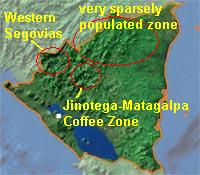 regions: the western Segovias and the
Matagalpa-Jinotega highlands. Much of what made a
protracted campesino rebellion in Las Segovias possible
derived from the safe refuge rebels found in Honduras to
the north and in the expansive tropical forests to the
east. The western Segovias, bordering Honduras,
was dominated politically and economically by a tiny
entrenched landowning elite residing in some two dozen
small towns, while the countryside was dominated by
scores of elite-owned haciendas, coffee farms, and
cattle ranches. The great majority of the
population, politically and socially subordinate,
resided in nearly a dozen disintegrating Indian
communities and hundreds of dispersed,
subsistence-oriented villages and hamlets. To the
south and east, the Jinotega-Matagalpa highlands
exhibited similar features, without the adjacent
international border but with a vast, virtually
uninhabited tropical forest on its eastern frontier, and
a more recently established native Nicaraguan and
foreign coffee elite employing seasonal wage labor on
large coffee plantations. (For detailed map of the
Western Segovias, click
regions: the western Segovias and the
Matagalpa-Jinotega highlands. Much of what made a
protracted campesino rebellion in Las Segovias possible
derived from the safe refuge rebels found in Honduras to
the north and in the expansive tropical forests to the
east. The western Segovias, bordering Honduras,
was dominated politically and economically by a tiny
entrenched landowning elite residing in some two dozen
small towns, while the countryside was dominated by
scores of elite-owned haciendas, coffee farms, and
cattle ranches. The great majority of the
population, politically and socially subordinate,
resided in nearly a dozen disintegrating Indian
communities and hundreds of dispersed,
subsistence-oriented villages and hamlets. To the
south and east, the Jinotega-Matagalpa highlands
exhibited similar features, without the adjacent
international border but with a vast, virtually
uninhabited tropical forest on its eastern frontier, and
a more recently established native Nicaraguan and
foreign coffee elite employing seasonal wage labor on
large coffee plantations. (For detailed map of the
Western Segovias, click
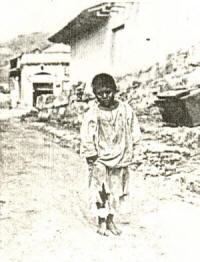 Spanish and Indian ancestry), Las
Segovias had only tenuous links to the national state
based in Managua. With functional literacy rates
at around 10%, the region had an overwhelmingly oral
culture. As elsewhere in Nicaragua, the political
economy was dominated by a very small class of
town-based, mostly white-skinned landowners and
political power-holders. The great majority of the
region's darker-skinned inhabitants toiled in
agriculture as smallholders, tenants, sharecroppers,
squatters, day laborers, and seasonal wage laborers in
the growing coffee and mining economies. The
partial and uneven growth of mining, coffee production,
commerce, and markets in the half century after 1870 led
to the emergence of a sizeable "middling" class of small
ranchers and coffee farmers, professionals, artisans,
traders, storeowners, mule drivers, telegraph operators,
and the like, comprising around 10-15% of the
population. By the 1920s this heterogeneous
middling class occupied the interstices of the region's
caste-like race-class hierarchy.
Spanish and Indian ancestry), Las
Segovias had only tenuous links to the national state
based in Managua. With functional literacy rates
at around 10%, the region had an overwhelmingly oral
culture. As elsewhere in Nicaragua, the political
economy was dominated by a very small class of
town-based, mostly white-skinned landowners and
political power-holders. The great majority of the
region's darker-skinned inhabitants toiled in
agriculture as smallholders, tenants, sharecroppers,
squatters, day laborers, and seasonal wage laborers in
the growing coffee and mining economies. The
partial and uneven growth of mining, coffee production,
commerce, and markets in the half century after 1870 led
to the emergence of a sizeable "middling" class of small
ranchers and coffee farmers, professionals, artisans,
traders, storeowners, mule drivers, telegraph operators,
and the like, comprising around 10-15% of the
population. By the 1920s this heterogeneous
middling class occupied the interstices of the region's
caste-like race-class hierarchy.