|
QUICK LINKS TO PREVIOUS & NEXT PC-DOCS
27.11.12 HARBAUGH
27.11.13 CRUM
27.11.14 DARNELL
27.11.19 WELLS
27.11.20 BELLINGER
27.11.26 KEIMLING
27.12.06 PEARD
|
|
27.11.19. Wells, Patrol from
Ocotal to Las Manos, Honduras & Return
|
|
P C - D O C S :
P A T R O L & C
O M B A T R E P O R T
S |
|
thru 1927 |
1928 |
1929 |
1930 |
1931 |
1932 |
1933 + |
|
1
|
2
|
3
|
4
|
5
|
6
|
7
|
8
|
9
|
10
|
11
|
12
|
|
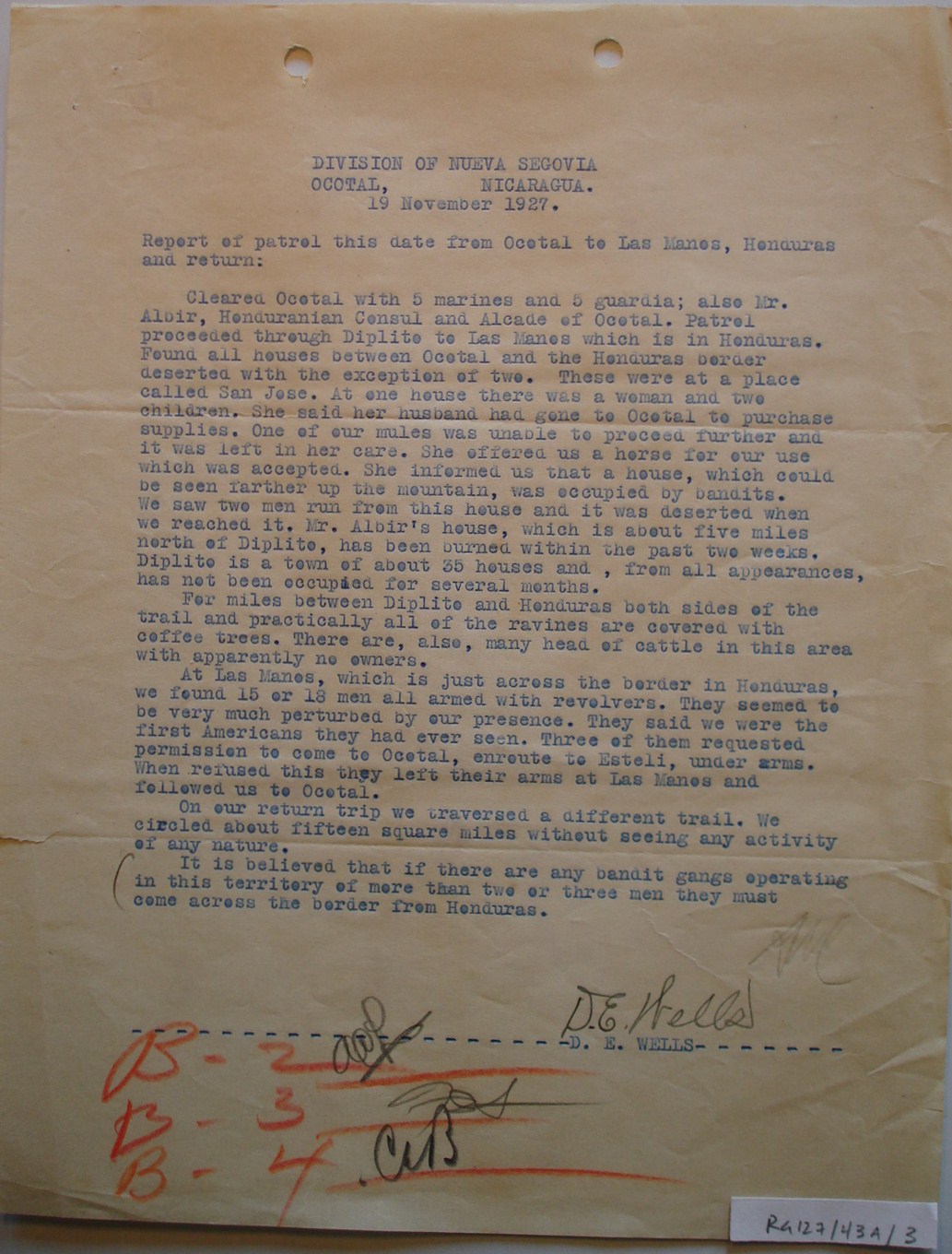
DIVISION OF NUEVA SEGOVIA
OCOTAL, NICARAGUA
19 November 1927.
 Report
of patrol this date from Ocotal to Las
Manos, Honduras and return: Report
of patrol this date from Ocotal to Las
Manos, Honduras and return:
Cleared Ocotal with 5 marines and 5 guardia; also Mr.
Albir, Honduranian Consul and Alcalde of
Ocotal. Patrol proceeded through Dipilto
to Las Manos which is in Honduras. Found
all houses between Ocotal and the
Honduras border deserted with the
exception of two. These were at a place
called San Jose. At one house there was
a woman and two children. She said her
husband had gone to Ocotal to purchase
supplies. One of our mules was unable to
proceed further and it was left in her
care. She offered us a horse for our use
which was accepted. She informed us that
a house, which could be seen farther up
the mountain, was occupied by bandits.
We saw two men run from this house and
it was deserted when we reached it. Mr.
Albir's house, which is about five miles
north of Dipilto, has been burned within
the past two weeks. Dipilto is a town of
about 35 houses and, from all
appearances, has not been occupied for
several months.
For many miles between Dipilto and
Honduras both sides of the trail and
practically all of the ravines are
covered with coffee trees. There are,
also, many head of cattle in this area
with apparently no owners.
At Las Manos, which is just across the border in
Honduras, we found 15 or 18 men all
armed with revolvers. They seemed to be
very much perturbed by our presence.
They said we were the first Americans
they had ever seen. Three of them
requested permission to come to Ocotal,
enroute to Esteli, under arms. When
refused this they left their arms at Las
Manos and followed us to Ocotal.
On our return trip we traversed a
different trail. We circled about
fifteen square miles without seeing any
activity of any nature.
It is believed that if there are any bandit gangs
operating in this territory of more than
two or three men they must come across
the border from Honduras.
- - - - - - - -- - - /s/ D. E. WELLS - -
- - - - - - -
127/43A/3
|
|
|
Summary & Notes:
•
Report used to open my "Sandino
Rebellion Revisited"
chapter in the Duke volume (1998):
these four groups of actors & the manner of
their
interactions used as allegories for the four
major social processes transforming Nicaragua
during this period: the US Marines
(imperialist intervention); the Guardia Nacional
(state formation); the "bandits" they stumbled
into (continuing civil war between Liberals
& Conservatives); and the EDSN
(popular nationalism; the episode's
invisible presence and why Marines were
mucking around in Las Segovias to begin with).
•
Report even more complex & layered than my
analysis in the above chapter suggests:
•
Woman warns patrol & lends them her horse
(fluidity of identities and allegiances).
•
Mr. Albir's straddling of national
boundaries (ambiguities of identities in the
borderlands).
•
Burning of Mr. Albir's house (continuing
violence & property destruction after the
Civil War).
•
Coffee trees and roaming cattle (emergent
capitalist economy meshed with older
pre-capitalist one).
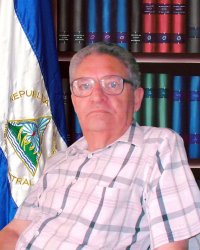 •
Postscript: According to
Jinotega historian & folklorist Eddy Kühl,
USMC Lieutnant D. Earl Wells later married
Jinotega native Anita Möller, daughter of
German-born merchant Paul Möller.
Anita Möller-Wells died around 2008; D. Earl
Wells died many years before. They had
three children: Freddy, Harvey and
Yves Wells Möller. The photo to the
right is of Harvey Wells Möller, historian,
author, linguist, and "one of the finest and
most cultivated people of Jinotega's latest
decades," in the words of Jinotega native E.
Arturo Castro-Frenzel. As of August
2012, Freddy and Yves were still alive,
Freddy living in Matagalpa and Yves in
Jinotega. An obituary of Harvey Wells
was published in Nuevo Diario in 2009:
http://archivo.elnuevodiario.com.ni/2009/03/28/nacionales/98533.
I thank E. Arturo Castro-Frenzel for this
information. •
Postscript: According to
Jinotega historian & folklorist Eddy Kühl,
USMC Lieutnant D. Earl Wells later married
Jinotega native Anita Möller, daughter of
German-born merchant Paul Möller.
Anita Möller-Wells died around 2008; D. Earl
Wells died many years before. They had
three children: Freddy, Harvey and
Yves Wells Möller. The photo to the
right is of Harvey Wells Möller, historian,
author, linguist, and "one of the finest and
most cultivated people of Jinotega's latest
decades," in the words of Jinotega native E.
Arturo Castro-Frenzel. As of August
2012, Freddy and Yves were still alive,
Freddy living in Matagalpa and Yves in
Jinotega. An obituary of Harvey Wells
was published in Nuevo Diario in 2009:
http://archivo.elnuevodiario.com.ni/2009/03/28/nacionales/98533.
I thank E. Arturo Castro-Frenzel for this
information.
|
|
P C - D O C S :
P A T R O L & C
O M B A T R E P O R T S |
|
thru 1927 |
1928 |
1929 |
1930 |
1931 |
1932 |
1933 + |
|
1
|
2
|
3
|
4
|
5
|
6
|
7
|
8
|
9
|
10
|
11
|
12
|
TOP OF PAGE
|
|