|
 ThE
BORDER WAS CRUCIAL to just about everything
being described in these pages. The imaginary line
between the nation-states of Honduras and Nicaragua
warped political & jurisdictional spaces in all kinds of
important &
interesting ways, creating diverse sets of constraints &
opportunities for everyone residing on either side of
it. Smugglers, outlaws & rebels generally found
the border very useful. Migrants, traders &
ordinary people usually ignored it. National
armies &
national governments often found it a major nuisance, because
their authority to impose the rule of law ended at the
border. ThE
BORDER WAS CRUCIAL to just about everything
being described in these pages. The imaginary line
between the nation-states of Honduras and Nicaragua
warped political & jurisdictional spaces in all kinds of
important &
interesting ways, creating diverse sets of constraints &
opportunities for everyone residing on either side of
it. Smugglers, outlaws & rebels generally found
the border very useful. Migrants, traders &
ordinary people usually ignored it. National
armies &
national governments often found it a major nuisance, because
their authority to impose the rule of law ended at the
border.
The border also created a
borderlands
—
not unlike other borderlands zones around the world,
such as the US-Mexico borderlands
—
a unique cultural &
political space created by the very existence of a
fixed line on the earth separating two sovereign nation-states.
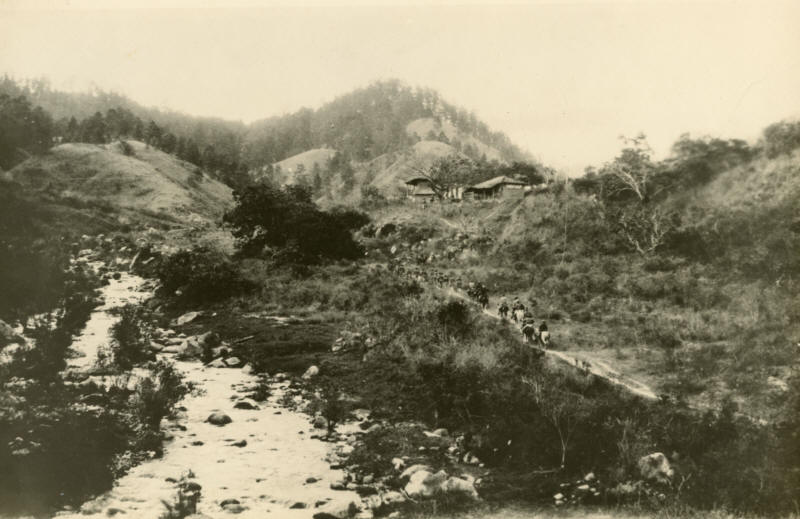
(Photo below: Marines on patrol approaching Paredes near the
Honduran border, late 1928, George C. Stockes papers,
Marine Corps Research Center, Quantico VA)
|
LA FRONTERA FUE CRUCIAL para
todo lo descrito en estas páginas.
La línea imaginaria entre las estados-nación de
Honduras y Nicaragua se deformaba creando
interesantes e importantes espacios políticos y
jurisdiccionales de todo tipo, además de
diversos conjuntos de constreñimientos y
oportunidades para todo aquél que residiera en
uno y otro lado de la frontera. Generalmente ladrones, forajidos
y rebeldes encontraban la frontera de mucha
utilidad. Los migrantes, comerciantes y la gente
común la ignoraban. Los ejércitos y gobiernos de
ambas naciones la consideraban una molestia
debido a que su autoridad para imponer orden
terminaba precisamente en la frontera.
La frontera también facilitó la creación
de una zona fronteriza
— no muy diferente a las zonas fronterizas
existentes alrededor del mundo, tal como la zona
fronteriza entre Estados Unidos y México — en
las cuales prevalecía un ambiente político y
cultural particular, creado gracias a la
existencia misma de una línea fijada en la
tierra que
separa a dos naciones soberanas. (Foto
abajo: una patrulla de marinos acercándose a
Paredes, cerca de la frontera hondureña a
finales de 1928, documentos de George C.
Stockes, Centro de Investigación de la
Infantería de Marina, Quantico VA)
|
|
This is the
homepage for evidence &
documents relating
to Honduras and the Nicaragua-Honduras borderlands in
the 19th & 20th centuries, focusing on the 15 or so
years from the Honduran Civil War of 1919 to the firm
consolidation of the dictatorial regimes of Anastasio
Somoza García in Nicaragua and
Tiburcio Carías Andino in Honduras in the mid-1930s.
Right now there are four links:
1. A big page containing
120 documents from a variety of sources, titled
The Segovian Borderlands, 1919-1926: Military
Mobilization, Political Struggle, and Social Conditions.
2. A
draft paper titled
The Vexatious Frontier Question: Capital, Coercion, and
Sovereignty in the Western Nicaragua-Honduras
Borderlands, 1919-1936
(MS-Word file). Presented at
the January 2008 annual meeting of the Conference on
Latin American History in Washington and
in March 2009 at the annual conference of the Middle
Atlantic Council of Latin American Studies (MACLAS). The paper sketches the dynamics of
Segovian borderlands history, society & culture during
this period & represents a kind of rough
draft for a journal article.
3.
An
Excel file that accompanies the
paper that maps out (by month) episodes of borderlands
military mobilization and political unrest from 1919 to
1936, along with periods of US intervention in both
countries and who & what political party controlled
which state apparatus in Nicaragua & Honduras.
4.
Link to the authoritative if
conventional,
Tim
Merrill, ed., Honduras: A Country Study, Honduras
(1995).
For maps
of the borderlands, see
PHOTO-DOCS
> MAPS.
Grateful acknowledgements
are extended to Sra. Lorena Torres of T-Vox México
for her assistance with translation.
|
Esta es la página
principal de los documentos y evidencia
relacionados con Honduras y su frontera con Nicaragua
durante los siglos XIX y XX, centrándose en los 15 o más
años de la guerra civil hondureña de 1919 hasta la
consolidación del régimen dictatorial de Anastasio
Somoza García en Nicaragua y Tiburcio Carias Andino en
Honduras a mediados de la década de 1930.
Actualmente existen cuatro vínculos:
1. Una página grande
que contiene 120 documentos de una variedad de fuentes,
titulada
La frontera
de Segovia, 1919-1923: Movilización militar, lucha
política y condiciones sociales.
2. Un borrador titulado
La penosa situación fronteriza: Capital, coerción y
soberanía en la frontera occidental entre Nicaragua y
Honduras, 1919-1936 (Archivo de Word).
Presentado en la reunión anual de Conference on Latin
American History (CLAH) en enero de 2008
en Washington y en marzo de 2009 en la conferencia del
Middle Atlantic Council on Latin American Studies (MACLAS).
El borrador bosqueja la dinámica de la historia,
sociedad y cultura en la zona fronteriza de las Segovias
durante este periodo y constituye un tipo de
borrador de un artículo de revista.
3. Un
archivo de Excel que acompaña al
borrador que esquematiza (por mes) episodios de la
movilización militar en la zona fronteriza y la
incertidumbre política vivida entre 1919 y 1936, junto
con los periodos de intervención estadounidense en ambos
países y los integrantes de qué partido político
controlaron cada aparato gubernamental en Nicaragua y
Honduras.
4. Enlace a la obra autoritario si convencional,
Tim
Merrill, ed., Honduras: A Country Study, Honduras
(1995).
Para mapas
de la zona fronteriza, ver
PHOTO-DOCS
> MAPS.
Se extiende
agradecimiento a Sra. Lorena Torres de T-Vox México
por su ayuda con la traducción.
|