|
QUICK LINKS TO PREVIOUS & NEXT PC-DOCS
24.02.18 BOURKE
24,03,24 BIRNBAUMER
27.05.19 CHAPPELL
27.06.07 SWANSON
27.06.22 RICHAL
27.07.16 HATFIELD
27.07.20 HATFIELD
|
|
24.02.18. Birnbaumer,
Marines in Nicaragua, 1924 (The
Leatherneck, March 1928)
|
|
P C - D O C S :
P A T R O L & C
O M B A T R E P O R T
S |
|
thru 1927 |
1928 |
1929 |
1930 |
1931 |
1932 |
1933 + |
|
1
|
2
|
3
|
4
|
5
|
6
|
7
|
8
|
9
|
10
|
11
|
12
|
|
 This account of a month-long US Marine
expedition through the war-torn
Segovian-Honduran borderlands in February-March
1924 offers a fuller account of the expedition
described in Lt. Bourke's official report of 18
Feb. 1924, above. This is not an official
report. It takes the form of a long
descriptive letter from USMC Sergeant F. F.
Birnbaumer to his "sidekick" describing his
just-completed 500-mile journey. It was
published four years later in the semi-official
Marine Corps magazine The Leatherneck
(March 1928, pp. 7-8, with two photos).
The article offers a fascinating portrait of
political and social conditions in the
borderlands from the perspective of a
plainspoken Marine sergeant and his fellow
grunts. Paragraphs are numbered for easier
reference.
This account of a month-long US Marine
expedition through the war-torn
Segovian-Honduran borderlands in February-March
1924 offers a fuller account of the expedition
described in Lt. Bourke's official report of 18
Feb. 1924, above. This is not an official
report. It takes the form of a long
descriptive letter from USMC Sergeant F. F.
Birnbaumer to his "sidekick" describing his
just-completed 500-mile journey. It was
published four years later in the semi-official
Marine Corps magazine The Leatherneck
(March 1928, pp. 7-8, with two photos).
The article offers a fascinating portrait of
political and social conditions in the
borderlands from the perspective of a
plainspoken Marine sergeant and his fellow
grunts. Paragraphs are numbered for easier
reference.
Este informe de una expedición Marina
norteamericana, de duración de un mes
en el febrero-marzo del ano 1924 a través de la
fronteriza Segoviana-Hondureña devastada por la
guerra, ofrece una relación más completa sobre
la expedición descrito por Bourke en el anterior
informe oficial, también de febrero de 1924.
Este no es un informe oficial. Toma la
forma de una larga carta descriptiva del
Sargento de los Marinos, F. F. Birnbaumer, a su
"compinche" describiendo su recién concluido
viaje de 500 millas. Se publicó cuatro
años más tarde en la revista semi-oficial del
Cuerpo de Infantería de Marina, Leatherneck
(1928 Marzo, págs. 7-8, con dos
fotografías). El artículo ofrece un
retrato fascinante de las condiciones políticas
y sociales en la zona fronteriza desde la
perspectiva de un franco Sargento Marino y sus
colegas gruñidos. Los párrafos están
numeradas para facilitar la referencia.
Note: Many
thanks to Ms. Linda Pudder for her
translation of this article. |
Nota: Muchas
gracias a Sra. Linda Pudder por su
traducción de este artículo.
|
|
T R A N
S C R I P
T I O N
|
|
|
Marines in
Nicaragua, 1924 |
1 |
In the
belief that some Leathernecks now serving in Nicaragua
will be relieved to learn that Nicaragua jungle ticks
and other insects may nibble gleefully, and yet leave
but little scars to stamp their memory on passing years,
an incident of yesteryear is recalled.
Managua, Nicaragua,
March
24, 1924.
Dear
Sidekick,
Hooray! Just finished scrubbing the last of the
cooties off of myself.
|
|
2 |
You have doubtless heard something of the
revolution which has been going on in Honduras
in a half-hearted fashion since last November.
I'm still getting quite a kick out of the
thought of Central American "Generals." We
were informed, while in Honduras, by a "general"
himself that there are thirty-six of them today
in that country.
|
|
3 |
Four other marines and myself, together with an
interpreter, have been following on the trail of
that revolution in both Honduras and Nicaragua
for the past month. A radio from the State
Department started it all off; that is, our end
of the deal. Quite a number of Marines here
volunteered for the trip, as it promised to be
quite a novelty for the local detachment.
Most of the Marines in camp would have been glad
to have gone, even though everyone knew it meant
hard riding, miserable food, not a great amount
of even bad water, and sometimes very little
sleep, but then look at the fun we'd have, to
which some other member of the party would
answer, "Oh, yes."
|
|
4 |
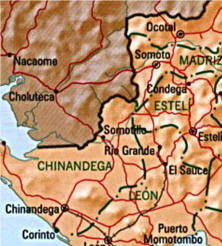
Break out your little map of Central America and
follow the "rosebud" trail that we covered on
burros. Leon, Chinandega, Punte Real,
Somotillo., St. Thomas, San Pedro, San
Francisco, Cacamuya gold mines, San Marcos de
Colon, Oyote, El Tamarindo, Somoto Grande,
Macuelizo, Las Limas, Los Manos, Ocotal, back to
Cacamuya mines by way of Somoto Grande and San
Marcos, back over the same run in the order
above named, finally back to Cacamuya and then
home again through Chinandega and Leon, a total
distance of five hundred or more miles covered,
over the roughest trails imaginable.
|
|
5 |
At two p.m. the five of us set out under orders on a handcar to Chinandega, a
station between Nicaragua and Corinto on the Ferrocarril del Pacifico de
Nicaragua. Chinandega was reached that night and we had to lay over until
the following evening getting horses and a guide. After much difficulty we
secured both mounts and an Indian guide and set out that evening for Somotillo,
near the Honduran-Nicaraguan border. All night was spent in the saddle in
the worst dust I had ever experienced. In many places it was several feet
deep in the sunken trail, a soft, white pulverized dust. The air in the
vicinity of the road was so filled with this dust that sight was difficult.
We tied handkerchiefs over our noses to keep from suffocating and even then the
fine dust sifted through and caused nose-bleed. Morning found us at Puente
Real (Royal Bridge). He was indeed a euphemist who gave that bridge its
name; a rickety bamboo span over a syrupy little stream, bordered on either side
with mud flats. To add insult to injury a toll of 15 cents per person and
five cents per animal is charged. Here we left the dust behind and all
hands felt like shouting for glee. We soon passed into a cactus and thorn
forest, quite a novelty, and all day we rode through a blazing sun, stopping
only for a few minutes to rest the horses. We had had no food, water or
sleep since leaving Chinandega the night before and some of us were beginning to
get a "little hungry." About five miles out of Somotillo my horse fell
over and proceeded to die, and I had the pleasure of hiking the remaining miles,
feeling none too pugnacious. My saddle and equipment was taken care of by
another of our party. Two other members of the party soon had to dismount
and lead, or rather drag their horses, the remainder of the way.
|
|
6 |
Somotillo was finally reached; how nice.
We chased the nearly naked wash-women out of the
only waterhole and drank deep. We still had four
or five cans of "willie" and beans and that was
reinforced with tortillas (pronounced
tor-tee-as). All this went down as if by
magic and everyone admitted we felt better.
Back we went and chased the dusky maidens out of
the waterhole again and went swimming.
|
|
7 |
The next day three of us made a side trip to the
border at St. Thomas, which was garrisoned by
Nicaraguan troops. We were received with
friendly demonstration and treated to our first
real native dinner of tortillas, stale meat and
very old eggs. Food here in these
foothills is not especially appetizing, and
particularly now during this revolution.
|
|
|
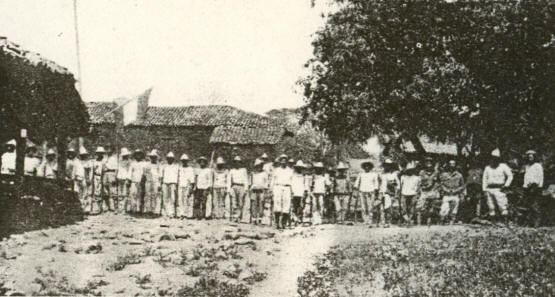
U. S.
Marines with Nicaraguan Soldiers at St. Thomas,
Nicaragua, February 1924
|
|
8 |
There is very little revolution, but lots of
plundering. The tortillas here are made
from the poor, stale, worm earthen corn, ground
wet and baked into a thin leathery pancake,
without any seasoning whatever. Meat is
hung up in the sun, but doesn't dry, for the
flies get to it first and the maggots next.
That little fact doesn't bother the natives
though. They nonchalantly knock the worms
off with a stick, throw the meat on a hot coal,
and presto, you have a nice juicy barbecue.
The eggs, they're good though! It
sometimes takes several days to find the nest,
and then the eggs are buried in straw for a
couple of weeks or months maybe. They come
out rather peculiar looking--maybe they are a
little "rotten." The most prized food here
is the birdlike, tough, fighting stock chicken.
Once captured, it is sort of cleaned and boiled
for about fifteen or twenty minutes. This
culinary process sets the flesh and makes it a
little less palatable. Then it is served
in its entirety on a palm leaf. These
people use palm leaves for plates when they
aren't too lazy to cut them. Knives,
forks, spoons, cups and saucers are unheard of.
The good old human hand fulfills all those
purposes and gourds make ideal cups. Of
course, the menfolk do use knives, the kind they
carry around with them and use to chop down
trees, kill wild beasts, and other men.
They are about four feet long, with a five-inch
blade, weigh about three pounds, and bear the
label "Collins" if they are the fashionable
kind. These make fairly good table knives.
I noticed one fellow use one to put a bit of
whey on a small cornmeal cake. In the
States the farmers call these things corn
knives, but here they are machettes.
|
|
9 |
We stayed in St. Thomas only a few hours and
returned to Somotillo, having covered about
forty miles, a big day's work with poor horses,
and our horses were always poor.
|
|
10 |
Another day was spent in hustling horses again.
In the afternoon we set out for San Pedro, still
higher in the hills and toward the Northeast.
We finished the last of our camp provisions and
dropped all equipment except a blanket and a
saddle bag. We could not carry either food
or more equipment on account of the poor horses
and the increasingly bad trails. We camped
in the hills that night and enjoyed a little
coffee and also the ticks, fleas, mosquitoes and
such little inconveniences. San Pedro,
garrisoned by Nicaraguan troops, was reached by
noon of the following day, and another native
dinner of tortillas and eggs was enjoyed by us.
In fact, we lived entirely on native grub for
over twenty days and none of us died, although
the MO. did treat me to a lot of emetin on my
return to camp. Somotillo, St. Thomas and
San Pedro were barracks towns with only a few
miserable huts, greatly overcrowded. At
San Pedro we obtained burros instead of horses,
better fitted for hill work and tougher than
horses, even on the rider. Every time I
see a burro now I want to walk up to him and
punch him on the nose and pull his ears.
We camped on a ledge that night and by noon next
day reached the Cacamuya Gold Mines, managed by
an American by the name of Samuelson. We
got real food there and how we made his Mex cook
put out the chow, and we got a bath, too, and
everyone took his first shave in a week.
We all appeared much less ferocious with the
hair off. We hated to leave Cacamuya a day
and a half later, but had to go on to San Marcos
de Colon, the headquarters of the Honduran
Government troops. There had been a young
battle there a week before and the houses were
pretty well sprayed with bullet holes. We
stayed no longer than it was necessary at San
Marcos, and proceeded on to El Tamarindo where
we met General Funez with his wing of the
revolutionary army.
|
|
|
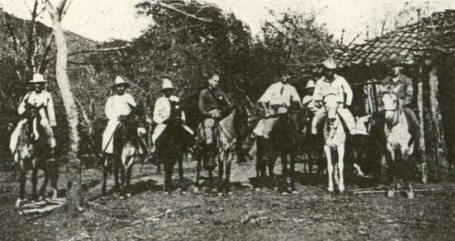
Gunnery Sgt. Bruce, Rene Wallace, Black Chief
and Small Detachment, 1924
|
|
11 |
The soldiers here on both sides were mostly
Indians, barefooted, with no uniforms except a
ribbon for the hat to designate their politics.
All the troops wore large straw sombreros,
trousers, but no shirts or shoes, and all looked
like ancient pirates. They were armed with
machettes, old 1884 single-shot Remingtons and
old 7 and 11-mm Austrian Mauser rifles, useful
as clubs but nothing else.
|
|
12 |
All of the troops were almost starved and have
killed off all the live stock in the country.
While we were in the general's hut a bunch of
soldiers chased a young heifer right up in front
of the hut and hacked its head off with a
machette. They did not trouble to skin it,
but just laid it open and each man fought to get
a chunk of meat. Then each man ran off to
himself and built a tiny fire to cook his piece.
Some of the meat was eaten raw. We were
glad to get away from the filth of this place.
|
|
13 |
Our guide led us astray during the night and
lost us in a dry river bed where we were forced
to camp until morning, and finally got on the
right trail to Somoto Grande. It will be
noted that we were traveling in Northeastward,
part of the time in Honduras and part of the
time in Nicaragua. Somoto was reached
without further event and three of us left the
following day for Honduras again.
|
|
14 |
We were again led astray by a poor guide, who
led us off the right trail and into a jungle of
underbrush and bull nettles. Macuelizo was
reached late that night after a long, hot,
tiresome ride on the mules.
|
|
15 |
Macuelizo is a tiny village hidden away in a
bowl shaped valley well up in the mountain
ridge. The inhabitants are simple,
religious folk who seldom venture more than
twenty miles from their homes.
|
|
16 |
Las Limas, the highest mountain, most
inaccessible, and just inside Honduras, was
reached by noon of the next day. Here
General Carias, the big chief of the
revolutionist cause, and the would-be president
of Honduras, had established his headquarters.
|
|
17 |
Carias
proved to be a man of good education and was
surrounded by staff officers of good mentality.
We also met several Americans here, officers in
the revolutionist army and soldiers of fortune.
The food here was even worse than previously
experienced on account of the large number of
soldiers here and all supplies are obtained
locally, there being no such thing as a base of
supplies. The next day we reached Las
Manos and spent the night. We nearly froze
that night as we were high up and the air was
very cold. It was so cold that we were
able to see our breath until about nine o'clock
the next morning, before the sun came out bright
and warm enough to thaw us out.
|
|
18 |
Our
southward trip from here to Ocotal and then back
to Somoto Grande was made through a beautiful
country, pierced by many mountain streams of
clear, cold water, and covered with dense pine
forests which filled the air with heavy pine
fragrance as is sometimes experienced in passing
through our own southern pine belt. One
man was left behind in Ocotal and the other two
joined us at Somoto Grande, but departed the
following day for Managua by way of the high
road to Leon, and the remaining three of us
returned to San Marcos, where it was rumored
another battle was soon to take place. We
stayed here three days awaiting developments and
then returned to Cacamuya Mines.
|
|
19 |
I
remained behind at Cacamuya and the remaining
Marine and the interpreter shoved off the next
morning for San Marcos again, then to Somoto
Grande and return to Cacamuya, which trip was
made in three days of hard traveling. It
was while at Cacamuya that news leaked through
of the landing of about two hundred sailors and
Marines on the North Coast of Honduras and their
occupation of Tegucigalpa.
|
|
20 |
Orders
were received to return to Managua, and we
journeyed homeward through San Pedro, Somotillo,
Puente Real, Chinandega, and then by train to
Managua. The return trip from Somotillo to
Chinandega, a distance of about sixty miles, was
again made at night to avoid the heat. We
rode for about an hour out of Puente Real
through the thick dust, and then, it started to
rain, the first of the season, and how it did
rain! It came down in waves and blasts.
The trail turned into a churned sea of mud and
water and the dust on the horses and ourselves
turned to muddy streaks, giving us a desperate
appearance. Several of the party had
purchased native undergarments, which come in
bright blues, reds and stripes. These
garments usually bleach white after a couple of
washings, so when the soaking rain hit us they
lost color so rapidly that one Marine, dressed
in a bright red garment, presented some
appearances of being wounded, and the color did
not fade nearly so quickly from the skin as from
the garment. The horses became frightened
at the unusual amount of swirling water in the
sunken trail, which was three feet deep in
places, and stumbled and wallowed about throwing
one man and covering all of us with mud.
|
|
21 |
We presented a most
sorry spectacle upon our arrival at Chinandega the next
day, but the following afternoon, when we arrived in
Managua once more, we were quite ourselves again, and
then after the first big chow someone said, "Just look
at the fun we had," to which all hands answered, "Uh
Huh."
|
|
|
The Leatherneck, March 1928, pp. 7-8
|
|
|
Los Marinos en
Nicaragua, 1924 |
|
1 |
EN EL CONVENCIMIENTO DE QUE ALGUNOS Leathernecks
sirviendo actualmente en Nicaragua se
desahogarán de saber que las garrapatas y otros
insectos de la selva se pueden picar a uno
jubilosamente, y sin embargo dejan sino pocos
cicatrices sellados en la memoria de los años
pasando, un incidente de antaño se recuerda.
Managua, Nicaragua,
24 de Marzo de 1924.
Estimado Compinche,
¡Hurra! Acabo de terminar de lavarme bien de los últimos
piojos.
|
|
2 |
Sin duda ha escuchado algo de la revolución que
se viene realizando en Honduras en medio de
manera entusiasta desde el pasado mes de
noviembre. Todavía me da una risa al pensar de
“Los Generales” de Centro América. Mientras que
estábamos en Honduras, un propio "General" nos
informó que hay treinta y seis de ellos en ese
país hoy en día.
|
|
3 |
Otros cuatro infantes de Marina y yo, junto con
un intérprete, llevamos siguiendo el rastro de
esa revolución en Honduras y en Nicaragua
durante este último mes. Una radiocomunicación
del Departamento de Estado empezó todo; es
decir, nuestra parte del trato. Un buen número
de infantes aquí se ofrecieron como voluntarios
para el viaje, ya que prometía ser una novedad
para el destacamento local. La mayoría de los
Marinos en el campamento habrían tenido el
placer de haber ido, aunque todo el mundo sabíaa
que significaba viajes a caballo difíciles,
comida miserable, ni siquiera mala agua en gran
cantidad, y a veces dormir muy poco, pero a ver
cuanto nos divertiríamos, a lo cual uno de los
otros miembros del grupo respondería, "Aj, sí".
|
|
4 |
Sáquele el mapita de América Central y siga el
camino "capullo de rosa" que recorrimos en
burro. Leon, Chinandega, Puente Real, Somotillo,
Sto. Thomas, San Pedro, San Francisco, Las Minas
de Oro Cacamuya , San Marcos de Colón, Oyote, El
Tamarindo, Somoto Grande, Macuelizo, Las Limas,
Las Manos, Ocotal, de vuelta a las minas
Cacamuya por Somoto Grande y San Marcos, a
repetir el mismo recorrido en el orden
mencionado anteriormente, finalmente de vuelta a
Cacamuya y luego a casa otra vez por Chinandega
y León, con una distancia total de más de
quinientas millas recorridas, a lo largo de los
caminos más difíciles imaginables.
|
|
5 |
A las dos de la tarde los cinco de nosotros,
bajo las órdenes, salimos en una vagoneta manual
para Chinandega, una estación entre Nicaragua y
Corinto en el Ferrocarril del Pacífico de
Nicaragua. Esa noche alcanzamos Chinandega y
tuvimos que quedarnos hasta la siguiente noche
organizando caballos y un guía. Tras muchas
dificultades conseguimos ambos montajes y un
guía indio y por la noche salimos para
Somotillo, situado cerca de la frontera
hondureña-nicaragüense. Pasamos toda la noche en
la silla en el peor polvo que jamás había
experimentado. En muchos lugares del camino
hundido de varios pies de profundidad, había un
suave, blanco polvo pulverizado. El aire en las
cercanías de la carretera estaba tan lleno de
este polvo que para ver fue difícil. Nos atamos
pañuelos para tapar las narices y evitar el
riesgo de asfixia y, aun el polvo fino pasó
tamizado resultando en hemorragias nasales. La
mañana nos encontró en el Puente Real (traducido
Puente Regio). El que le dio nombre a ese puente
era una experta a los eufemismos; una extensión
desvencijado de bambú tendido encima de un
quebradito almibarado, que limita a ambos lados
con pisos de lodo. Para colmo, un peaje de 15
céntimos por persona y cinco centavos por animal
se paga. Aquí dejamos el polvo detrás y todo el
mundo tenían ganas de gritarse jubilosamente.
Pronto pasamos por un bosque de cactus y espina,
una novedad bastante, y durante todo el día
andamos bajo un sol abrasador, parando solo un
par de minutos para que se descansaran los
caballos. No habíamos comido, bebido ni dormido
desde que salimos de Chinandega la noche
anterior y algunos de nosotros empezábamos a
tener un "poco de hambre." A cinco millas más o
menos de Somotillo mi caballo se cayó y procedió
a morir, y yo tuve el placer de ir a pie el
resto del camino, sintiéndome nada pugnaz. Otro
de nuestro grupo se llevó mi montura y equipo.
Otros dos miembros del grupo pronto tuvieron que
desmontar y llevar, o más bien arrastrar sus
caballos, el resto del camino.
|
|
6 |
Finalmente llegamos a Somotillo; qué bonito.
Corrimos a las lavanderas casi desnudas del
único ojo de agua y bebimos profundamente.
Todavía nos quedaban cuatro o cinco latas de
"chorizo" y frijoles que se reforzaron con
tortillas (se pronuncia tor-ti-ya). La comida se
bajó como por arte de magia y todos admitimos
que nos sentíamos mejor. Fuimos de vuelta al ojo
de agua y volvimos a correr a las doncellas
oscuras de la charca y después nos bañamos.
|
|
7 |
El día siguiente tres de nosotros hicimos una
excursión a la frontera, a Santo Thomas un
guarnición de tropas nicaragüenses. Nos
recibieron con una demostración amistosa y nos
trataron a nuestra primera cena nativa autentica
de tortillas, carne rancia y huevos pasados. La
comida aquí en estas colinas no es especialmente
apetecible, y sobre todo ahora durante esta
revolución.
|
|
|
Marinos
norteamericanos con soldados nicaragüenses en
Santo Tomás, Nicaragua, febrero de 1924
|
|
8 |
Hay muy poca revolución, pero hay un montón de
saqueo. Las tortillas están hechas de maíz
pobre, rancio, de barro de gusano, y molido
húmedo para hacer un fino panqueque correoso sin
condimentos ningunos. Carne está colgado en el
sol pero no se seca, ya que las moscas llegan
primeras y después la cresa. Este detallito no
importa a los nativos. Con un aire despreocupado
ellos quitan los gusanos con un palo, tira la
carne al carbón, y presto, allí tiene un buen
asado jugoso. Pero los huevos, si que están
bien! A veces se necesita varios días para
hallar el nido, y los huevos estarán bien
tapados de paja durante un par de semanas o
meses tal vez. Salen bastante peculiar - quizás
estén un poco "podrido." Una de las comidas más
preciadas aquí es la gallina dura, de buen
linaje luchador. Una vez capturado, se limpia,
más o menos, y se pone a hervir durante unos
quince o veinte minutos. Este proceso culinario
establece la carne y le hace un poco menos
comible. Luego se sirve en su totalidad en una
hoja de palmera. Esta gente utiliza las hojas de
palmera como platos cuando no está demasiado
perezosa para cortarlas. Cuchillos, tenedores,
cucharas, tazas y platillos son desconocidos. La
fiel mano humana cumple con todos esos objetivos
y calabazas hacen tazas ideales. Por supuesto,
los hombres utilizan cuchillas, el tipo que se
lleva siempre y se utiliza para cortar árboles,
matar bestias salvajes, y a otros hombres. Miden
alrededor de cuatro pies de largo, con cinco
pulgadas de hoja, pesan aproximadamente tres
libras, y llevan la marca de "Collins" si sean
el tipo de moda. Estos sirven de bastante buenas
cuchillas de mesa. Miré a un colega utilizar uno
para echar un poco de suero en un pastelito de
harina de maíz. En los Estados Unidos los
agricultores llaman a estas cosas cuchillos de
maíz, pero aquí se llaman machetes.
|
|
9 |
Nos quedamos en Santo Tomás solamente unas pocas
horas y regresamos a Somotillo, de haber viajado
unos cuarenta millas, fue una gran jornada de
trabajo con caballos malos, y nuestros caballos
siempre eran malos.
|
|
10 |
Otro día se perdió buscando caballos otra vez.
Por la tarde partimos a San Pedro, más elevado
todavía en las colinas y ubicado hacia el
noroeste. Terminamos el último de nuestros
comestibles y dejamos todo el equipo menos una
manta y una alforja. No podíamos llevar
alimentos ni más equipos a causa de los
inferiores caballos y los senderos cada vez más
malos. Acampamos en las colinas esa noche y
disfrutamos un poco de café y también las
garrapatas, pulgas, mosquitos y tal
inconvenientes pequeños. Llegamos a mediodía del
día siguiente a San Pedro, guarnecido por tropas
nicaragüenses, y nos disfrutamos de otra cena
nativa de tortillas y huevos. De hecho, vivimos
totalmente de comida nativa durante más de
veinte días, y ninguno de nosotros se murió,
aunque a regresar al campamento el oficial de
sanidad me dio el gusto de tomar mucho Emetina.
Somotillo, Santo Tomás y San Pedro eran pueblos
de cuarteles con unas pocas chozas miserables
con gran hacinamiento. En San Pedro conseguimos
burros en vez de caballos, más aptos para trepar
y más duros que caballos, incluso para el
jinete. Cada vez que veo un burro ahora le
quiero dar un puñetazo en la nariz y tirar las
orejas. Acampamos en un saliente esa noche y el
día siguiente a mediodía llegamos a Las Minas de
Oro Cacamuya, administrado por un americano con
el nombre de Samuelson. Allí el cocinero Mex de
Samuelson nos dio comida verdadera y cuanta
comida le hicimos echarnos! Nos bañamos también
y cada uno se afeitó por primer vez en una
semana. Todos nos parecíamos ser mucho menos
feroz con el pelo quitado. No nos gustó para
dejar Cacamuya un día y medio más tarde, pero
tuvimos que ir a San Marcos de Colón, la sede de
las tropas del Gobierno de Honduras. Había sido
una lucha recién iniciada allí una semana antes
y las casas estaban bien rociado con agujeros de
bala. No nos quedamos más tiempo que necesario
en San Marcos, y nos seguimos adelante a El
Tamarindo donde nos reunimos con el General
Fúnez con su ala del ejército revolucionario.
|
|
|
Sgto.
de Artillería Bruce, Rene Wallace, Black Chief
("Jefe Negro") y pequeño destacamento, 1924
|
|
11 |
Los soldados aquí en ambos lados eran
principalmente indios, de pies descalzos, sin
uniformes salvo una cinta de opciones en el
sombrero para designar sus políticas. Todos los
soldados llevaban grandes sombreros de paja,
pantalones, pero nada de camisetas ni zapatos, y
todos parecían piratas antiguos. Estaban armados
con machetes, los Remington antiguos de 1884 de
disparo único y 7 y 11mm Austriaco Máuser
fusiles viejos, útil como garrote pero nada más.
|
|
12 |
Todos los soldados estaban hambrientos y habían
matado todo el ganado de la zona. Mientras
estábamos en la cabaña del General un montón de
soldados persiguieron una vaquillona hasta justo
enfrente de la cabaña y le cortaron la cabeza
con un machete. No les importaba despellejarla,
solamente se la abrieron y cada hombre luchó
para conseguir un pedazo de carne. Después cada
hombre se huyó solito para hacerse un pequeño
fuego y cocinar su pedazo. Algunos comieron la
carne cruda. Nos alegramos de alejarnos de la
inmundicia de este lugar.
|
|
13 |
Nuestro guía nos llevó por mal camino durante la
noche y nos perdió en el lecho seco de un río
donde nos vimos obligados a acampar hasta la
mañana y por fin encontrar el camino correcto a
Somoto Grande. Cabe señalar que estábamos
viajando hacia el Nordeste, parte del tiempo en
Honduras y parte del tiempo en Nicaragua.
Llegamos a Somoto sin más sucesos y tres de
nosotros el día siguiente partimos para Honduras
de vuelta.
|
|
14 |
Nos vemos de nuevo desviados por una mala guía
que nos llevó del camino correcto a una selva de
malezas y ortigas. Llegamos a Macuelizo ya tarde
en la noche después de un largo, caliente,
pesado viaje en las mulas.
|
|
15 |
Macuelizo es un pequeño pueblo escondido en un
valle cuenco bien alto en la cresta de la
montaña. Los habitantes son simples, religiosos
y raramente se aventuran a más de veinte millas
de sus hogares.
|
|
16 |
A mediodía del día siguiente llegamos a Las
Limas, la montaña más alta, más inaccesible, y
justo en el interior de Honduras. Aquí General
Carías, el gran jefe de la causa revolucionaria,
y el aspirante presidente de la República de
Honduras, ha establecido su cuartel general.
|
|
17 |
Carias
demostró ser un hombre de buena educación y fue
rodeado por los funcionarios de la buena
mentalidad. También nos reunimos con varios
estadounidenses aquí, los miembros de la mesa en
el ejército revolucionario y soldados de
fortuna. La comida aquí estaba aún más grave que
sufrido anteriormente a causa de la gran
cantidad de militares aquí y todos los
suministros se obtiene localmente, ya que no hay
tal cosa como una base de suministros. El día
siguiente llegamos a Las Manos y pasamos la
noche. Casi nos congelamos esa noche como
estábamos bastante altos y el aire estaba muy
frío. Hacía tanto frío que nos podíamos ver
nuestra respiración hasta las nueve de la mañana
del día siguiente, antes de que el sol saliera
brillante y lo suficientemente caliente para
descongelarnos.
|
|
18 |
Nuestro
viaje al sur de aquí a Ocotal y de vuelta a
Somoto Grande se realizó a través de un país
hermoso, atravesado por muchos arroyos de
montaña de agua clara y fría, y cubierto por un
bosque denso de pinos que llenan el aire con una
fragancia pesada de pino, tal como se vive a
veces al pasar a través de nuestra propia correa
sureña del pino. Un hombre fue dejado en Ocotal
y los otros dos se juntaron con nosotros en
Somoto Grande, pero se partieron el día
siguiente para Managua por medio de la carretera
a León, y los otros tres de nosotros regresamos
a San Marcos, donde se rumorea que otra batalla
pronto se llevará a cabo. Nos alojamos aquí tres
días aguardando los acontecimientos y luego
volvimos a Las Minas de Cacamuya.
|
|
19 |
Me quede
en Cacamuya y el Marino restante y el intérprete
se marcharon la mañana siguiente para San Marcos
una vez más y luego a Somoto Grande y de vuelta
a Cacamuya, lo cual viaje fue realizado en tres
días de viaje duro. Fue durante la estancia en
Cacamuya que filtraron noticias del desembarco
de unos doscientos marineros y Marinos en la
costa norte de Honduras y su ocupación de
Tegucigalpa.
|
|
20 |
Recibimos
las órdenes a volver a Managua, y hicimos viaje
hacia casa pasando por San Pedro, Somotillo,
Puente Real, Chinandega, y luego en tren a
Managua. El viaje de regreso de Somotillo a
Chinandega, a una distancia de unos sesenta
millas, se hizo de noche nuevamente para evitar
el calor. Cabalgamos durante una hora de Puente
Real a través de la gruesa capa de polvo, y
después, comenzó a llover, la primera de la
temporada, y cómo lo hizo lluvia! Esto se
produjo en forma de ondas y explosiones. El
sendero se convirtió en un mar agitado de fango
y agua, y el polvo tapando los caballos y
nosotros se hizo en rayas de barro, lo que nos
dio una apariencia desesperada. Varios del grupo
habían comprado ropa interior nativa, que viene
en brillantes azules, rojos y rayas. Estas
prendas suelen blanquear después de un par de
lavados, así que cuando el diluvio nos golpeo se
perdieron su color tan rápidamente que un
infante de Marina, vestido con una prenda roja
brillante, se presentó algunos aspectos de ser
herido, y el color no se desapareció tan
rápidamente de la piel como de la prenda. Los
caballos se asustaron a la cantidad inusual de
agua remolino en el camino hundido, lo cual fue
de tres pies de profundidad en algunos puntos, y
tropezaron y se revolcaron, arrojando a un
hombre y cubriendo a todos con barro.
|
|
21 |
Nos presentamos un espectáculo lamentable al
llegar en Chinandega el día siguiente, pero el
día siguiente por la tarde, cuando llegamos a
Managua una vez más, nos quedamos bastante nuevo
y después de la primera gran comida alguien
dijo, "Mírense a la diversión que tuvimos", a la
que todas las manos contestaron, "Ajá".
|
|
|
The Leatherneck, 1928
Marzo, págs. 7-8
|
|
Summary & Notes:
•
¶ 2: "The
Revolution which has been going on in
Honduras since last November" -- he's right: see this brief political history of Honduran
& borderlands turmoil during this period (in
an MSWord document),
here.
•
¶ 10: Cacamuya Gold mines owned by an
American named Samuelson; in later years Mr.
Samuelson will fulminate against the "a
bunch of lazy barefoot Indians" as he
characterized Sandino's supporters.
•
Some vivid & evocative descriptions of the
landscape & social geography here -- if read
against the grain of the condescending tone.
•
Interesting descriptions of Tiburcio
Carías Andino, who in the early 1930s would
cement his dictatorial rule over the
country; see
this Excel file
for a graphic illustrating the outlines of
Honduran political struggles during these
years.
Resumen y Notas:
• 
2: "La revolución que se viene realizando en
Honduras desde el pasado mes de noviembre"
-- está en lo correcto: ve esta breve
historia política de tumulto hondureño y su
fronteriza durante este período (documento
de MS Word)
AQUÍ.
• 
10: Cacamuya minas de oro propiedad de un
estadounidense llamado Samuelson; en años
posteriores el Sr. Samuelson, se
despotricará contra los "un montón de Indios
perezosos descalzados" como el calificó a
los partidarios de Sandino.
•
Algunos vivos y sugestivas descripciones del
paisaje y geografía social aquí -- si se lee
en contra de la costumbre del tono
condescendiente.
•
Interesantes las descripciones de Tiburcio
Carías Andino, que en los inicios de la
década de 1930, el cementó su gobierno
dictatorial en el país; para ver un gráfico
que muestra las líneas generales de luchas
políticas hondureñas durante estos años ve
ESTE ARCHIVO DE EXCEL.
|
|
P C - D O C S :
P A T R O L & C
O M B A T R E P O R T
S |
|
thru 1927 |
1928 |
1929 |
1930 |
1931 |
1932 |
1933 + |
|
1
|
2
|
3
|
4
|
5
|
6
|
7
|
8
|
9
|
10
|
11
|
12
|
TOP OF PAGE
|
|