|
MARINE DETACHMENT, SOMOTO, NICARAGUA
7 November 1927.
|
From: |
Second Lieutenant George H.
Bellinger |
|
To: |
Commanding Officer |
|
Subject: |
Patrol |
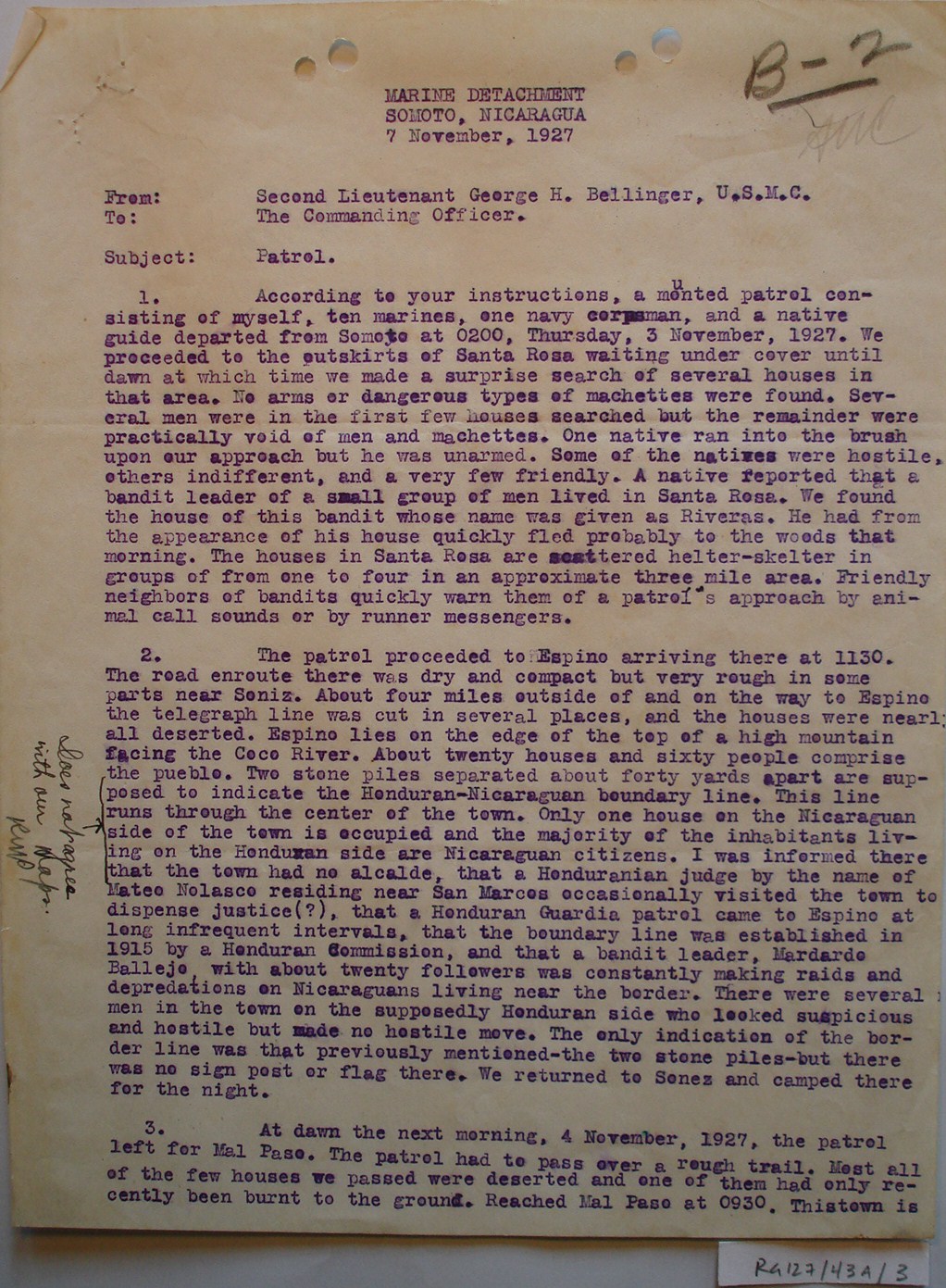
 1. According to
your instructions, a mounted patrol
consisting of myself, ten marines, one
navy corpsman, and a native guide
departed from SOMOTO at 0200, Thursday,
3 November 1927. We proceeded to the
outskirts of SANTA ROSA waiting under
cover until dawn at which time we made a
surprise search of several houses in
that area. No arms or dangerous types of
machettes were found. Several men were
in the first few houses searched but the
remainder were practically void of men
and machettes. One native ran into the
brush upon our approach but he was
unarmed. Some of the natives were
hostile, others indifferent, and a very
few friendly. A native reported that a
bandit leader of a small group of men
lived in SANTA ROSA. We found the house
of this bandit whose name was given as
Riveras. He had from the appearance of
his house quickly fled probably to the
woods that morning. The houses in SANTA
ROSA are scattered helter-skelter in
groups of from one to four in an
approximate three miles area. Friendly
neighbors of bandits quickly warn them of
a patrol's approach by animals calls or
by runner messengers.
1. According to
your instructions, a mounted patrol
consisting of myself, ten marines, one
navy corpsman, and a native guide
departed from SOMOTO at 0200, Thursday,
3 November 1927. We proceeded to the
outskirts of SANTA ROSA waiting under
cover until dawn at which time we made a
surprise search of several houses in
that area. No arms or dangerous types of
machettes were found. Several men were
in the first few houses searched but the
remainder were practically void of men
and machettes. One native ran into the
brush upon our approach but he was
unarmed. Some of the natives were
hostile, others indifferent, and a very
few friendly. A native reported that a
bandit leader of a small group of men
lived in SANTA ROSA. We found the house
of this bandit whose name was given as
Riveras. He had from the appearance of
his house quickly fled probably to the
woods that morning. The houses in SANTA
ROSA are scattered helter-skelter in
groups of from one to four in an
approximate three miles area. Friendly
neighbors of bandits quickly warn them of
a patrol's approach by animals calls or
by runner messengers.
2. The patrol proceeded to Espino arriving
there at 1130. The road enroute there
was dry and compact but very rough in
some parts near SONIZ. About four miles
outside of and on the way to ESPINO the
telegraph line was cut in several
places, and the houses were nearly all
deserted. ESPINO lies on the edge of the
top of a high mountain facing the Coco
River. About twenty houses and sixty
people comprise the pueblo. Two stone
piles separated about forth yards apart
are supposed to indicate the
HONDURAN-NICARAGUAN boundary lines. This
line runs through the center of the
town. Only one house on the Nicaraguan
side of the town is occupied and the
majority of the inhabitants living on
the Honduran side are Nicaraguan
citizens. I was informed there that the
town had no alcalde, that a Honduran
judge by the name of Mateo Nolasco
residing near San Marcos occasionally
visited the town to dispense justice
(?), that a Honduran Guardia Patrol
came to ESPINO at long infrequent
intervals, that the boundary line was
established in 1915 by a Honduran
Commission, and that a bandit leader,
Mardardo Ballejo [Medardo Vallejos] with about twenty followers was constantly
making raids and depredations on
Nicaraguans living near the border.
There were several men in the town and
supposedly Honduran side who looked
suspicious and hostile but made no
hostile move. The only indication of the
border line was that previously
mentioned - the two stone piles - but
there was no sign post or flag there. We
returned to SONAZ and camped there for
the night.
3. At dawn the next morning, 4 November
1927, the patrol left for MAL PASO. The
patrol had to pass over a rough trail.
Most all of the few houses we passed
were deserted and one of them had only
recently been burnt to the ground.
Reached MAL PASO at 0930. This town is
[p. 2]
 situated
on the side of a mountain half way up
and has about 18 houses in fairly close
proximity to each other. The place was
quiet and very few men were seen. The
people voiced anxiety and alarm about
the bandit Ballejo [Vallejos]. situated
on the side of a mountain half way up
and has about 18 houses in fairly close
proximity to each other. The place was
quiet and very few men were seen. The
people voiced anxiety and alarm about
the bandit Ballejo [Vallejos].
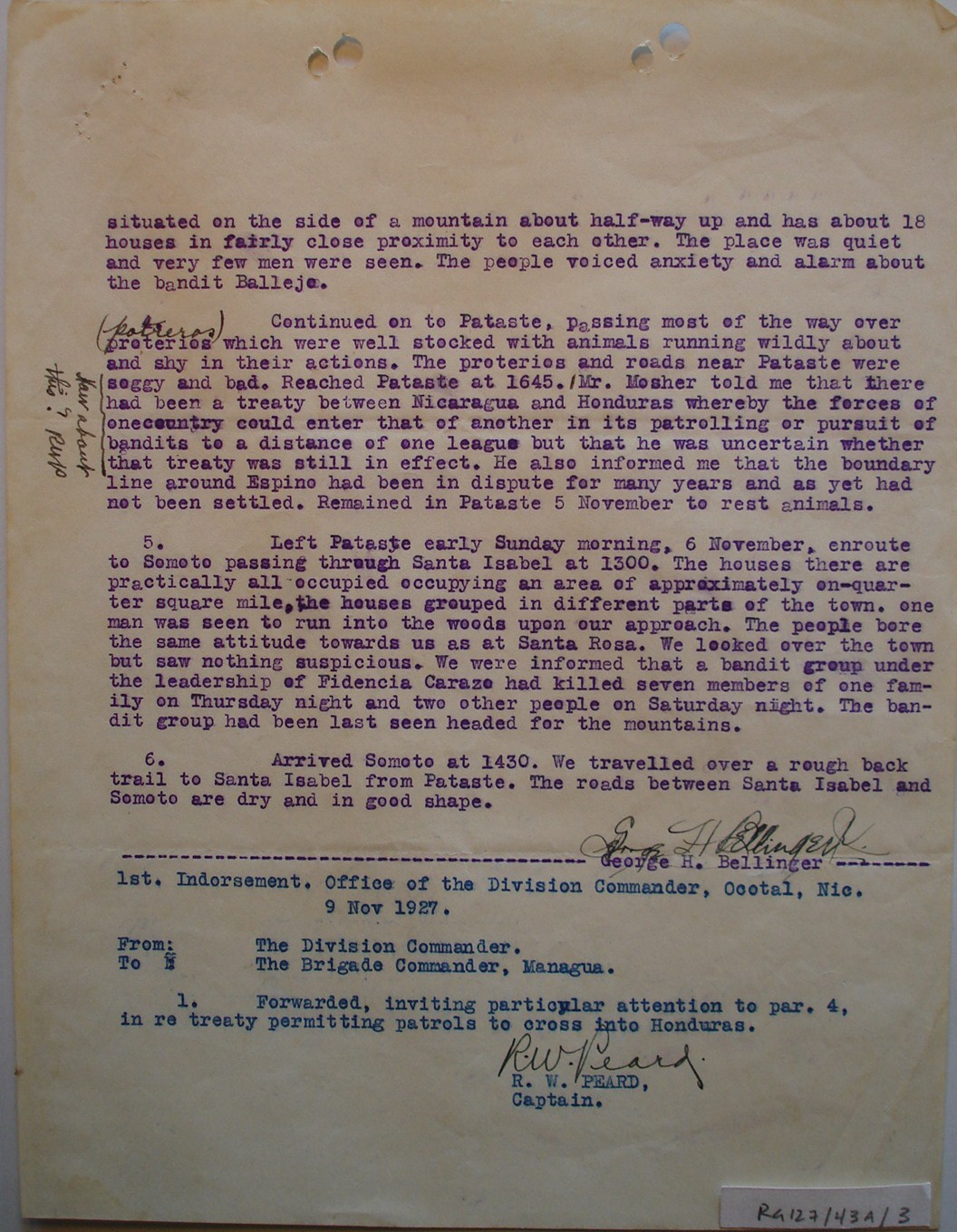
4. Continued on to Pataste passing most of
the way over potreros which were well
stocked with animals running wildly
about and shy in their actions. The
protrerios [marginal comment: "potreros"] and roads near PATASTE were
soggy and bad. Reached PATASTE at 1645.
Mr. Mosher told me that there had been a
treaty between Nicaragua and Honduras
whereby the forces of one country could
enter that of another in its patrolling
or pursuit of bandits to a distance of
one league but that he was uncertain
whether the treaty was still in effect.
[marginal comment: "How about
this? RWP"] He also informed me that the
boundary line around ESPINO had been in
dispute for many years and as yet had
not been settled. Remained in PATASTE 5
November to rest animals.
5. Left PATASTE early Sunday morning 6
November, enroute to SOMOTO passing
through SANTA ISABEL at 1300. The houses
there are practically all occupied
occupying an area of approximately
one-quarter square mile, the houses
grouped in different parts of the town.
One man seen to run into the woods upon
our approach. The people bore the same
attitude toward us at SANTA ROSA. We
looked over the town but saw nothing
suspicious. We were informed that a
bandit group under the leadership of
Fidencia Carazo [Fidencio Carazo] had
killed seven members of one family on
Thursday night and two other people on
Saturday night. The bandit group had
been last seen headed for the mountains.
6. Arrived SOMOTO at 1430. We traveled over a
rough back trail to SANTA ISABEL from
PATASTE. The roads between SANTA ISABEL
and SOMOTO are dry and in good shape.
/s/ GEORGE BELLINGER
- - - - - - - - - - - - - - - - - - - -
- - - - - - - -
1st indorsement OFFICE OF THE DIVISION
COMMANDER OCOTAL Nic.
9 Nov 1927
From: The Division
Commander
To: The
Brigade Commander Managua
1. Forwarded inviting particular attention to
paragraph 4, in re treaty permitting
patrols to cross into Honduras.
/s/ R. W. PEARD
NA127/43A/2
|