|
MARINE DETACHMENT, JICARO, NICARAGUA.
12 October 1927.
|
From: |
The Commanding Officer. |
|
To: |
The Commanding Officer 5th
Regt., Managua, Nicaragua. |
|
Subject: |
Engagement with the enemy at
SAPOTILLAL, Nueva Segovia
9 October, 1927 |
1. At about 11:30 a.m., Saturday 8 October, word
was brought here by plane that Lt.
Thomas and his observer had crashed into
the side of a hill near QUILALI and that
both were unhurt. A Ham map of Nicaragua
was also dropped to me showing the
location of the plane which indicated it
to be about 3 miles NW of QUILALI. At
that time there was a patrol of ten men
enroute from here to OCOTAL, with all
our good saddle animals. A mounted guard
immediately were asked to intercept
them. They returned to Jicaro at 3:30
p.m. with the animals in a worn out
condition due to their haste in
returning, so that they would have been
useless for a long patrol had I waited
for them.
2. Meanwhile realizing that haste was important
since the aviators were in grave
condition danger, I took 8 marines (all
the available men able to stand the
trip), 10 guardia nacional, and Dr. J.
B. O'Neill (since I believed it likely
that the aviators would need medical
treatment), borrowed four horses and one
mule, and with 3 days rations proceeded
at 12:45 p.m., by forced marching toward
QUILALI. At 7:00 p.m., reached a point 7
miles NW of QUILALI, having marched 18
miles, and halted for the night. The men
were at that time in an exhausted
condition, 6 of the marines and several
of the Guardia being weakened by a
recent attack of malaria. Had I had more
exact information as to the location of
the plane and the road to follow, I
would have rested a few hours and pushed
on that night. Before leaving JICARO I
had told the men that I expected to have
to fight to get to the plane, but I
expected to reach there before any great
number of the enemy could assemble.
3. At 6:45 a.m., Sunday, 9 October, proceeded
toward QUILALI and at 8:00 a.m., reached
a point 3 miles NW of QUILALI. Could
obtain no information of a plane from
inhabitants and therefore halted and
waited for the planes to arrive. When
planes arrived they indicated for me the
area where the wreck was located. It was
about 3 miles N of us in a direct line,
but in order to reach it we had to make
a long circuit marching back about 3 1/2
miles and then following a ridge of
difficult mountains. It took 3 1/4 hours
marching to reach the place and
meanwhile the planes had to leave us
because of shortage of gasoline.
4. The mountain on which the plane crashed is
called SAPOTILLAL. Before reaching it we
met a woman and a boy, both of whom
separately told us that the plane was
there but they knew nothing of the
aviators. Before starting up the hill I
halted the patrol and gave hill a close
scrutiny. No movement or anything
suspicious could be noted. The trail
wound around the side of the hill with
hill rising steeply to our left, and we
were about 100 yards up when the advance
guard was fired on from the trail ahead.
Halted, took the best cover available
and returned the fire. The hill was
occupied by about 200 bandits who seemed
to be well armed and had plenty of
ammunition. It was my intention to go
forward and take the hill, when we began
to receive heavy fire from a hill to our
right and rear, and distant about 100
yards. About 10 dynamite bombs were
thrown close to us at this time from
above. Amen above us were yelling to
those on the other hill to fire lower,
and on the other hill they were
directing them to drop dynamite bombs on
us. [ p. 2 ]
5. Considered that if we went forward we would be
completely cut off and that our
ammunition would soon run out. Directed
no automatic fire, to save ammunition.
Decided to turn back and fight our way
thru the smaller force. There were about
100 of them occupying the hill and the
road we had just come over, and we could
hear more coming in the distance,
yelling as they came. We attacked this
band and drove them over the hill. Rifle
and hand grenades were of great
assistance. We received heavy fire from
our rear during this attack, and
Sergeant Porfirio Melendez, GN, was shot
through the head and instantly killed. A
dynamite bomb exploded halfway between
PFC R. H. Welch and myself, who dropped
back of his own accord, waited for a
rush from our rear, and broke it up with
a hand grenade, probably killing three
or four. Pvt. McKenzie who was assigned
to guard the rear, dropped behind
farther than was necessary and killed
three with his Thompson gun. One of
these obviously was a leader. Cpl. Neel
accurately placed rifle grenades where
groups of enemy were ahead of us and
materially assisted in clearing the way.
I was leading with the hand grenades,
and since the brush along the road
seemed to be full of the enemy it was
necessary to throw them only a short
distance. At one time while trying to
pull a pin from a grenade Pvt Struck
shot and killed a bandit who was
sighting in on me about 10 yards
distant. In the hollow between the 2
hills Pvt Green killed 2 men hiding in a
banana grove and wounded a third, all of
whom had dynamite bombs in their hands.
The guardia behaved splendidly. One of
them continued to fire his rifle after
half of the barrel had been blown off.
The entire patrol were cool and
deliberate in their actions, advancing
under cover where possible and taking
careful aim before firing.
6. In that manner we got out from between the two
bands and they ceased firing. 1 horse
with rations, 1 loaded with blanket
rolls and a horse and mule with saddles
were killed. 1 horse remained. We took a
trail leading about north which would
run into a road for SAN ALBINO.
Proceeded about 200 yards and
encountered another band of about 75
marching toward us, who were evidently
reinforcements coming in. We were on a
slight rise and halted. They attacked
immediately. The trail was narrow and
the brush thick on either side, so that
it was not impossible to deploy, and Dr.
O'Neill, Pvt. Golak and myself received
and broke up the attack forcing them to
retreat to the next hill. The bandits to
our rear had reorganized and were
closing in. Believing that our only way
out lay ahead, decided to push forward.
Dr. O'Neill at his own request led this
attack. We were held up by a heavy
machine gun fire until a rifle grenade
killed the machine gunner. Pvt. F.
Gutierrez, GN, was shot thru the
forehead by machine gun. Pushed forward
about 200 yards. The enemy hid in the
brush as we advanced and fired from very
close range. Dr. O'Neill and Pvt. Welch
had taken a rifle and belt from a dead
Guardia and killed at least two during
this advance. Pvt. J. Benavides and L.
Bustos, GN, were killed, one shot thru
heart and the other thru the stomach.
7. Halted after advancing about 200 yards and
hearing additional reinforcements coming
for the band ahead of us, decided as a
last resort to take to the brush. Had
hesitated to do this because of the
thick brush, the danger of becoming
split up and lost, and our unfamiliarity
with the country. Our guides had left
during the fight and I had lost my
compass.
8. At 5:45 p.m., having fought 2 1/4 hrs we
turned left and went down a very steep
ravine. We apparently slipped out from
between the two forces without them
knowing it. Going down ravine, took 1
bandit prisoner, fully armed and
equipped. Were afraid to shoot him for
fear of giving away our position. He had
run into us accidentally. Followed this
ravine until we found a small stream and
followed stream until midnight. At 6:00
a.m., Oct 10, resumed travel until we
reached JICARO river about 8:00 a.m.,
and followed it upstream to JICARITO
where we took the main road to JICARO
and arrived there at 11:30 p.m. [ p. 3 ]
9. Estimate distance traveled by this route about
30 miles. The difficulties of travel
cannot be accurately described. At times
we had to leave the stream and cut our
way over steep hills thru heavy brush,
to get past a bad spot in the stream.
Were without food from 5:00 a.m., the
9th until planes dropped rations the
afternoon of the 10th. We arrived in
JICARO suffering from exposure and
complete exhaustion, bruised, cut up by
thorns and bitten by insects. Believed
that there was great danger that enemy,
traveling by road, would intercept and
cut us off.
10. A very conservative estimate of the total
number we engaged is 400 and it is
believed that it may have run over that
number. During both phases of
engagements we were under very heavy
fire and it is a miracle that we did not
suffer more casualties. That the
casualties were all Guardia cannot be
explained in any way, as they fought
side by side with the marines and were
equally exposed.
11. A fairly accurate count of the number of
enemy known to be killed or mortally
wounded, brings it to about 40, and this
does not include any estimate of the
casualties from these hand and rifle
grenades whose effect we could not see.
I believe that 55 or 60 would be no
exaggeration.
12. Every marine and every Guardia did more than
his share, and every one of them did
something exceptional.
13. Separate recommendations for awards for
bravery will be submitted later, and I
believe that this group of eight marines
and six surviving Guardia deserve the
reward of a decoration as much as anyone
every before deserved it.
C. J. O'SHEA
1st Lieut. USMC,
Commanding.
NA127/212
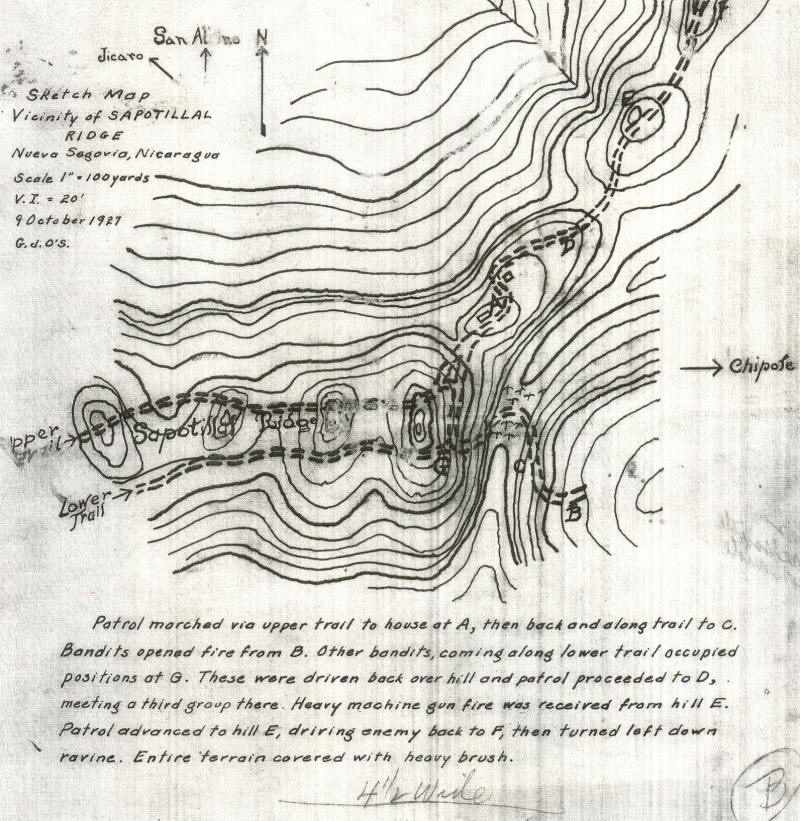
Sketch Map of Fight at
Sapotillal Ridge, 9 Oct 1927 (attached to the above
report)
Ancillary
Document:
Sandino's Account of the
Capture & Execution
of the Airmen at Zapotillal, 8 Oct. 1927
8 October 1927
The arms of the
revolution on this memorable date have covered
themselves with glory. The adventurous pirates once more
have bitten the dust in our aggressive mountains,
because our powerful con-cons and excellent marksmanship
of our excellent riflemen will let the civilized world
know the cause which is defended with sacred justice and
legitimate right, omnipotent God will fight our cause
and conduce us toward success. Once more the cowardly
punitives who in the air make motions of greatness
because they have the advantage that in the airplanes
they pilot they assassinate cravenly our peaceful
countrymen, have suffered a defeat today at 10 am after
trying to fight with a small guerrilla expedition around
the zone of Quilali under the command of the valiant
captain Abram Centeno. The two airplanes made evolutions
in the air after a strong bombardment with machine guns
and bombs and were of the apparatuses falling in our
power also one of the aviators and the mechanic who
threw bombs. Said aviators being captured there were
judged by a Council of War and shot summarily, applying
to them the same law that the adventurer Feland wanted
to apply to the patriot and legitimate Nicaraguan
General Augusto C. Sandino when he made him an outlaw in
his own country.
/s/ A. C. SANDINO
Source: NA127/43A/29, English
only, hitherto unpublished, a discarded
earlier draft of doc. 34, dated Oct. 10,
1927, in Robert Edgar Conrad, trans.,
Sandino, Testimony of a Nicaraguan Patriot
(Princeton,
1990), pp. 114-115. See
EDSN-Docs 27.10.08
Back to EDSN-Docs
|

.jpg) "On the morning of October
8, a two-plane patrol spotted a Sandinista pack
train and swooped down upon it with machine guns
blazing. The Sandinistas fired back
with rifles and hit one of the planes. The
wounded plane limped through the air for a few
minutes and then crash-landed on Zapotillo
ridge. The other plane flew low over the
wreckage and dropped a map to the downed
aviators, Second Lieutenant Earl A. Thomas and
Sergeant Frank E. Dowdell. . . . the hapless
aviators were overtaken and captured by a band
of guerrillas. That same day the two Marines
were tried before a Sandinista court-martial and
shot. The body of Lieutenant Thomas was hanged
from a tree and photographed. Then the
Sandinistas set up an ambush for the expected
rescue party." (Neill Macaulay, The
Sandino Affair, Duke U. Press, 1985, pp.
92-93; photograph of Lt. Thomas, US National
Archives)
"On the morning of October
8, a two-plane patrol spotted a Sandinista pack
train and swooped down upon it with machine guns
blazing. The Sandinistas fired back
with rifles and hit one of the planes. The
wounded plane limped through the air for a few
minutes and then crash-landed on Zapotillo
ridge. The other plane flew low over the
wreckage and dropped a map to the downed
aviators, Second Lieutenant Earl A. Thomas and
Sergeant Frank E. Dowdell. . . . the hapless
aviators were overtaken and captured by a band
of guerrillas. That same day the two Marines
were tried before a Sandinista court-martial and
shot. The body of Lieutenant Thomas was hanged
from a tree and photographed. Then the
Sandinistas set up an ambush for the expected
rescue party." (Neill Macaulay, The
Sandino Affair, Duke U. Press, 1985, pp.
92-93; photograph of Lt. Thomas, US National
Archives)