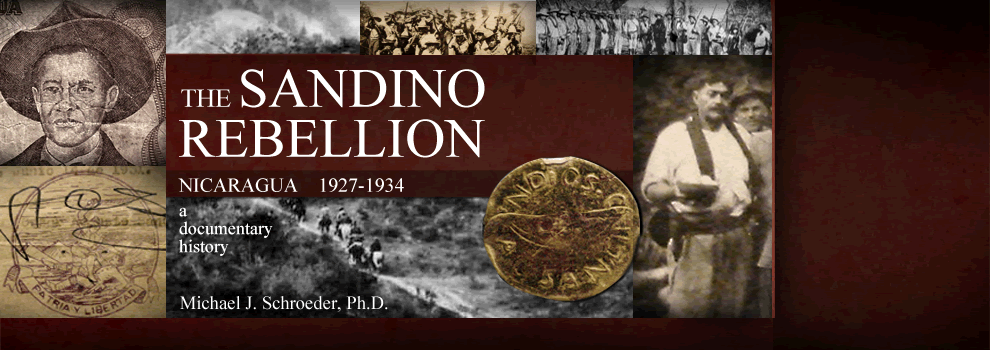

|
ADDED MARCH 2018: 103 NEVER BEFORE PUBLISHED PHOTOS FROM MARINE CORPS PRIVATE WILLIAM E. PLOCHARSKI, DEPLOYED IN LAS SEGOVIAS FIGHTING SANDINO'S "BANDITS" 1928-1929
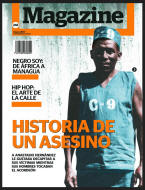
THIS WEBSITE'S RESEARCH SPOTLIGHTED IN A COVER STORY IN LA PRENSA MAGAZINE (MANAGUA) IN JAN. 2017. THANKS TO THE NICARAGUAN JOURNALIST AMALIA DEL CID FOR A TERRIFIC ARTICLE!
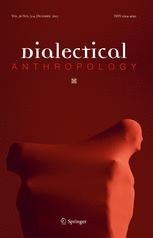
ARTICLE INTERWOVEN WITH THIS WEBSITE AWARDED THE 2013 DAVIS PRIZE BY THE MIDDLE ATLANTIC COUNCIL ON LATIN AMERICAN STUDIES (MACLAS) — "CULTURAL GEOGRAPHIES OF GRIEVANCE & WAR: NICARAGUA'S ATLANTIC COAST REGION IN THE FIRST SANDINISTA REVOLUTION, 1926-1934," DIALECTICAL ANTHROPOLOGY, DEC. 2012
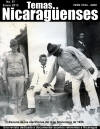
SEE ALSO MY RECENT PUBLICATIONS IN THE OPEN-ACCESS ONLINE ACADEMIC MAGAZINE, REVISTA DE TEMAS NICARAGÜENSES, 2012—2018, AT WWW.TEMASNICAS.NET
AS FEATURED ON NICARAGUAN TV, CDNN CHANNEL 23, FEB 21, 2012 & IZQUIERDA VISIÓN • A JOINT INTERVIEW WITH WALTER C. SANDINO BY NICARAGUAN FILMMAKER MARCIO VARGAS, NOW ON
ALSO ON YOUTUBE, INTERVIEW WITH LA REVISTA TIERRA NICA IN JINOTEGA, JULY 2014:
AND AS FEATURED ON CDNN CHANNEL 23 'DANILO LACAYO EN VIVO ' FRI 16 JULY 2010 (© DANILO LACAYO)
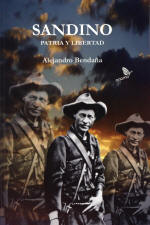
"Afortunadamente, existe ahora una fuente extraordinaria sobre Sandino y el EDSNN al alance del público. Se trata del extraordinario sitio web www.sandinorebellion.org pacientemente administrado y enriquecido regularmente por el historiador norteamericano Professor Michael J. Schroeder, con el apoyo de sus estudiantes de Lebanon Valley College. Continuamos encontrando nueva documentación sobre Sandino, el EDSNN y la lucha en las Segovias en diversos archivos norteamericanos con fotografías, documentos y periódicos de la época, pacientemente digitalizados por Schroeder y sus estudiantes, incluyendo la costa del Caribe y sobre la Guardia Nacional." - Alejandro Bendaña, Sandino: Patria y Libertad (Managua: anamá Ediciones, 2016).
"Los centroamericanos y en particular los nicaragüenses tenemos que agradecer y aprovechar la existencia de este portal Sandino Rebellion que contiene numerosos documentos y fotografías que ilustran sobre la intervención y ocupación militar norteamericana en Nicaragua y la heroica resistencia de Augusto C. Sandino. Este importante y destacado esfuerzo del historiador Michael Schroeder y de quienes han colaborado con él, nos permite asomarnos, desde nuestros lugares, a documentación que de otra forma, solamente sería accesible a unos pocos."
- Dora María Téllez, former Sandinista commander &
public servant, founding member of the Sandinista Renovation
Movement (MRS), and now historian and Nicaraguan
representative of Enlace Académico, at "Amor, Paz y Justicia, sea para todos nuestros Hermanos y Hermanas que visitan este Web Site. Y de manera muy especial en nombre de toda nuestra familia, sea también este deseo para nuestro querido Hermano el Profesor Michael Schroeder, por haber dedicado una parte importante de su vida a la recopilación de información sobre la Vida y Obra del General Augusto C. Sandino y de sus compañeros de lucha, pues reconocemos la dedicación y el esfuerzo en su trabajo, logrando avanzar en beneficio de los nicaragüenses y de la humanidad. No creo que exista en la Web un historiador capaz de haber recopilado tanta información sobre estos acontecimientos historicos. Siempre más allá . . . " - Walter C. Sandino, grandson of Augusto C. Sandino, Executive President of the Fundación Augusto Nicolás Calderón Sandino (FANCS), and author of El libro de Sandino: El Bandolerismo de Sandino en Nicaragua (Managua: INPASA, 2009).
Visit the FANCS website at "A stunning enterprise — a virtual Sandino online encyclopedia and data base — and an obligatory starting point for anyone researching twentieth century Nicaraguan history." - Barry Carr, Senior Fellow, Institute of Latin American Studies, La Trobe University "Discovering your site was like finding a buried treasure ..." read more from William Alvarez, US Marine Corps, of Atlanta GA "A Nicaraguan artist friend just forwarded me your website. I've read enough to know that it is like finding gold on the moon! ..." read more from Linda John of San Francisco CA SEEKING VOLUNTEER TRANSLATORS & TRANSCRIBERS Richard Siu in Florida. Linda Pudder in Rivas, Nic. Brandon Ray in Illinois. Lorena Torres in Mexico City. Four volunteers who've contributed mightily to this website, because they saw & see its historical value, and because they are generous human beings. Might you volunteer to work on this project? Right now thousands of documents on this topic cry out to be transcribed. Thousands more desperately seek translatation into Spanish. Maybe you could work on one of them! If your work ends up on this website, you'll be thanked and your work acknowledged. All the work can be done electronically. Meantime, copious thanks to Richard Siu, Linda Pudder, Brandon Ray, and Lorena Torres! SE BUSCA TRANSCRIPTORES Y TRADUCTORES VOLUNTARIOS Richard Siu en Florida. Linda Pudder en Rivas, Nic. Brandon Ray en Illinois. Lorena Torres en la Ciudad de México. Cuatro voluntarios que han contribuido poderosamente a este sitio web, porque vieron y ven su valor histórico, y porque son seres humanos generosos. ¿Podría usted ofrecer su mano de obra para este proyecto? Ahorita hay miles de documentos que están pidiendo a gritos ser transcritos. Miles más buscan desesperadamente ser traducidos al español. Quizás usted podría trabajar en uno de ellos! Si los resultados de su trabajo aparecen acá en este Website, se le agradece por nombre y su trabajo será reconocido. Todo el trabajo se puede realizar por vía electrónica. Mientras, muchas gracias a Richard Siu, Linda Pudder, Brandon Ray, y Lorena Torres! GRANTS RECIPIENT AT LEBANON VALLEY COLLEGE FROM spring 2009 to the present, this website project has been awarded more than $16,500 from Lebanon Valley College's Pleet Initiative for Student-Faculty Research; the Arnold Grants in Experiential Education; and the Dick Joyce Endowment of the Dept. of History, Politics & Global Studies, in memory of beloved LVC History Professor Dick Joyce (d. 2005). Many thanks to David & Lynn Pleet of Lebanon PA; to Ed & Jeanne Arnold of Lebanon PA; and to Lloyd R. Helt, Jr. & Ruth Gray (Lloyd Helt was Dick Joyce's student back in the 1970s and loved his classes on European history!) — thanks to all for their generous support, and to the many LVC students who've devoted their time, labor, and creativity to this project.
In grateful appreciation to Sra. Lorena Torres for her expert & generous volunteer work transcribing and translating documents for this website project, we heartily recommend her transcription business, T-Vox México, at
ECO-TOURISM IN NICARAGUA A great way to see Nicaragua's countryside and support local businesses is the award-winning Finca Esperanza Verde in the verdant mountains of San Ramón near Matagalpa. To quote from FEV's promotional materials, "Come relax at our organic coffee farm complete with 5 hiking trails, gorgeous views, a butterfly garden, yoga pavilion, hammock hut and waterfall swimming hole ... All of Finca Esperanza Verde's ecotourism income stays in the community supporting local jobs and businesses." FEV is a project of Sister Communities of San Ramón, Nicaragua. Visit the Finca Esperanza Verde website here |





Introduction to the Site
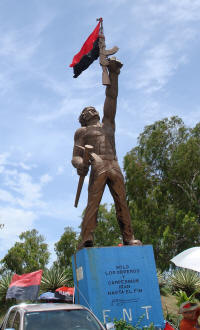 This
Website is envisioned as a comprehensive,
interpretive, open-access digital archive on the
nationalist rebellion against US military intervention in Nicaragua led
by Augusto C. Sandino in the 1920s and '30s. Rigorous accuracy,
judicious interpretation, and the democratization of knowledge rank
among its most important guiding principles. (Right: Statue in
Managua commemorating the 1979 Triumph of the Sandinista Revolution,
July 19, 2009; photo by the author.)
This
Website is envisioned as a comprehensive,
interpretive, open-access digital archive on the
nationalist rebellion against US military intervention in Nicaragua led
by Augusto C. Sandino in the 1920s and '30s. Rigorous accuracy,
judicious interpretation, and the democratization of knowledge rank
among its most important guiding principles. (Right: Statue in
Managua commemorating the 1979 Triumph of the Sandinista Revolution,
July 19, 2009; photo by the author.)
Right now this Website houses and integrates more than 4,855 archival documents on the rebellion, comprising around 12,000 pages of hard-copy text & images, with a good portion of the text transcribed and fully searchable (see UPDATE BOX, below). It also lists & identifies the archival locations of another 5,000 or so documents, together comprising over 15,000 pages of text. Eventually (by the year 2025, I hope) this website will house and integrate over 30,000 documents — and thousands more pages of published texts — materials collected over two decades in archives & libraries in the United States and Nicaragua. All but a handful are public domain, though I do suggest some SIMPLE PROTOCOLS for using & citing this material.
This tsunami of evidence on this oft-mentioned but little understood guerrilla war and nationalist campesino rebellion offers an unprecedented look at events "on the ground" in a major episode of foreign invasion & occupation during the golden age of US imperialism in the circum-Caribbean (c. 1898-1934). The portrait of Sandino's revolt that emerges from this documentary deluge is vastly more nuanced and complex than any scholar or poet has yet conveyed.
.jpg) Yet
however nuanced this portrait, however intricate and
messy and confusing, it is also true that most everything you read about
in these pages was rooted in a
simple reality: the executive branch of the US federal government,
as part of a larger imperial project, invaded & occupied this small Central American country, and a small group of
Nicaraguans, led by a charismatic patriot, resisted that invasion &
occupation by force of arms.
(Left: 1984 Bulgarian
postage stamp commemorating the 50th anniversary of Sandino's death)
Yet
however nuanced this portrait, however intricate and
messy and confusing, it is also true that most everything you read about
in these pages was rooted in a
simple reality: the executive branch of the US federal government,
as part of a larger imperial project, invaded & occupied this small Central American country, and a small group of
Nicaraguans, led by a charismatic patriot, resisted that invasion &
occupation by force of arms.
(Left: 1984 Bulgarian
postage stamp commemorating the 50th anniversary of Sandino's death)
The Website's Focus. As a social & cultural historian, I am mainly interested in the Sandino revolt as a social and cultural process, as a local response to foreign invasion and occupation. The documents presented here reflect this focus. They were selected because they speak, in some fashion, to the agency of Nicaraguans and Segovianos in shaping their own history.
By Way of Background & Context. The US Marines first intervened militarily in Nicaragua in the civil war of 1912, and were stationed in the country more or less continuously for the next 20 years. Nicaragua effectively became a U.S. protectorate, surrendering much of its sovereignty to the United States, as was true of much of the circum-Caribbean during this period. READ MORE
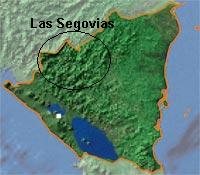 Las
Segovias.
In
the late 1920s this rugged region bordering Honduras was home to about 120,000
people spread over some 6,000 square miles of mountains, valleys,
forests, and jungles, in several dozen towns and hundreds of villages,
hamlets, and homesteads. Even before the Marines arrived,
extreme inequality, oppression, exploitation, poverty, and violence dominated the
social landscape. After May 1927 Segovianos flocked to Sandino's banner. The Marine invasion
intensified; the US-created National Guard grew in power; and by 1932
the Sandinista rebels, based in Las Segovias and organized into a
government of their own, threatened to topple the national government.
READ
MORE
Las
Segovias.
In
the late 1920s this rugged region bordering Honduras was home to about 120,000
people spread over some 6,000 square miles of mountains, valleys,
forests, and jungles, in several dozen towns and hundreds of villages,
hamlets, and homesteads. Even before the Marines arrived,
extreme inequality, oppression, exploitation, poverty, and violence dominated the
social landscape. After May 1927 Segovianos flocked to Sandino's banner. The Marine invasion
intensified; the US-created National Guard grew in power; and by 1932
the Sandinista rebels, based in Las Segovias and organized into a
government of their own, threatened to topple the national government.
READ
MORE
The Imperial Spotlight. Before mid-1927 there is very little documentation on Las Segovias, a frontier region bordering Honduras mostly ignored by the national state. Then in June 1927 came the Marine invasion & occupation, and our documentary base explodes. For 5½ years the US imperial spotlight — expressed in a dazzling variety & quantity of texts — illluminated the hidden corners & crevices of a culture & society & history hitherto almost totally obscured. The interpretive challenge for scholars is to read these texts against the grain, in the words of Ranajit Guha in his classic The Prose of Counter-Insurgency (1988) — and with a fertile & reasoned historical imagination. Alongside this explosion of imperial texts was the proliferation of texts & artifacts created by the Sandinista rebels that the Marines & Guardia were trying to eradicate. In January 1933 the spotlight vanished, and a month later Sandino's armed rebellion basically ended in a provisional peace treaty with the newly elected Sacasa government. The Marines went home, carting hundreds of boxes of records with them. What the US imperial gaze spotlighted for those 6 or so years constitutes the bulk of what I wish to share here — alongside a wide variety of sources from Honduras, Mexico, Great Britain, Germany & beyond. Smaller in scale but often punchier in impact are the textual fragments & social memories produced in Las Segovias that survived the brutal repression that followed Sandino's assassination in 1934.
 Animating
Questions. Lots
of questions inspire & animate this website.
Mainly I'm interested in what the US invasion &
occupation, the formation of the Guardia Nacional, and
Sandino's revolutionary movement meant for ordinary
Segovianos — campesinos, Indians, tenants &
sharecroppers, smallholders & squatters, miners &
migrant workers, seasonal & day laborers (who together comprised some
85-90% of the region's population), as well as townsfolk, artisans & smugglers, peddlers &
traders, boat-drivers & mule-drivers, ranchers &
coffee growers, merchants & professionals, politicians &
military leaders — individuals, families & communities
caught up in a whirlwind of foreign invasion and
insurgency as complex and multifaceted as any in
history. I also want to know what these events meant in the broader sweep of
history — in Nicaragua, Central America, the Western
Hemisphere, and the Atlantic World — and how they intersected
with broader changes within these overlapping spheres.
What manner of revolutionary movement was this?
What were its origins, characteristics, and legacies? All
the documents here speak in some fashion to these
broader questions & themes.
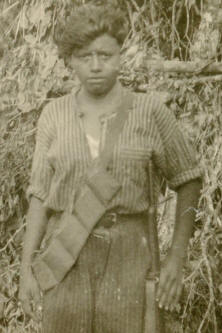
(Right: young
woman soldier with Conservative forces in 1926-27 Civil
War; detail of one of a series of 30 photos taken by US
Military Attaché Major A. W. Blooor in March 1927,
published here for the first time, from US National
Archives II, College Park MD, in the Photo-Doc pages,
here)
Animating
Questions. Lots
of questions inspire & animate this website.
Mainly I'm interested in what the US invasion &
occupation, the formation of the Guardia Nacional, and
Sandino's revolutionary movement meant for ordinary
Segovianos — campesinos, Indians, tenants &
sharecroppers, smallholders & squatters, miners &
migrant workers, seasonal & day laborers (who together comprised some
85-90% of the region's population), as well as townsfolk, artisans & smugglers, peddlers &
traders, boat-drivers & mule-drivers, ranchers &
coffee growers, merchants & professionals, politicians &
military leaders — individuals, families & communities
caught up in a whirlwind of foreign invasion and
insurgency as complex and multifaceted as any in
history. I also want to know what these events meant in the broader sweep of
history — in Nicaragua, Central America, the Western
Hemisphere, and the Atlantic World — and how they intersected
with broader changes within these overlapping spheres.
What manner of revolutionary movement was this?
What were its origins, characteristics, and legacies? All
the documents here speak in some fashion to these
broader questions & themes.
(Right: young
woman soldier with Conservative forces in 1926-27 Civil
War; detail of one of a series of 30 photos taken by US
Military Attaché Major A. W. Blooor in March 1927,
published here for the first time, from US National
Archives II, College Park MD, in the Photo-Doc pages,
here)
 Why a Documentary History?
Historians
come and historians go, but the documents endure. These documents,
if read with enough care and attention and alongside extant
published literature, will bring us as close as we can get to
understanding what this tumultuous period meant for ordinary Segovianos, and to its
complexities as a social process locally, nationally, and transnationally.
Documents, of course, do not speak for themselves. They must be
analyzed and
interpreted,
which is the job of historians and of rational human beings generally.
Publishing these documents online creates not only a valuable tool for
students and researchers. It also means that others might
interpret these documents differently than I do. That is as it
should be. I introduce or conclude many documents with some interpretive
comments. Others might disagree with my interpretations or
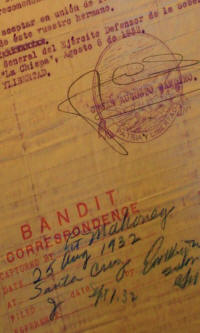
emphases. If you do, let me know! Let a thousand interpretations bloom! (Left: detail
of letter from Sandino to Faustino González, 2 April 1931, one of around
1,000 Sandinista documents to be published here for the first time)
Why a Documentary History?
Historians
come and historians go, but the documents endure. These documents,
if read with enough care and attention and alongside extant
published literature, will bring us as close as we can get to
understanding what this tumultuous period meant for ordinary Segovianos, and to its
complexities as a social process locally, nationally, and transnationally.
Documents, of course, do not speak for themselves. They must be
analyzed and
interpreted,
which is the job of historians and of rational human beings generally.
Publishing these documents online creates not only a valuable tool for
students and researchers. It also means that others might
interpret these documents differently than I do. That is as it
should be. I introduce or conclude many documents with some interpretive
comments. Others might disagree with my interpretations or
emphases. If you do, let me know! Let a thousand interpretations bloom! (Left: detail
of letter from Sandino to Faustino González, 2 April 1931, one of around
1,000 Sandinista documents to be published here for the first time)
 This way anybody —
you, for example — can tap into this densely
integrated web of information and ask just about any
kind of historical question you want to ask. You can ask about war-making or coffee
making. Vocabularies of political violence or
social geographies of production and trade.
Gender, class & race relations. Popular
nationalism. Poverty, malnutrition & disease. Military tactics & strategy.
Insurgency & counterinsurgency. Borderlands &
identities. Local political economies.
Historical geography. State formation & guerrilla
war. Leadership, weapons & tactics.
Production & settlement patterns. Social memory &
identity formation. Just
about anything. There is a whole universe in this
little grain of sand.
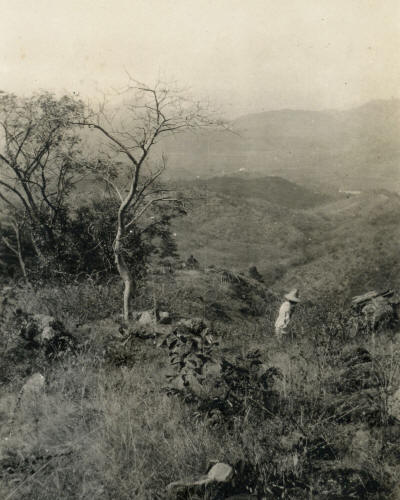
(Right: campesino in field, Western Segovias,
1928, George F. Stockes Collection, MCRC, one of 71 photos from the Stockes Collection
published here)
This way anybody —
you, for example — can tap into this densely
integrated web of information and ask just about any
kind of historical question you want to ask. You can ask about war-making or coffee
making. Vocabularies of political violence or
social geographies of production and trade.
Gender, class & race relations. Popular
nationalism. Poverty, malnutrition & disease. Military tactics & strategy.
Insurgency & counterinsurgency. Borderlands &
identities. Local political economies.
Historical geography. State formation & guerrilla
war. Leadership, weapons & tactics.
Production & settlement patterns. Social memory &
identity formation. Just
about anything. There is a whole universe in this
little grain of sand.
(Right: campesino in field, Western Segovias,
1928, George F. Stockes Collection, MCRC, one of 71 photos from the Stockes Collection
published here)
I create this site in the classic tradition of scholarship: as an original contribution to existing knowledge on a specific set of questions about the world. In part it is envisioned as a documentary annex to my book in progress. In part it is meant to give back to the Nicaraguan people a part of their own history. In whole it is rooted in the hope that we — humanity, and especially US citizens and policymakers — might learn from our mistakes. The story told by these documents is not only edifying & important but endlessly interesting and should become part of humanity's common stock of knowledge.
What's Here? Right now only a fraction of the collection is published here, perhaps 10 percent. The other 90 percent awaits publication of my book-in-progress, The Sandino Rebellion. The goal is to make the end product — the printed book & this website — a genuinely hybrid print-web text. Meantime all documents currently available can be found via this Document Update Box:
The bulk of these primary documents were culled from the Records of the United States Marine Corps & Nicaraguan National Guard, housed mainly in the US National Archives (Record Group 127, or RG127), comprising about 150 linear feet of files. Other major repositories housing materials that are housed here include the Marine Corps Research Center; the Library of Congress; the US State Department; la Hemeroteca Nacional Manolo Cuadra (Managua); el Instituto de Historia de Nicaragua y Centroamerica (IHNCA-UCA, also in Managua); and others. Most everything filtered out of these collections and presented here speaks in some way to how Central Americans, Nicaraguans, and Segovianos acted to shape their own history.
How is the Website Organized? Densely. And so it's easy to use. For a full explanation, see the user's guide. Briefly: At the top of every page are links to ten document collections, ten thematic collections, eight other links, and a Google search engine. At the heart of the site are 20 homepages serving as portals into 20 collections of documents, sorted by type & theme. With so many documents & branches & sub-branches, the site is designed to be simple & easy to navigate, find & cross-reference information, and find your way back to where you started from & ended up. Again, please see the USER'S GUIDE.
Suggestions, corrections & comments invited. This website launched March 2007 & revamped in March 2010.
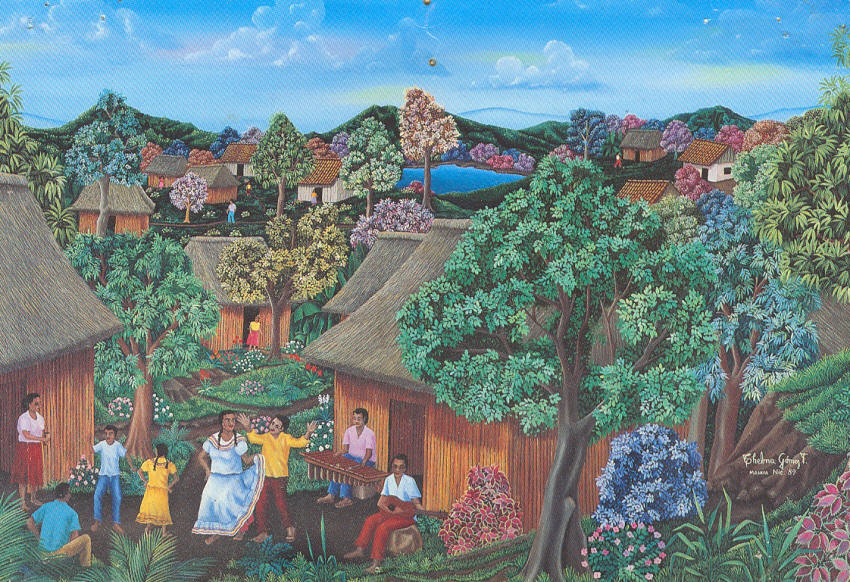
Painting by Thelma Gómez F., Masaya, Nicaragua, 1989
|
SUGGESTED PROTOCOLS FOR USING & CITING THIS WEBSITE Except where indicated, all the documents and images populating this website are in the public domain and anyone is free to use them for any reason. This happy circumstance coincides with the philosophy undergirding this project that insists on the democratization of information and knowledge on issues and topics of public concern and public interest. That said, I ask that people who use materials found in these pages cite this website as the source and drop me a courtesy note to let me know about it. Such information will help me to build on the strengths of this project and secure additional funding to keep moving it forward. Thank you. |
|
Acknowledgements & Copyright Copious thanks are extended to Lebanon Valley College and the Pleet Initiative for Student-Faculty Collaboration, the Arnold Grant for Experiential Education, and the Dick Joyce Endowment for their generous funding of this website; to my teachers & mentors in Minnesota & Michigan & beyond whose sage voices from long ago I often still hear; and to everyone who's ever helped with this project over the past 28 years. It is a very long list. * Agradezco a Arturo Castro-Frenzel, José Mejía Lacayo, y Walter Castillo Sandino por ayudar en corregir mis traducciones, por su amistad, y por ser mis maestros sobre las cosas nicaragüenses. * Tim Haak and Mile6.com LLC of Elizabethtown PA built the dynamic web templates and continue to offer expert help at the drop of a hat. * All original material © Michael J. Schroeder, 2007-2018. All rights reserved. |
Visitors since March 2010: